

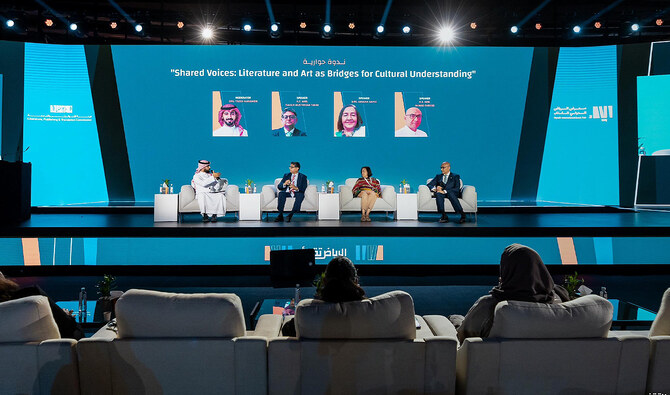


ISLAMABAD: Pakistani panelists at Saudi Arabia’s largest annual book fair said this week “cultural diplomacy” could open new arenas of cooperation between the two nations as they called for more quality translations of literature in the Arabic and Urdu languages and the exchange of writers and artists.
The Riyadh International Book Fair, themed “Riyadh Reads” and spread over 800 pavilions, is organized yearly by the Literature, Publishing, and Translation Commission and will run from Sept. 26 to Oct. 5, with over 2,000 publishing houses from 30 countries participating, according to state SPA news agency. The fair schedule includes seminars, panel discussions, poetry recitals, stage performances and workshops.
On Tuesday, the fair hosted a panel titled “Shared Voices: Literature and Art as Bridges of Culture and Understanding,” featuring Ahmad Farooq, ambassador of Pakistan to Saudi Arabia, Suljuk Mustansar Tarar, ambassador of Pakistan to the Netherlands, and Ameena Saiyid, a well-known Pakistani publisher and the founder of the famed Karachi Literary Festival.
The panel was moderated by Yazed Almulhem, a strategic planning consultant with the Saudi Tourism Investment Company.
“Saudi Arabia and Pakista historically shared close ties, but cultural diplomacy offered a new vista of deepening the relationship even further, as cultural affinities brought people together,” the Pakistani embassy said in a statement shared with media on Wednesday.

Ahmad Farooq (left), Pakistan envoy to Saudi Arabia, Suljuk Mustansar Tarar (2L), Pakistan envoy to the Netherlands and the son of renowned writer Mustansar Hussain Tarar and Ameena Saiyid (2R), a Pakistani publisher and the founder of Karachi Literary Festival, pose for a picture at the Riyadh International Book Fair in Riyadh, Saudi Arabia, on October 1, 2024. (Pakistan Embassy Saudi Arabia)
In pursuance of these efforts, the embassy said it was “meaningfully engaged” with the Saudi Ministry of Culture through 11 cultural commissions and several projects were in the pipeline.
Speaking to Arab News, Ambassador Tarar, an author and the son of renowned writer Mustansar Hussain Tarar, said books “unified nations” and thus better translations were necessary for cross-acculturation.
“Having quality translations of good fiction and literature in Arabic and Urdu is very important to develop a stronger understanding of each other,” he said.
The author said the book fair was a “great opportunity” to be part of an engaging conversation on culture’s role as a “bridge-builder” and its impact on fostering understanding across different societies and cultures.
“The messaging was very useful that indeed arts and literature can provide a great opportunity to connect different countries, especially countries from the wider Islamic world or global south,” Tarar added. “It is a very important tool for countries like us, such as Pakistan or even Saudi Arabia, to proactively pursue public diplomacy or cultural diplomacy in bringing forth the overall context of our society.”
Another panelist, Saiyid, a publisher and former managing director of the Oxford University Press, said literature festivals were essential as a “platform for cross-cultural dialogue.”
“They encourage us to engage with unfamiliar perspectives by listening to diverse voices, and through that, we actually break down stereotypes, and we foster greater understanding across borders,” she told Arab News over the phone from Riyadh.
“In our discussion, I actually emphasized the importance of exchange programs that bring artists and writers from Pakistan to Saudi Arabia and vice versa, as this fosters understanding, helps us appreciate different viewpoints, and breaks down existing stereotypes.”
Saiyid, who in 2005 became the first Pakistani woman to be awarded the Order of the British Empire for her services to women’s rights, education, and intellectual property rights, said she hoped more Arab writers and artists would visit Pakistan “and become a part of our festivals, which will help to promote understanding of cross-cultural literature and art.”


