WHO says trachoma blinding disease no longer ‘public health problem’ in Pakistan

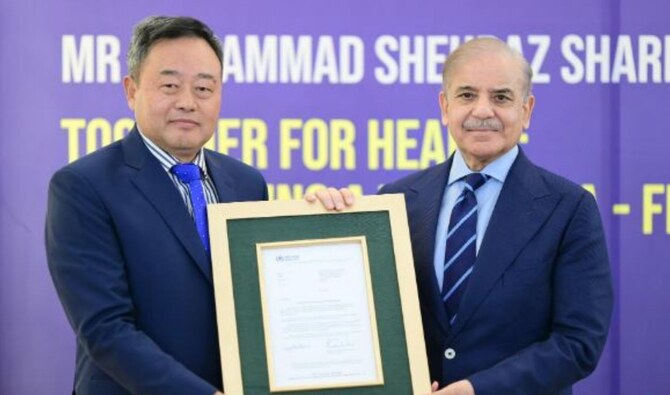
The Head of Mission of the World Health Organization (WHO) in Pakistan, Dr. Lou Dapeng, presents a certificate of the elimination of TRACHOMA as a public health problem in Pakistan to Prime Minister Muhammad Shehbaz Sharif on October 1, 2024 in Islamabad, Pakistan. (Photo courtesy: WHO Pakistan)
Short Url
Updated 01 October 2024
Follow

WHO says trachoma blinding disease no longer ‘public health problem’ in Pakistan

  • Trachoma is an eye disease caused by infection with Chlamydia trachomatis bacterium
  • The infection can result in irreversible blindness if it is left untreated, the WHO says

ISLAMABAD: Prime Minister Shehbaz Sharif on Tuesday stressed the need for effective supervision to prevent the return of trachoma to Pakistan after the World Health Organization (WHO) declared that the disease was no longer a public health problem in the South Asian country.
Trachoma is a disease of the eye caused by infection with the Chlamydia trachomatis bacterium and can result in irreversible blindness if left untreated. Pakistan is the 19th country globally to reach this historic milestone, according to the WHO.
Speaking at a ceremony held with regard to trachoma’s elimination, PM Sharif said it was a “very fortunate day” in the history of Pakistan.
“It is hoped that this disease will never return to Pakistan,” he said in televised comments. “For this, we will always have to keep in place whatever preventive measures are there, and keep a very effective supervision and check and balance.”
The WHO earlier said Pakistan’s success in eliminating trachoma underscored the government’s political commitment to public health, the value of WHO technical support and the incredible contributions of health professionals, endemic communities, civil society and partners.
“The achievement is a significant marker in the global fight against preventable diseases and their elimination,” it said.
In 1997, Pakistan became the first country to be certified free of dracunculiasis (Guinea-worm disease) transmission, according to the WHO. Elimination of trachoma as a public health problem adds to this legacy.
The world health body said Pakistan’s successful elimination of trachoma as a public health problem served as a powerful reminder that the control, elimination and eradication of many neglected tropical diseases was an attainable goal.
In a statement, WHO Director-General Dr. Tedros Adhanom Ghebreyesus described the elimination of the disease as a “monumental achievement” for Pakistan.
“This milestone is a testament to the unwavering dedication of Pakistan’s health workers, including many working at community level,” Ghebreyesus said.
“It underscores the power of collective action, innovative thinking and a shared commitment to a healthier future for all. I commend Pakistan for its dedication and success in safeguarding the vision of millions.”


Pakistan to play India in T20 World Cup, government says

Updated 09 February 2026
Follow

Pakistan to play India in T20 World Cup, government says

  • Islamabad announced boycotting the Feb. 15 match in Colombo to protest the ICC’s exclusion of Bangladesh from the T20 World Cup
  • Pakistan’s government says the decision to play India is taken to protect ‘spirit of cricket and to support the continuity of global sport’

ISLAMABAD: Pakistan Prime Minister Shehbaz Sharif has cleared the country’s cricket team to play India in the T20 World Cup on Feb. 15, the Pakistani government announced late Monday, ending a week-long standoff.

Islamabad announced boycotting the Feb. 15 match in Colombo to protest the International Cricket Council’s (ICC) exclusion of Bangladesh from the T20 World Cup, following Dhaka’s decision to not play matches in India owing to security fears.

On Sunday, ICC Deputy Chairman Imran Khwaja arrived in Lahore for talks with Pakistan Cricket Board (PCB) officials and Bangladesh Cricket Board (BCB) President Aminul Islam as the sport’s governing body strived to save the high-stakes T20 World Cup encounter.

PCB Chairman Mohsin Naqvi met PM Sharif late Monday and briefed him regarding the outcomes of high-level deliberations held between the PCB, Bangladesh board and ICC representatives, the Pakistani government said on X.

“The Government of Pakistan has reviewed the formal requests extended to the PCB by the Bangladesh Cricket Board, as well as the supporting communications from Sri Lanka, the United Arab Emirates, and other member nations. These correspondences sought Pakistan’s leadership in securing a viable solution to recent challenges,” the Pakistani government said.

“In view of the outcomes achieved in multilateral discussions, as well as the request of friendly countries, the Government of Pakistan hereby directs the Pakistan National Cricket Team to take the field on February 15, 2026, for its scheduled fixture in the ICC Men’s T20 World Cup.”

The BCB earlier thanked the PCB, ICC and all others for their positive roles in trying to “overcome recent challenges,” particularly thanking PCB Chairman Naqvi and Pakistani cricket fans for demonstrating “exemplary sportsmanship and solidarity.”

“We are deeply moved by Pakistan’s efforts to go above and beyond in supporting Bangladesh during this period. Long may our brotherhood flourish,” BCB President Islam said in a statement.

“Following my short visit to Pakistan yesterday and given the forthcoming outcomes of our discussions, I request Pakistan to play the ICC T20 World Cup game on 15 February against India for the benefit of the entire cricket ecosystem.”

The dispute stemmed from the ICC’s decision to replace Bangladesh with Scotland last month after Bangladesh refused to play tournament matches in India. Dhaka’s decision followed the removal of Mustafizur Rahman from the Indian Premier League (IPL). He was bought for $1 million by the IPL’s Kolkata Knight Riders, but on Jan. 3 the Board of Control for Cricket in India (BCCI) ordered Kolkata to release Mustafizur without a public explanation but amid regional tensions.

Pakistani cricket authorities subsequently announced boycotting the match against India at R. Premadasa Stadium in Colombo on Feb. 15. An India-Pakistan fixture is the sport’s most lucrative asset, generating a massive share of global broadcasting and sponsorship revenue.

“This decision [to play India in T20 World Cup] has been taken with the aim of protecting the spirit of cricket, and to support the continuity of this global sport in all participating nations,” the Pakistani government said.

“We remain confident that our team will carry the spirit of sportsmanship and national pride onto the field as they compete for global glory.”