

‘I pleaded guilty to journalism,’ Wikileaks’ Assange

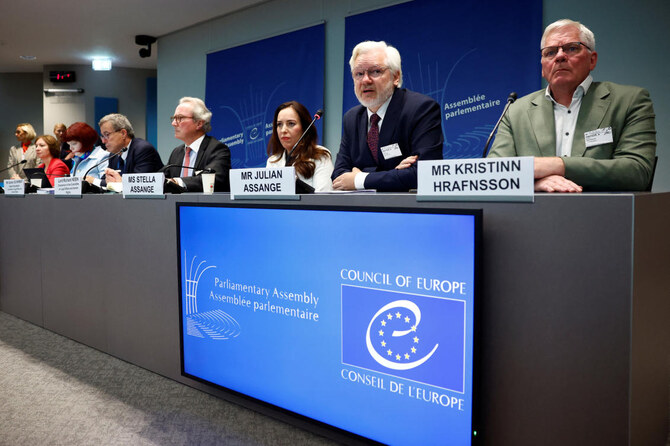
WikiLeaks' founder Julian Assange, his wife Stella Assange and Wikileaks Editor-in-Chief Kristinn Hrafnsson attend a hearing on Julian Assange's detention and conviction, in Strasbourg, France, October 1, 2024. (REUTERS)
Short Url
Updated 01 October 2024
Follow

‘I pleaded guilty to journalism,’ Wikileaks’ Assange

  • The Council of Europe brings together the 46 signatory states of the European Convention on Human Rights, with little say over Assange’s legal fate

STRASBOURG: Wikileaks founder Julian Assange on Tuesday said he was released after years of incarceration only because he had pleaded guilty to doing “journalism,” which he described as a pillar of a free society.
Assange spent most of the last 14 years either holed up in the Ecuadoran embassy in London to avoid arrest, or locked up at Belmarsh Prison in the British capital.
He was released from jail in June, after serving a sentence for publishing hundreds of thousands of confidential US government documents.
“I am not free today because the system worked. I am free today after years of incarceration because I pleaded guilty to journalism,” Assange told the Council of Europe rights body at its Strasbourg headquarters in his first public comments since his release.
“I eventually chose freedom over unrealisable justice... justice for me is now precluded,” Assange said, noting he had been facing a 175-year jail sentence.
Speaking calmly and flanked by his wife Stella who fought for his release, he added: “Journalism is not a crime, it is a pillar of a free and informed society.”
“The fundamental issue is simple. Journalists should not be prosecuted for doing their jobs,” said Assange.
The trove of confidential documents released by Wikileaks included searingly frank US State Department descriptions of foreign leaders, accounts of extrajudicial killings and intelligence gathering against allies.
Assange argued his case provided an insight into “how powerful intelligence organizations engage in transnational repression” against their foes, adding that this “cannot become the norm here.”

He said that during his incarceration “ground has been lost,” regretting that he now sees “more impunity, more secrecy and more retaliation for telling the truth.”
“Freedom of expression and all that flows from it is at a dark crossroads,” he told the hearing of the legal committee of the Parliamentary Assembly of the Council of Europe (PACE).
“Let us all commit to doing our part to ensure the light of freedom never dims and the pursuit of truth will live on and the voices of many are not silenced by the interests of the few,” he said.
Assange’s case remains deeply contentious.
Supporters hail him as a champion of free speech and say he was persecuted by authorities and unfairly imprisoned. Detractors see him as a reckless blogger whose uncensored publication of ultra-sensitive documents put lives at risk and jeopardized US security.
US President Joe Biden, who is likely to issue some pardons before leaving office next January, has previously described Assange as a “terrorist.”
Assange’s timing and his choice of venue have puzzled some observers.
The Council of Europe brings together the 46 signatory states of the European Convention on Human Rights, with little say over Assange’s legal fate.
Assange is still campaigning for a US presidential pardon for his conviction under the Espionage Act.


Jailed French journalist files appeal in Algeria’s top court: lawyers

Updated 15 December 2025
Follow

Jailed French journalist files appeal in Algeria’s top court: lawyers

  • Gleizes was arrested in May 2024 after traveling to Tizi Ouzou in northeastern Algeria’s Kabylia region — home to the Amazigh Kabyle people — to write about the country’s most decorated football club, Jeunesse Sportive de Kabylie

ALGIERS: French journalist Christophe Gleizes, sentenced to seven years behind bars in Algeria on terror-related charges, has filed an appeal seeking a new trial with the country’s highest court, his lawyers said Sunday.
“Christophe Gleizes registered an appeal at (the court of) Cassation” on Sunday, the deadline for filing, his French lawyer Emmanuel Daoud told AFP in a message, declining to comment further.
Gleizes’ Algerian lawyer Amirouche Bakouri made a similar announcement on Facebook.
Earlier this month, an Algerian appeals court upheld the seven-year prison term for the sportswriter, who was first convicted of “glorifying terrorism” in June.
Gleizes was arrested in May 2024 after traveling to Tizi Ouzou in northeastern Algeria’s Kabylia region — home to the Amazigh Kabyle people — to write about the country’s most decorated football club, Jeunesse Sportive de Kabylie.
In 2021, he had met in Paris with the head of the Movement for the Self-Determination of Kabylie (MAK), a foreign-based group designated a terrorist organization by Algiers earlier that year.
At this month’s appeal hearing, Gleizes had said he did not know the MAK had been listed as a terrorist organization, and asked the court’s forgiveness for his “journalistic mistakes.”
The court’s decision to uphold his sentence was denounced by the rights group Reporters Without Borders (RSF), as well as the French government.
Gleizes’s jailing comes at a time of diplomatic friction between Paris and Algiers that began last year when France officially backed Moroccan sovereignty over the disputed Western Sahara region, where Algeria backs the pro-independence Polisario Front.
He is currently France’s only journalist imprisoned abroad, according to RSF, and French President Emmanuel Macron has vowed to work toward his release.

Mother makes plea

The mother of the jailed journalist Christophe Gleizes wrote a letter to Algeria’s president requesting he pardon her son from his seven-year sentence on terror-related charges.
“I respectfully ask you to consider granting Christophe a pardon, so that he may regain his freedom and his family,” Sylvie Godard wrote in the letter, which was dated December 10 and seen by AFP on Monday.
“Nowhere in any of his writings will you find any trace of statements hostile to Algeria and its people,” she wrote in her letter to President Abdelmadjid Tebboune.