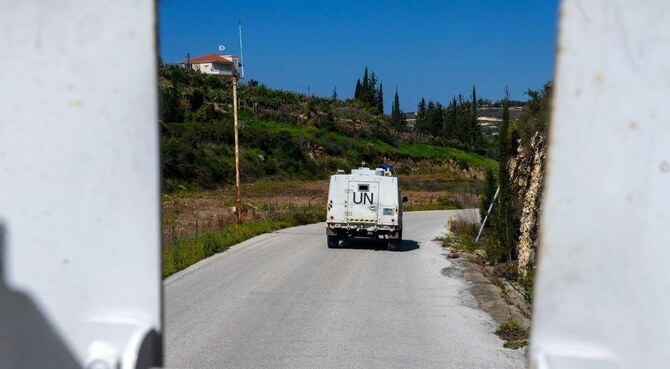
UNITED NATIONS, UNITED STATES: United Nations peacekeepers in Lebanon have been unable to conduct patrols because of the intensity of Israeli strikes and Hezbollah’s rockets targeting Israel, a UN spokesman said Monday.
With more than 10,000 personnel, the peacekeeping force has been stationed in Lebanon since 1978, with its role strengthened after a 33-day conflict between Hezbollah and Israel in 2006.
“Our UNIFIL Blue Helmets remain in position in the mission’s area of responsibility, while the intensity of fighting is preventing their movements and ability to undertake their mandated tasks,” Stephane Dujarric, spokesman for UN Secretary-General Antonio Guterres, told a media briefing.
“Given the intensity of the rockets going back and forth, they are not able to do patrolling,” he added.
Even before the dramatic escalation in fighting seen in recent weeks, several Blue Helmets had been wounded in the crossfire between Israel and Lebanon’s Hezbollah movement.
The peacekeepers mission, under Security Council Resolution 1701, is to “control the area” and help the Lebanese government and armed forces establish control south of the Litani River, which is around 30 kilometers (20 miles) from the border with Israel.
The resolution ended a war between Israel and Hezbollah in 2006.
It called for all armed personnel to pull back north of the Litani, except for Lebanese state security forces and United Nations peacekeepers.
While Hezbollah has not had a visible military presence in the border area since then, the group still holds sway over large parts of the south.
Dujarric said the peacekeepers “are able to observe what they can from where they are but they are not doing any road patrols,” adding that some civilian staff “have been moved north” as a precaution.
“We have a contingency plan and we’re looking at the situation hour by hour,” he added.


![]()

UN peacekeepers in Lebanon ‘not able’ to patrol: UN spokesman
Short Url
https://arab.news/gcmq4
UN peacekeepers in Lebanon ‘not able’ to patrol: UN spokesman
- Stephane Dujarric: ‘Given the intensity of the rockets going back and forth, they are not able to do patrolling’
- Dujarric: ‘We have a contingency plan and we’re looking at the situation hour by hour’


Latest updates


© 2026 SAUDI RESEARCH & PUBLISHING COMPANY, All Rights Reserved And subject to Terms of Use Agreement.