


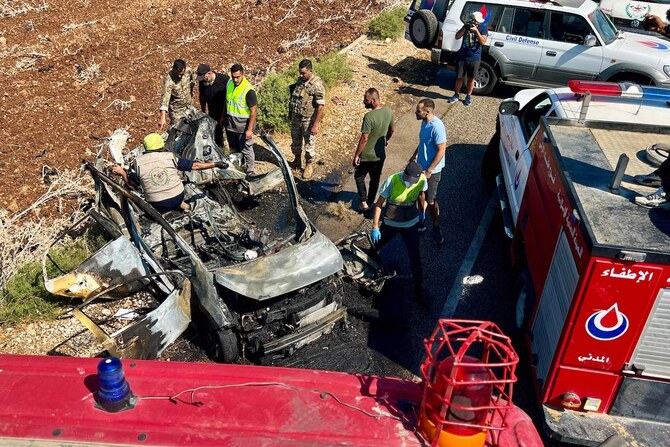

BEIRUT: An Israeli strike on a vehicle in southern Lebanon killed two people on Monday, the Health Ministry said.
The two civilians providing services to UNIFIL were killed in an airstrike conducted by a military drone, which targeted their civilian vehicle on the main road to Naqoura, where UNIFIL headquarters are located.
A fire erupted immediately in the vehicle, resulting in the deaths of Hussein Mahdi and his cousin Ali Mahdi, both of whom were employed by Techno Building Materials, a company based in Mount Lebanon that provides contracted services to UNIFIL.
The two employees were accustomed to commuting to and from UNIFIL headquarters to carry out the duties assigned to them.
BACKGROUND
Israel has been exchanging fire near-daily with Hezbollah since clashes along the border began last October.
The Public Health Emergency Operations Center of the Ministry of Health confirmed the deaths.
In June, three contractors associated with UNIFIL sustained injuries when their vehicle came under gunfire in the town of Chamaa, located in southern Lebanon.
At that time, UNIFIL reported that the contractors were targeted while en route home from the UNIFIL Sector West headquarters in Chamaa. Fortunately, their injuries were not severe.
In its recent vote regarding the renewal of UNIFIL’s mandate for another year, the UN Security Council unanimously adopted a resolution that included a call for all relevant parties to take prompt actions aimed at de-escalation and stability along the Blue Line.
UNIFIL “deplores that so many people have been hurt or killed since Oct. 8. Attacks on civilians are violations of international humanitarian law. They must stop,” said UNIFIL spokesperson Kandice Ardiel.
In response to the Naqoura attack, Hezbollah said that it “targeted the settlements of Ein Yaakov, Ja’aton and Yehiam with barrages of Katyusha rockets.”
Reports from Israeli media indicated that sirens were activated in these areas.
The operations center of the Ministry of Public Health said that “Israeli artillery shelling with phosphorus bombs on the town of Khiam resulted in a citizen suffering from suffocation, necessitating treatment at the governmental hospital in Marjeyoun.”
A driver survived after his truck was hit by Israeli machine gun fire while passing on the border road between Kfar Kila and Adaisseh.
Israeli Defense Minister Yoav Galant confirmed on Sunday that “confrontations with Hezbollah will continue until the residents of the north are returned to their homes.”
In this context, former Israeli Minister Benny Gantz called on the government to “conclude a deal in the Gaza Strip to release the hostages and focus the military efforts in the north in the face of Hezbollah. Prolonging the war in Gaza and the West Bank will lead to a delay in addressing Hezbollah.”
Israeli media continues to talk about “the possibilities of a war breaking out with Hezbollah and the discussions inside Israel in terms of targeting the group with additional strikes to make it lose much of its military capabilities.”
The town of Yaroun in the Bint Jbeil district was hit with intermittent artillery shelling coming from the Israeli positions on the other side of the border, while an airstrike targeted the town of Aita Al-Shaab.
On the other hand, Israeli Channel 12 reported that five missiles were launched from Lebanon toward Mattat in the Upper Galilee region.
Hezbollah announced a series of attacks that targeted a group of Israeli soldiers located in Har Adir with shells and “achieved a direct hit.”
It also targeted “buildings used by soldiers in the settlements of Avivim and Al-Manara with the appropriate weapons.”
Hostilities between the Israeli army and Hezbollah escalated on the night of Sunday to Monday, leading to deaths and injuries.
Israeli Army spokesperson Avichay Adraee said that air force warplanes carried out strikes targeting Hezbollah military buildings in Yaroun, Aita Al-Shaab, Hanine, Tayr Harfa, and Blida, which are border towns controlled by Hezbollah.
The operations center said that the Israeli strike on Aita Al-Shaab injured four people and that on Beit Yahoun three people. The one that hit Beit Lif killed one person, injuring eight others.


