

Malaysian PM to arrive in Pakistan on Wednesday with trade, connectivity on agenda

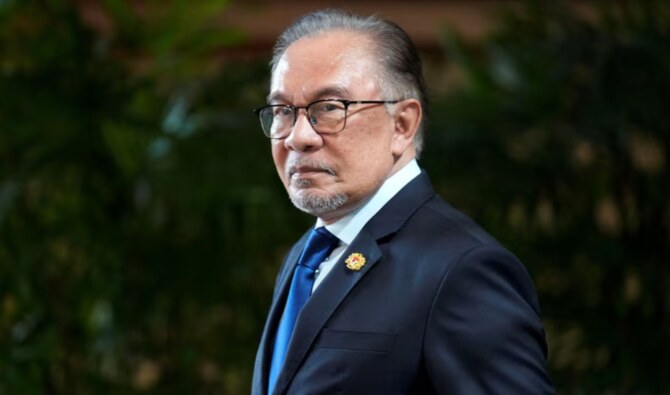
An undated file photo of Malaysian Prime Minister Dato’ Seri Anwar Ibrahim. (REUTERS/FILE)
Short Url
Updated 30 September 2024
Follow

Malaysian PM to arrive in Pakistan on Wednesday with trade, connectivity on agenda

  • Pakistan, Malaysia enjoy a strong bilateral relationship, rooted in shared Islamic values and historical ties
  • Islamabad says the visit provides an important opportunity to further strengthen Pakistan-Malaysia relations

ISLAMABAD: Malaysian Prime Minister Dato’ Seri Anwar Ibrahim will arrive in Pakistan on Wednesday on a three-day visit to strengthen ties in trade, connectivity, energy and other sectors, the Pakistani foreign office said on Monday.

Pakistan and Malaysia enjoy a strong bilateral relationship, rooted in shared Islamic values and historical ties. Since 1957, they’ve fostered economic cooperation, defense collaborations, and cultural exchange. The Pakistan-Malaysia Free Trade Agreement of 2008 boosted trade and investment, while regular high-level visits have solidified their partnership, underpinned by mutual respect and trust.

The Malaysian prime minister will be undertaking the visit from October 2-4 on the invitation of his Pakistani counterpart Shehbaz Sharif, according to the Pakistan foreign office. He will be accompanied by a high-level delegation comprising Malaysian ministers, deputy ministers and senior officials.

“Prime Minister Dato’ Seri Anwar Ibrahim will hold meetings with Prime Minister Muhammad Shehbaz Sharif,” the Pakistani foreign office said in a statement.

“The two sides will discuss a wide-ranging agenda to further strengthen Pakistan-Malaysia ties in diverse fields including trade, connectivity, energy, agriculture, halal industry, tourism, cultural exchanges and people-to-people contacts.”

During the visit, the Pakistani foreign office said, both sides will also discuss regional and global developments. “This visit provides an important opportunity to further strengthen Pakistan-Malaysia relations,” it added.

Bilateral trade between both countries was recorded at $1.5 billion in 2023-24. The major exports of Pakistan to Malaysia include rice, condensate oil, onions, potatoes, home textiles, corn, seafood, and meat, palm oil and its products, petroleum, LNG, computers and laptops, nonwoven wadding, and fiberboard, according to the High Commission of Pakistan in Malaysia.

Tourism between both countries has gained momentum over the past few years and Malaysia currently ranks among the top tourist source countries to Pakistan. Around 160,000 Pakistani nationals were residing in Malaysia and over 3,800 students from Pakistan were also enrolled in Malaysian higher education institutes, making the country the third largest source of international students in Malaysia.

Pakistan is also one of the major workforce source countries for Malaysia in various key sectors including plantation, construction, manufacturing, agriculture and services, it added.


Pakistan launches double-decker buses in Karachi after 65 years to tackle transport woes

Updated 31 December 2025
Follow

Pakistan launches double-decker buses in Karachi after 65 years to tackle transport woes

  • Karachi citizens will be able to travel in double-decker buses from Jan. 1, says Sindh government
  • City faces mounting transport challenges such as lack of buses, traffic congestion, poorly built roads

ISLAMABAD: The government in Sindh province on Wednesday launched double-decker buses in the provincial capital of Karachi after a gap of 65 years, vowing to improve public transport facilities in the metropolis. 

Double-decker buses are designed to carry more passengers than single-deck vehicles without taking up extra road space. The development takes place amid increasing criticism against the Sindh government regarding Karachi’s mounting public transport challenges and poor infrastructural problems. 

Pakistan’s largest city by population faces severe transportation challenges due to overcrowding in buses, traffic congestion and limited bus options. Commuters, as a result, rely on private vehicles or unregulated transport options that are often unsafe and expensive.

“Double-decker buses have once again been introduced for the people of Karachi after 65 years,” a statement issued by the Sindh information ministry said. 

Sindh Transportation Minister Sharjeel Inam Memon and Local Government Minister Syed Nasir Hussain Shah inaugurated the bus service. The ministry said the facility will be available to the public starting Jan. 1. 

The statement highlighted that new electric bus routes will also be launched across the entire province starting next week. It added that the aim of introducing air-conditioned buses, low-fare services, and fare subsidies is to make public transport more accessible to the people.

The ministry noted that approximately 1.5 million people travel daily in Karachi using the People’s Bus Service, while around 75,000 passengers use the Orange Line and Green Line BRT services.

“With the integration of these routes, efforts are being made to benefit up to 100,000 additional people,” the ministry said.