

Pakistani woman in high-profile hit-and-run case granted bail on drug charges

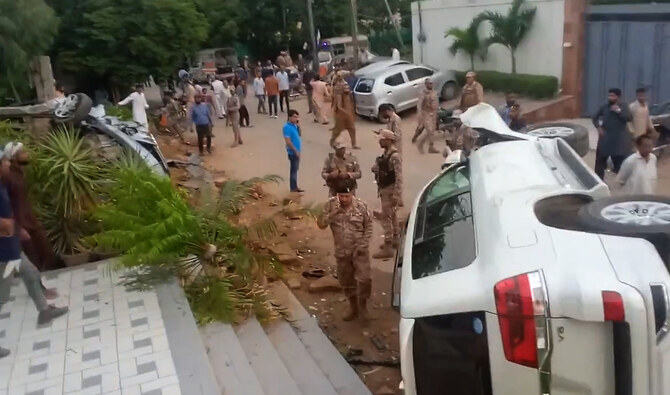
In this screengrab, taken from a video posted on social media platform X, security personnel gather as vehicle lies upside down after an accident in Karachi on August 19, 2024. A high-profile hit-and-run case that claimed two lives, according to police. (X/@MkashanBhatti_)
Short Url
Updated 30 September 2024
Follow

Pakistani woman in high-profile hit-and-run case granted bail on drug charges

  • Natasha Danish, wife of prominent Karachi businessman, was arrested in August for killing two people in accident
  • Judge says case attracted negative media attention toward Danish, points out differences in urine and blood tests

KARACHI: A Pakistani woman who is a suspect in a high-profile hit-and-run case in Karachi is set to walk free after the Sindh High Court granted her bail on Monday, three weeks after she was denied the same by a trial court over allegations that she was driving under the influence of methamphetamine drug when she killed two people. 

Natasha Danish, the wife of a prominent businessman in Karachi, was arrested in August for causing a fatal accident that killed two people and caused injuries to five others. Danish had earlier received bail in the manslaughter case after the victims’ families pardoned her. However, she remained in custody on charges of driving under the influence of methamphetamine.

During a hearing of the case on Monday, the defense counsel argued that Danish was wrongfully charged under Section 11 of The Prohibition (Enforcement of Hadd) Order, 1979 which deals with alcohol consumption. The defense counsel argued that Danish was accused of consuming methamphetamine, not alcohol.

Despite opposition from the prosecution, Justice Mohammad Karim Khan Agha granted post-arrest bail to Danish. In his written order, the judge cited several reasons that questioned the justification to detain her further. 

“This case has attracted a lot of media attention much of which is not in favor of the applicant as well as outcry from civil society, which might have caused prejudice to her trial,” the judge argued in his order, a copy of which is available with Arab News.

He noted that while Danish’s urine test had shown traces of methamphetamine, her blood test did not. He said these raised questions about the strength of the case, adding that further inquiry was needed to ascertain the truth. 

 “The urine sample given by the applicant found that the methamphetamine (ice) narcotic was detected in the given sample, hence there appears to be a contradiction between the two reports (blood & urine) which makes this a case of further inquiry,” he wrote. 

The court also pointed out that the primary case involving the accident had been resolved after the victims’ families had pardoned Danish. The judge noted that Danish, a mother of three, had already spent six weeks in jail and that her prolonged detention could not be justified given the circumstances.

 “The maximum sentence would most probably be less than three years which would entitle her to the grant of bail,” the judge said. 

The judge pointed out that Danish’s children, which includes a young daughter, needed her mother’s support. He noted the ongoing trial was expected to take time as there were 13 witnesses yet who had to testify.

The decision to grant bail was based on a preliminary assessment of the evidence, with the court clarifying that it would not influence the outcome of the trial. Danish was ordered to provide a surety bond of Rs. 1 million in exchange for bail. 

Danish’s case has attracted significant media attention in Pakistan, particularly after CCTV footage of the fatal accident circulated on social media in August. The footage showed Danish’s vehicle colliding with a motorbike, killing a student and her father.
Tens of thousands flee northwest Pakistan over fears of military operation

Updated 28 January 2026
Follow

Tens of thousands flee northwest Pakistan over fears of military operation

  • More than 70,000 people, mostly women and children, have fled remote Tirah region bordering Afghanistan 
  • Government says no military operation underway or planned in Tirah, a town in Khyber Pakhtunkhwa province

BARA, Pakistan: More than 70,000 people, mostly women and children, have fled a remote region in northwestern Pakistan bordering Afghanistan over uncertainty of a military operation against the Pakistani Taliban, residents and officials said Tuesday.

Pakistan’s Defense Minister Khawaja Mohammad Asif has denied the claim by residents and provincial authorities. He said no military operation was underway or planned in Tirah, a town in Khyber Pakhtunkhwa province.

Speaking at a news conference in Islamabad, he said harsh weather, rather than military action, was driving the migration. His comments came weeks after residents started fleeing Tirah over fears of a possible army operation.

The exodus began a month after mosque loudspeakers urged residents to leave Tirah by Jan. 23 to avoid potential fighting. Last August, Pakistan launched a military operation against Pakistani Taliban in the Bajau r district in the northwest, displacing hundreds of thousands of people.

Shafi Jan, a spokesman for the provincial government in Khyber Pakhtunkhwa, posted on X that he held the federal government responsible for the ordeal of the displaced people, saying authorities in Islamabad were retracting their earlier position about the military operation.

Khyber Pakhtunkhwa Chief Minister Suhail Afridi, whose party is led by imprisoned former Prime Minister Imran Khan, has criticized the military and said his government will not allow troops to launch a full-scale operation in Tirah.

The military says it will continue intelligence-based operations against Pakistani Taliban, who are known as Tehrik-e-Taliban Pakistan, or TTP. Though a separate group, it has been emboldened since the Afghan

Taliban returned to power in 2021. Authorities say many TTP leaders and fighters have found sanctuary in Afghanistan and that hundreds of them have crossed into Tirah, often using residents as human shields when militant hideouts are raided.

Caught in the middle are the residents of Tirah, who continued arriving in Bara.

So far, local authorities have registered roughly 10,000 families — about 70,000 people — from Tirah, which has a population of around 150,000, said Talha Rafiq Alam, a local government administrator overseeing the relief effort. He said the registration deadline, originally set for Jan. 23, has been extended to Feb. 5.

He said the displaced would be able to return once the law-and-order situation improves.

Among those arriving in Bara and nearby towns was 35-year-old Zar Badshah, who said he left with his wife and four children after the authorities ordered an evacuation. He said mortar shells had exploded in villages in recent weeks, killing a woman and wounding four children in his village. “Community elders told us to leave. They instructed us to evacuate to safer places,” he said.

At a government school in Bara, hundreds of displaced lined up outside registration centers, waiting to be enrolled to receive government assistance. Many complained the process was slow.

Narendra Singh, 27, said members of the minority Sikh community also fled Tirah after food shortages worsened, exacerbated by heavy snowfall and uncertain security.

“There was a severe shortage of food items in Tirah, and that forced us to leave,” he said.

Tirah gained national attention in September, after an explosion at a compound allegedly used to store bomb-making materials killed at least 24 people. Authorities said most of the dead were militants linked to the TTP, though local leaders disputed that account, saying civilians, including women and children, were among the dead.