Pakistan top court rejects Lahore High Court’s appointments to Punjab election tribunals

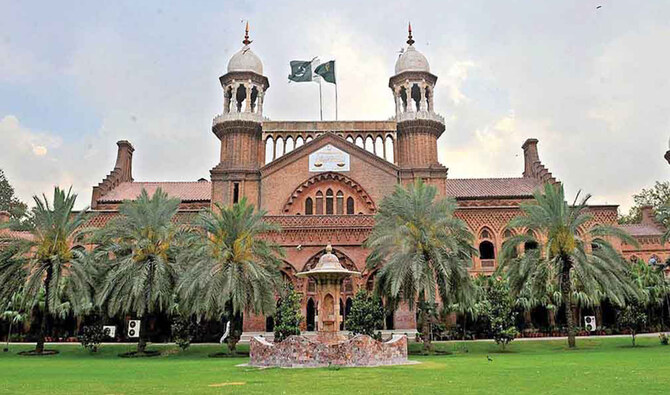
The picture shared by state-run media, APP, on May 3, 2024, shows the Lahore High Court building in Lahore, Pakistan. (APP/File)
Short Url
Updated 30 September 2024
Follow

Pakistan top court rejects Lahore High Court’s appointments to Punjab election tribunals

  • Pakistan’s ECP had asked top court to determine whether authority to appoint election tribunals wrests with it or Lahore High Court
  • Former prime minister Imran Khan’s party, which accuses Election Commission of being pro-government, criticizes the verdict

ISLAMABAD: The Supreme Court of Pakistan on Monday declared an earlier decision by the Lahore High Court (LHC) to appoint judges to eight election tribunals in Punjab to hear petitions related to the February 8 polls as null and void, ruling in favor of the country’s electoral watchdog. 

The Election Commission of Pakistan (ECP) had appealed against the LHC’s decision and sought clarity from the top court on whether the commission or the LHC chief justice has pre-eminence when it came to appointing election tribunals under Section 140 of the Elections Act 2017.

The controversy began in February when the commission asked the LHC for names of serving judges to be appointed to election tribunals in Punjab. The LHC provided the commission the names of two judges which were notified by the ECP. On April 4, the LHC chief justice nominated six more judges for their appointment to election tribunals out of which only two were notified by the ECP. The electoral watchdog sought more names from the high court for appointment to election tribunals in Rawalpindi and Bahawalpur. 

In reply, the LHC chief justice objected to the ECP’s demand, stating that the commission never sought names of judges for their appointment to election tribunals in the past. In its July 12 verdict, the LHC ruled that a high court chief justice has pre-eminence or dominance in matters of appointment of election tribunals under Section 140 of the Elections Act 2017. 

“The Supreme Court has set aside the June 12 verdict of the single bench of Lahore High Court and accepted the Election Commission’s review regarding the matter of constitution of election tribunals,” state-owned Pakistan Television News (PTV News) reported, adding that a five-member bench of the apex court headed by Chief Justice Qazi Faez Isa announced the verdict. 

“The Supreme Court cited in its decision that the verdict given by the Lahore High Court cannot be quoted as a precedent in the future,” PTV News added. 

Former prime minister Imran Khan’s Pakistan Tehreek-e-Insaf (PTI) party, which has leveled rigging allegations against the ECP in the past, criticized the judgment. 

“The judgment given by Justice Qazi Faez Isa regarding the election tribunals seems as if he is in a hurry to pave the way for his extension,” PTI lawyer Shoaib Shaheen told reporters outside the Supreme Court. 

 Khan’s party has accused the government of attempting to grant an extension in tenure to Isa, who is widely viewed to be aligned with the ruling coalition and in opposition to its chief rival, the PTI, through a set of proposed constitutional amendments that it is yet to produce in parliament. 

The government denies these allegations and says the amendments— expected to establish a federal constitutional court, raise the retirement age of superior judges by three years and modify the process for the top judge’s appointment— are aimed at providing speedy justice to thousands of litigants in the country. 


Pakistan, seven Muslim nations back Palestinian technocratic body, stress Gaza-West Bank unity

Updated 15 January 2026
Follow

Pakistan, seven Muslim nations back Palestinian technocratic body, stress Gaza-West Bank unity

  • The National Committee for the Administration of the Gaza Strip was announced on January 14
  • Muslim nations call for consolidation of the ceasefire and unimpeded humanitarian aid into Gaza

ISLAMABAD: Pakistan and seven other Muslim-majority countries on Thursday welcomed the formation of a temporary Palestinian technocratic body to administer Gaza, stressing that it must manage daily civilian affairs while preserving the institutional and territorial link between the Gaza Strip and the West Bank amid the ongoing peace efforts.

In a joint statement, the foreign ministers of Pakistan, Egypt, Jordan, Saudi Arabia, Qatar, Türkiye, Indonesia and the United Arab Emirates said the newly announced National Committee for the Administration of the Gaza Strip would play a central role during the second phase of a broader peace plan aimed at ending the war and paving the way for Palestinian self-governance.

“The Ministers emphasize the importance of the National Committee commencing its duties in managing the day-to-day affairs of the people of Gaza, while preserving the institutional and territorial link between the West Bank and the Gaza Strip, ensuring the unity of Gaza, and rejecting any attempts to divide it,” the statement said.

The committee, announced on Jan. 14, is a temporary transitional body established under United Nations Security Council Resolution 2803 and is to operate in coordination with the Palestinian Authority, the ministers said.

The statement said the move forms part of the second phase of US President Donald Trump’s Comprehensive Peace Plan for Gaza, which the ministers said they supported, praising Trump’s efforts to end the war, ensure the withdrawal of Israeli forces and prevent the annexation of the occupied West Bank.

The top leaders of all eight Muslim countries attended a meeting with Trump in New York last September, shortly before he unveiled the Gaza peace plan.

The ministers also called for the consolidation of the ceasefire, unimpeded humanitarian aid into Gaza, early recovery and reconstruction and the eventual return of the Palestinian Authority to administer the territory, leading to a just and sustainable peace based on UN resolutions and a two-state solution on pre-1967 lines with East Jerusalem as the Palestinian capital.