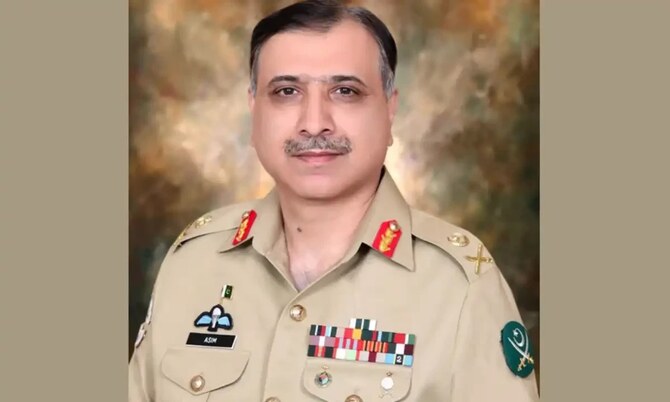
Lt Gen Asim Malik takes charge as new chief of Pakistan’s ISI agency today

The picture shared by Pakistani state media, PTV News, on September 23, 2024, shows the newly appointed head of the Inter-Services Intelligence (ISI), Lt. Gen. Muhammad Asim Malik. (PTV News)
Short Url
Updated 30 September 2024
Follow

Lt Gen Asim Malik takes charge as new chief of Pakistan’s ISI agency today

  • Malik takes over from his predecessor, Lt Gen Nadeem Anjum, who was appointed by ex-PM Imran Khan in 2021
  • His posting comes as Pakistan faces surging attacks in its western provinces of Khyber Pakhtunkhwa and Balochistan

ISLAMABAD: Lt. Gen. Asim Malik will take charge as the new chief of Pakistan’s Inter-Services Intelligence (ISI) today, Monday, exactly a week after he was picked to head the powerful spy agency.

Malik, who was serving as an adjutant general at the General Headquarters (GHQ) in Pakistan’s garrison city of Rawalpindi when his name was announced as the new head of the ISI last Monday, will be replacing Lt. Gen. Nadeem Anjum. His predecessor was appointed by then-prime minister Imran Khan in 2021.

The army is arguably the most influential institution in Pakistan, with the military having ruled the country for about half of its 77-year history since independence from Britain and enjoying extensive powers even under civilian administrations.

“Lt. Gen. Muhammad Asim Malik has been appointed as DG ISI,” state television PTV News said last Monday. “Lt. Gen. Asim Malik will assume charge of his new responsibilities on Sept. 30.”

Sharing details about the new ISI chief, PTV had said Malik previously served in the Balochistan infantry division and commanded the infantry brigade in Pakistan’s volatile northwestern Waziristan district.

Malik also earned an honorary sword in his course and has served as chief instructor at the National Defense University (NDU), and as an instructor at the Command and Staff College Quetta. He is a graduate of Fort Leavenworth in the United States and the Royal College of Defense Studies in London, the state television said.

The head of the ISI occupies one of the country’s most powerful positions. His posting comes at a time when Pakistan faces surging militant attacks in the country’s northwestern Khyber Pakhtunkhwa (KP) and southwestern Balochistan provinces by separatists and religiously motivated militants. The surge in militant attacks in KP has marred Pakistan’s relations with Afghanistan, whose government it accuses of providing sanctuaries to the Pakistani Taliban militants who launch attacks in Pakistan. The Taliban deny these allegations and have urged Pakistan to resolve their security challenges internally.

Created in 1948, the ISI gained importance and power during the 1979-1989 Soviet occupation of Afghanistan, and is now rated one of best-organized intelligence agencies in the developing world.

The agency is seen as the Pakistani equivalent of the US Central Agency (CIA) and Israel’s Mossad. Its size is not publicly known but the ISI is widely believed to employ tens of thousands of agents, with informers in many spheres of public life.

The military intelligence agency is believed to have a hidden role in making many of the nuclear-armed nation’s policies, including in Afghanistan and India. The threat to Pakistan from nuclear-armed neighboring India has been a main preoccupation of the ISI through the decades.



Pakistan remittances seen surpassing $40 billion in FY26 as Saudi Arabia leads November inflows

Updated 4 sec ago
Follow

Pakistan remittances seen surpassing $40 billion in FY26 as Saudi Arabia leads November inflows

  • The country’s November remittances rose 9.4 percent year-on-year to $3.2 billion, official data show
  • Economic experts say rupee stability and higher use of formal channels are driving the upward trend

ISLAMABAD: Pakistan’s workers’ remittances are expected to exceed the $40 billion mark in the current fiscal year, economic experts said Tuesday, after the country recorded an inflow of $3.2 billion in November, with Saudi Arabia once again emerging as the biggest contributor.

Remittances are a key pillar of Pakistan’s external finances, providing hard currency that supports household consumption, helps narrow the current-account gap and bolsters foreign-exchange reserves. The steady pipeline from Gulf economies, led by Saudi Arabia and the United Arab Emirates, has remained crucial for Pakistan’s balance of payments.

A government statement said monthly remittances in November stood at $3.2 billion, reflecting a 9.4 percent year-on-year increase.

“The growth in remittances means the full-year figure is expected to cross the $40 billion target in fiscal year 2026,” Sana Tawfik, head of research at Arif Habib Limited, told Arab News over the phone.

“There are a couple of factors behind the rise in remittances,” she said. “One of them is the stability of the rupee. In addition, the country is receiving more inflows through formal channels.”

Tawfik said the trend was positive for the current account and expected inflows to remain strong in the second half of the fiscal year, noting that both Muslim festivals of Eid fall in that period, when overseas Pakistanis traditionally send additional money home for family expenses and celebrations.

The official statement said cumulative remittances reached $16.1 billion during July–November, up 9.3 percent from $14.8 billion in the same period last year.

It added that November inflows were mainly sourced from Saudi Arabia ($753 million), the United Arab Emirates ($675 million), the United Kingdom ($481.1 million) and the United States ($277.1 million).

“UAE remittances have regained momentum in recent months, with their share at 21 percent in November 2025 from a low of 18 percent in FY24,” said Muhammad Waqas Ghani, head of research at JS Global Capital Limited. “Dubai in particular has seen a steady pick-up, reflecting improved inflows from Pakistani expatriates owing to some relaxation in emigration policies.”