

Pakistan PM offers help to Nepal as death toll from flood surges to 170

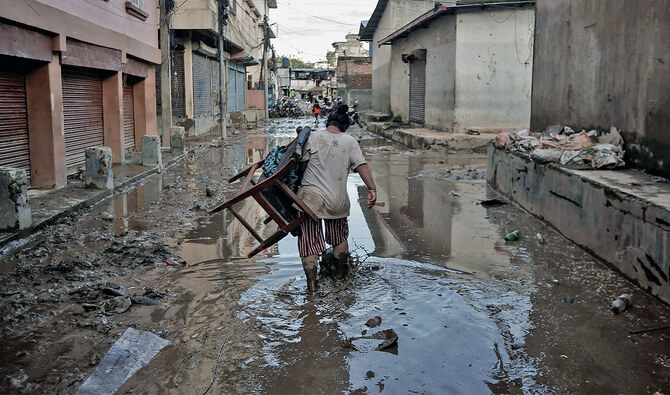
A woman carrying a chair walks along a muddy street as the floodwater recedes from a residential area that was flooded by the overflowing Bagmati River following heavy rains in Kathmandu, Nepal on September 29, 2024. (REUTERS)
Short Url
Updated 30 September 2024
Follow

Pakistan PM offers help to Nepal as death toll from flood surges to 170

  • Devastating floods and landslides triggered by rain in Nepal last week have killed at least 170
  • Heavy rains, flash floods and landslides this monsoon season killed nearly 350 people in Pakistan

ISLAMABAD: Pakistan’s Prime Minister Shehbaz Sharif has offered help to Nepal, as the death toll from devastating floods and landslides in the country surged to 170 on Monday. 

Rescuers in Nepal recovered dozens of bodies from buses and other vehicles that were buried in landslides near the capital Katmandu on Sunday, with various media outlets reporting that the death toll has surged to 170. 

While floods and landslides caused by torrential rains are common across the region during the monsoon period, weather officials in the Himalayan nation attribute these rainstorms to climate change and a low-pressure system in the Bay of Bengal. 

In a message on social media platform X, Sharif said he was “deeply saddened” by Nepal’s devastating floods. 

“Having suffered calamitous floods ourselves in 2022, Pakistan stands in full solidarity with Nepal and is ready to extend any help necessary,” he wrote on Sunday. 

Separately, Pakistan’s foreign office expressed solidarity with Nepal as floods raged in the South Asian country. 

“Our thoughts and prayers are with all who have lost loved ones and livelihood in the floods,” the Pakistani foreign office said in a statement on Sunday. “Pakistan stands in solidarity with the government and people of Nepal in this moment of tragedy.”

The Pakistani prime minister was referring to the torrential monsoon rains in 2022 when unusually heavy rains and the melting of glaciers triggered flash floods across the country. Over 1,700 people were killed, critical infrastructure was damaged and large swathes of crops were damaged and washed away. Pakistan estimated losses to be over $30 billion from the floods. 

Heavy rains triggered flash floods and killed nearly 350 in Pakistan this monsoon season that began in late June, according to the country’s disaster management authority. Pakistan and other countries in South Asia have seen erratic changes in weather patterns in recent years that scientists have blamed on climate change.


At ECO meeting, Pakistan proposes ‘Regional Innovation Hub’ to curb natural disasters

Updated 21 January 2026
Follow

At ECO meeting, Pakistan proposes ‘Regional Innovation Hub’ to curb natural disasters

  • Pakistan hosts high-level 10th ECO Ministerial Meeting on Disaster Risk Reduction in Islamabad
  • Innovation hub to focus on early warning technologies, risk informed infrastructure planning

ISLAMABAD: Pakistan has proposed to set up a “Regional Innovation Hub on Disaster Risk Reduction” that focuses on early warning technologies and risk informed infrastructure planning, the Press Information Department (PID) said on Wednesday, as Islamabad hosts a high-level meeting of the Economic Cooperation Organization (ECO).

The ECO’s 10th Ministerial Meeting on Disaster Risk Reduction (DRR) is being held from Jan. 21-22 at the headquarters of the National Disaster Management Authority (NDMA) in Pakistan’s capital. 

The high-level regional forum brings together ministers, and senior officials from ECO member states, representatives of the ECO Secretariat and regional and international partner organizations. The event is aimed to strengthen collective efforts toward enhancing disaster resilience across the ECO region, the PID said. 

“Key agenda items include regional cooperation on early warning systems, disaster risk information management, landslide hazard zoning, inclusive disaster preparedness initiatives, and Pakistan’s proposal to establish a Regional Innovation Hub on Disaster Risk Reduction, focusing on early warning technologies, satellite data utilization, and risk-informed infrastructure planning,” the statement said. 

The meeting was attended by delegations from ECO member states including Pakistan, Türkiye, Azerbaijan, Iran, Kyrgyzstan, Tajikistan, Turkmenistan and Uzbekistan. Representatives of regional and international organizations and development partners were also in attendance.

Discussions focused on enhancing regional coordination, harmonizing disaster risk reduction frameworks, and strengthening collective preparedness against transboundary and climate-induced hazards impacting the ECO region, the PID said. 

ECO members states such as Pakistan, Türkiye, Afghanistan and others have faced natural calamities such as floods and earthquakes in recent years that have killed tens of thousands of people. 

Heavy rains triggered catastrophic floods in Pakistan in 2022 and 2025 that killed thousands of people and caused damages to critical infrastructure, inflicting losses worth billions of dollars. 

Islamabad has since then called on regional countries to join hands to cooperate to avert future climate disasters and promote early warning systems to avoid calamities in future.