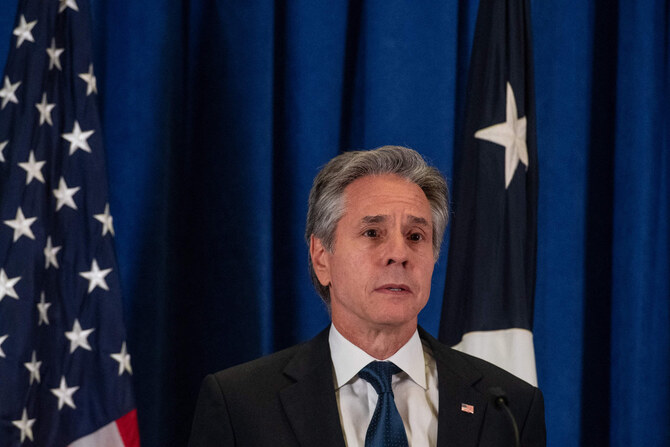

NEW YORK: US Secretary of State Antony Blinken on Friday questioned China’s sincerity in seeking peace in Ukraine as he directly pressed his counterpart over exports that boost Russia’s military.
Blinken met Chinese Foreign Minister Wang Yi on the sidelines of the UN General Assembly, the latest talks as the two powers look to dial down once-soaring tensions.
While crediting the diplomacy with bringing progress, Blinken warned that the United States would not back down on concerns over China’s exports to Russia and made clear that Washington could impose more sanctions.
Blinken said that China is fueling the “war machine” of Russian President Vladimir Putin.
“When Beijing says that, on the one hand, that it wants peace, it wants to see an end to the conflict, but on the other hand is allowing its companies to take actions that are actually helping Putin continue the aggression, that doesn’t add up,” Blinken told a news conference.
“Our intent is not to decouple Russia from China. Their relationship is their business,” he said.
“But insofar as that relationship involves providing Russia what it needs to continue this war, that’s a problem for us, and it’s a problem for many other countries, notably in Europe,” Blinken added.
The top US diplomat said that China has provided 70 percent of machine tools and 90 percent of microelectronics needed by Russia for military production that includes rockets and armored vehicles.
Wang told Blinken during the meeting that China’s position on the Ukraine conflict was “open and aboveboard, always advocating for peace and dialogue, and working toward a political solution,” Beijing’s foreign ministry said in a statement on Saturday.
“The US should stop smearing and sanctioning China and refrain from using the issue to create divisions and provoke bloc confrontations,” Wang added.
China says it has not directly provided weapons to Russia and draws a contrast with the United States, which has shipped billions of dollars in weapons to Ukraine since the 2022 invasion by Russia.
Wang told a Security Council session on Tuesday that China was “not a creator of the Ukraine crisis, nor are we a party to it. China has all along stood on the side of peace.”
Ukrainian President Volodymyr Zelensky in a UN address criticized China and Brazil for promoting negotiations to end the war, saying that forcing Ukraine to accept a peace deal was akin to colonialism.
The two countries kept up the drive on Friday, leading a statement with other emerging powers that calls for a “comprehensive and lasting settlement” through diplomacy.
But in a thinly veiled criticism of Putin’s recent saber-rattling, the emerging powers called on all sides to refrain “from the use or the threat of weapons of mass destruction.”
South Africa and Turkiye were among the powers that also signed the statement.
Putin this week threatened to use nuclear weapons in the event of a major attack on Russian soil as Ukraine, looking to hit back against the invasion, seeks Western weapons to strike deeper across the border.
Since Blinken and Wang last met in July at a regional conference in Laos, China has pleased the United States by releasing an American pastor imprisoned for years, although other Americans are detained.
Chinese President Xi Jinping, during a summit in November 2023 with counterpart Joe Biden, agreed to key US demands of restoring military communication between the two powers.
He also agreed to take action against producers of ingredients in fentanyl, the painkiller behind an overdose epidemic in the United States.
But a wide range of disagreements remain.
Blinken said he warned Wang against Beijing’s “dangerous, destabilizing actions” on the South China Sea, where tensions have risen sharply between China and US ally the Philippines.
On the disputed waterway, Wang urged the US to “stop stirring up trouble...and undermining the efforts of regional countries to maintain peace and stability.”
Wang also slammed US “suppression” of China’s trade, technology, and economy and told Blinken that Washington should pursue “dialogue with respect.”
“Since the US has repeatedly expressed that it does not intend to confront China, it should establish a rational understanding of China at its core, create a proper way of coexistence, (and) engage in dialogue with respect,” Wang told Blinken.
The latest meeting came ahead of the November 5 election in which Republican candidate Donald Trump has vowed to take a harder line on China.
Biden and Vice President Kamala Harris, who is running against Trump, have said that they seek dialogue to avoid conflict between the two powers, although their administration has also taken a hard line.
Blinken’s deputy, Kurt Campbell, recently told a congressional hearing that China posed a broader challenge to the United States than the Soviet Union did during the Cold War.