


ISLAMABAD: The Pakistan Meteorological Department (PMD) has initiated a $50 million project in collaboration with the World Bank to upgrade its system by installing state-of-the-art radars and establishing 300 new weather stations, a top official confirmed this week.
According to the Global Climate Risk Index, Pakistan ranks as the fifth most vulnerable country to climate change, facing extreme weather events like floods, droughts and heatwaves that significantly affect agriculture and infrastructure.
Given the situation, PMD’s work of providing weather forecasts and issuing public warnings to ensure protection, safety and general awareness has acquired greater significance, though it faces limitations as the majority of its systems rely on manual observation methods.
“The project of the World Bank is of $50 million,” Sahibzad Khan, the PMD director general, told Arab News in an exclusive interview. “In the first phase, we will [spend] $40 million, but we will also get the remaining $10 million as this is a three-year project.”
He said the project was approved in September 2023, and after completing all the documentation, it was operationalized this week.
“Under the project, we will have 300 automated weather stations,” he added. “We are installing five radars from World Bank and to integrate observational data, radar data, satellite data, we are installing high-performance computers.”

The picture taken on September 25, 2024, shows J-BIRD radar weather system at the National Weather Forecast Center in Islamabad, Pakistan. (AN photo)
Khan informed the network of weather stations will be established within the next three years, hoping it will make the PMD system significantly more efficient, with a much higher rate of accuracy and improved forecasting capabilities.
“We will have 105 new automated weather stations in Balochistan and 75 each in [Khyber Pakhtunkhwa] and Punjab and 45 will be used in Sindh which will increase our capacity of data collection,” he said.
The PMD official informed Pakistan currently had around 100 manual observatory weather stations across the country but needed more, as a larger network would significantly increase the accuracy of weather forecasts.
“According to the World Meteorological Organization, every 40 kilometers should have an observational station but we have not been able to do it in Pakistan yet,” he added.

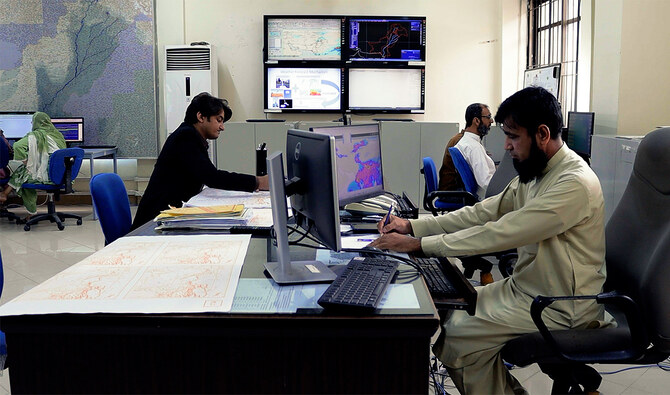
An official of the Pakistan Meteorological Department is analyzing weather data at the National Weather Forecast Center in Islamabad on September 25, 2024. (AN photo)
Khan said his organization will also install five modern radars with different ranges, with the most advanced ones in Lahore and Gwadar. He also pointed out the PMD will also get a high-performing computing component to integrate and process all the data.
Speaking to Arab News, PMD director Dr. Zaheer Ahmed Babar said the forecast system required a robust network of weather observatories.
“We are trying to invest in the observation system because weather observation system not only consists of the observatories, it also consists of the radars, it also consists of the satellite images,” he added.
Babar said the weather system depended upon the initial conditions, which change every three hours.
He informed that PMD experts generated forecasts by visualizing and analyzing various models, subsequently publishing the information in text form on the website.
“The National Disaster Management Authority, Provincial Disaster Management Authorities, and the District Management Authorities are then given this information in text form,” he added.


