

Pakistan’s finance minister announces plan to abolish ‘non-filer’ status with punitive actions

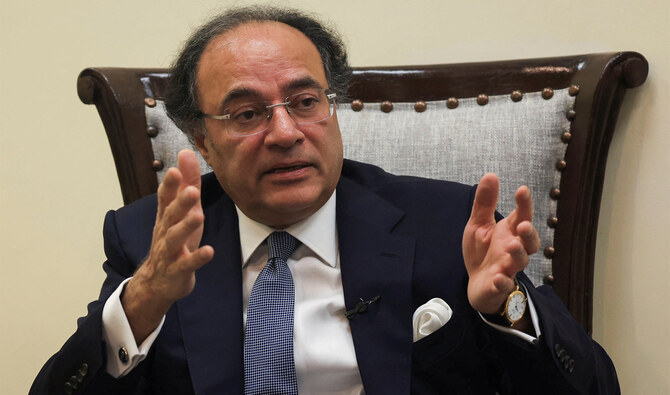
Pakistan Finance Minister Muhammad Aurangzeb speaks during an interview with Reuters at his office in Islamabad, Pakistan, on July 19, 2024. (REUTERS/File)
Short Url
Updated 27 September 2024
Follow

Pakistan’s finance minister announces plan to abolish ‘non-filer’ status with punitive actions

  • Previously, people in Pakistan paid nominal rates on various transactions to avoid filing tax returns
  • Muhammad Aurangzeb says the government is taking steps to improve tax compliance, enforcement

ISLAMABAD: Federal Minister for Finance and Revenue Muhammad Aurangzeb said on Thursday the government plans to eliminate the “non-filer” category by taking punitive actions against those who previously paid nominal amounts on various transactions to avoid filing tax returns.

The minister made the statement in an interview with Voice of America, a day after the International Monetary Fund (IMF) approved a $7 billion loan program to support Pakistan’s cash-strapped economy.

The government has implemented stringent economic reforms in recent years, including the removal of subsidies and increased power tariffs, based on recommendations from the global lender to stabilize the financial outlook before achieving macroeconomic stability.

Aurangzeb noted, after the loan approval in a separate statement, that Pakistan will face “transitional pain” if it aims to make this the last IMF program by continuing with structural reforms.

“Previously, we had this system where if someone was a non-filer, we said you can pay a nominal rate and stay outside the tax system,” he said during the interview. “Now, we’re taking it to a punitive level. It’s about time we address this invention of the non-filer status, which I think only exists in our country.”

“As a country, our hand has been forced,” he continued. “We no longer have the capacity to allow anyone in this country to remain a non-filer.”

The minister acknowledged that the IMF conditionalities had become more stringent with every loan program, attributing it to the “credibility and trust deficit.”

“We sign the structural benchmarks but never follow through,” he said. “That’s why they are strict. This time, we are going to go through the reforms.”

He maintained the government aims to widen the tax net by incorporating the agriculture, retail and wholesale sectors.

He also pointed out that measures are being taken to improve compliance and enforcement, which had previously been weak.

The IMF and World Bank chiefs have already praised Pakistan’s recent economic reforms, though international lending agencies also stress the need to stay the course in order to further strengthen the national economy.


Pakistan capital market transitions to T+1 settlement cycle ahead of multiple advanced markets

Updated 7 sec ago
Follow

Pakistan capital market transitions to T+1 settlement cycle ahead of multiple advanced markets

  • A T+1 settlement cycle means that securities transactions are finalized and settled one business day after trade date
  • Effective from Feb. 9, all eligible trades at the PSX are now settled on a T+1 basis, replacing the previous T+2 cycle

KARACHI: Pakistan’s capital market has officially transitioned to the Trade plus one (T+1) settlement cycle, a landmark reform that strengthens efficiency, reduces risk and aligns the country with international best practices, the Pakistan Stock Exchange (PSX) said on Tuesday.

A T+1 settlement cycle means that securities transactions are finalized and settled one business day after the trade date, which reduces counterparty risk and improves capital efficiency in the exchange of funds and securities. 

Effective from Feb. 9, all eligible trades at the PSX are now settled on a T+1 basis, replacing the previous T+2 cycle. The transition was implemented under the guidance of the Securities and Exchange Commission of Pakistan (SECP) through close collaboration among all stakeholders, according to the PSX.

It aligns Pakistan’s capital market with leading markets such as the United States, Canada, Mexico, Argentina, Jamaica and China, which have already adopted shorter settlement cycles. Europe, the UK and Switzerland are set to follow by 2027. By moving early, Pakistan has demonstrated its commitment to modernization and investor protection.

“The transition to the T+1 settlement cycle brings important advantages for Pakistan’s capital market. It enables faster access to funds and securities, improving liquidity, while reducing settlement and counterparty risk through shorter exposure periods,” the PSX said.

“Quicker trade finalization enhances efficiency and the reform strengthens investor confidence, particularly among institutional and foreign investors. Together, these benefits support a stronger and more resilient market aligned with global best practices.”

Pakistan’s stock market has touched historic highs in recent months as broad institutional buying boosted investor confidence amid ongoing economic reforms under international lending programs. Pakistani state media reported in Jan. around 135,000 new investors had joined the PSX over the last 18 months.

SECP Chairman Dr. Kabir Ahmed Sidhu commended the PSX, the Central Depository Company and the National Clearing Company of Pakistan for the successful implementation of the T+1 settlement system.

“The reform brings Pakistan’s capital market at par with modern jurisdictions by accelerating trade settlement, reducing counterparty and market risks, and enhancing liquidity,” he was quoted as saying by the PSX.

“The adoption of T+1 will strengthen investor confidence and align Pakistan’s capital market with evolving international standards and global best practices.”