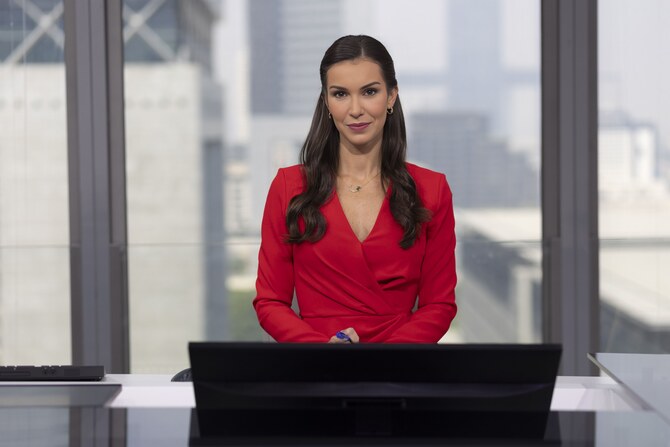

DUBAI: Joumana Bercetche’s career as a news anchor is about more than just presenting financial headlines, it is about telling the story of the Arab world to the West.
As the new host of Bloomberg’s “Horizons Middle East and Africa,” Bercetche has become one of the leading voices of the region in the international media.
Her job goes beyond covering markets and geopolitical events; it is also about breaking down complex narratives and fostering understanding between two distinct cultures.
“I see my role as two-fold: I am a host that covers economic and geopolitical issues but I am also a storyteller and I have a real opportunity to tell stories from the region,” she told Arab News.
“There is so much energy in this part of the world. The fact that I can speak and connect to people in Arabic makes them at ease and feel more comfortable to speak to me.”
Born in the UK and raised in Lebanon, Bercetche’s deep ties to both the Arab world and the West have helped her navigate the complexities of explaining the Middle East on a global stage.
After earning a degree in Economics from the American University of Beirut, she spent more than a decade working in London’s financial sector, at institutions such as Citigroup, Goldman Sachs and Merrill Lynch, before switching careers to pursue journalism in 2017.
“I enjoyed what I was doing in banking but I felt too boxed in playing a certain role. I felt I had more ability of going broader in the topics I was interested in,” Bercetche said.
In 2016, therefore, she began to think about other opportunities that might suit her skill set.
“I asked myself, what would I like to do? I am interested in markets, I am curious, I like to chat with people and I like to communicate. But being a broadcast journalist wasn’t necessarily the path I was thinking of pursuing.”
In fact, her foray into journalism came about by chance. After creating research videos for former employer Citigroup, her work caught the eye of someone in the media industry who asked if she had ever considered a career in broadcast journalism.
“I decided to give it a try,” Bercetche said. “Changing paths and careers requires a leap of faith. I was excited but anxious as well. I thought, ‘What if I don’t become successful? What if this isn’t the right move to make?’ But then, in the worst case I could always go back to my banking job, so I took my leap of faith.”
The leap paid off. After working as a CNBC anchor in London, Bercetche joined Bloomberg in Dubai in February this year and is now one of the few Arab women who hold prominent positions in the international business media.
As a show host on a channel that reaches more than 400 million households worldwide, she views her role as a unique chance to share stories about the rapid transformations in the region, particularly as countries such as the Saudi Arabia and the UAE pursue bold development initiatives.
“You get the sense that something is being built,” Bercetche said. “You have Saudi Arabia’s Vision 2030, you have the UAE and other neighboring countries also working on their own visions, you walk around and see all this construction — there is excitement in the air.”
Moving from London to Dubai was another significant life decision but Bercetche feels a deep connection with the region and its future.
“There is a sense that it’s a period of development,” she said. “You can see the transformative impact of the high-level decision-makers.”
Despite her success, the transition to such a high-profile career was not without its challenges, and as a TV anchor she said she has learned to develop “a thick skin” when dealing with public scrutiny.
“If someone is criticizing you, consider the source,” she said. “Is it coming from someone you respect? Is it constructive? If the answer is yes, then take it on.
“If it’s being directed indiscriminately from someone who’s lashing out at you from some unknown profile online, ignore it.”
Bercetche is a strong advocate for the role of women in media, particularly in terms of balancing a career with family life. While she acknowledges the support she has received from female bosses throughout her career, she admits that juggling her job as a news anchor with motherhood has been her greatest challenge.
“Becoming a mother has been the biggest gift to me,” she said. “There is a lot of pressure on working parents to find the right balance between home and work life.
While she dedicates most of her time to her young children, she especially takes advantage of any extra time she gets from finishing early on some days. “It’s always a balancing act; it’s not easy. You never fully get over the guilt, you just park it,” she said.
Reflecting on the milestones in her career so far, Bercetche said that success is a moving target, depending on the phase of one’s life.
“Starting my career in London was an experience in itself,” she added. “As for my journalism career, I am proud of what we’ve done, collectively as a team, in such a short period of time so far. A milestone’s a moving target.”
Her advice to aspiring journalists is simple: “Work hard. You have to be curious and remember the most useful question to ask: ‘Why?’
“Try to get to the bottom of the facts and get a convincing answer. Learn from your mistakes. Nobody’s flawless but it’s how you respond to the mistakes that will determine the success and longevity of your career. Be patient; things happen in due time.”