

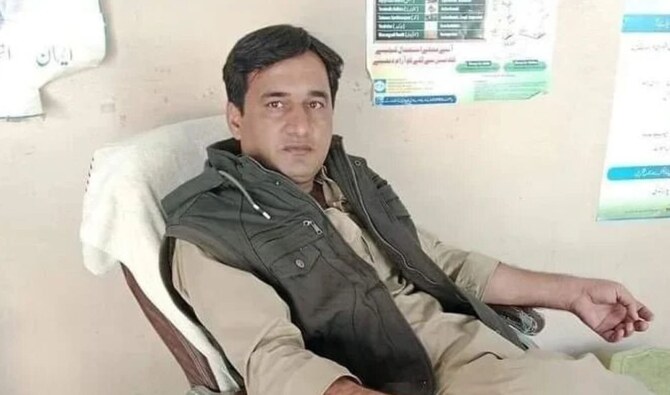

MULTAN: The provincial government in Pakistan’s Sindh province said on Thursday police had orchestrated the killing of a doctor who was in custody after he was accused of blasphemy, marking the first time the government has accused security forces of what the doctor’s family and rights groups have called an extrajudicial killing by police.
According to the provincial interior minister, Ziaul Hassan, a government probe concluded that Shah Nawaz, a doctor from Sindh province, was killed shortly after he gave himself up to authorities in what was a staged “fake encounter” engineered by security forces.
There was no shootout with armed men as police had claimed, Hassan told reporters at a news conference in the southern port city of Karachi, and added that Nawaz’s family would be able to file murder charges against the police officers who killed him.
Hours after Nawaz was fatally shot and his body handed over to his family, a mob snatched it from Nawaz’s father and burned it.
Hassan’s statement backed up Nawaz’s family’s allegations earlier this week that officers had lied about the circumstances of his death when they said he was killed in a shootout between police and armed men.
Shah Nawaz had given himself up to police last week in the district of Mirpur Khas, following assurances that he would be given a chance to prove his innocence.
Days earlier in the city of Umerkot, a mob claimed he had insulted Islam’s Prophet Muhammad and shared blasphemous content on social media, and demanded his arrest. The mob also burned Nawaz’s clinic.
Accusations of blasphemy — sometimes even just rumors — can spark riots and mob rampages in Pakistan. Although killings of blasphemy suspects by mobs are common, extra-judicial killings by police are rare.
Under Pakistan’s controversial blasphemy laws, anyone found guilty of insulting Islam or Islamic religious figures can be sentenced to death — though authorities have yet to carry out a death sentence for blasphemy.
Nawaz’s father thanked the government for backing the family and demanded that his son’s killers face justice under the eye-for-an-eye concept under Sharia, or Islamic law.
“We have only one demand: those police officers who staged the killing of my son ... must also be killed in the same manner,” said Nawaz’s father, Mohammad Saleh.
Saleh told The Associated Press over the phone that he was grateful for all the support that the family was given and to all those who condemned extremist clerics who had enraged the mob with calls for his son to be killed.
“Those who killed my son should be punished quickly so that others learn a lesson and not indulge in extra-judicial killings in the future,” Nawaz’s mother, Rehmat Kunbar, said.
She added that her son can no longer come back to her but that she wanted to save the children of other parents from the hands of “extremists.”
Nawaz’s killing was the second case of an extra-judicial killing by police this month in Pakistan.
A week before, an officer opened fire inside a police station in the southwestern city of Quetta, fatally wounding Syed Khan, a suspect held on accusations of blasphemy.
Khan was arrested after officers rescued him from an enraged mob that claimed he had insulted Islam’s prophet. But he was killed by a police officer, Mohammad Khurram, who was quickly arrested.
However, the tribe and the family of the slain man later said they had pardoned the officer.


