Pakistan PM urges Security Council to end Israel’s ‘genocidal war’ in Gaza, demands sanctions

Palestinians search for survivors amid the rubble of a building, which collapsed after Israeli bombardment on a building adjacent to it, in the Sheikh Radwan neighborhood in Gaza City on September 23, 2024, amid the ongoing war between Israel and the Hamas group. (AFP)
Short Url
Updated 26 September 2024
Follow

Pakistan PM urges Security Council to end Israel’s ‘genocidal war’ in Gaza, demands sanctions

  • The prime minister says the world body can no longer ignore the ‘festering’ dispute in Kashmir
  • Sharif seeks effective measures against the ‘resurgence of the threat of terrorism from Afghanistan’

ISLAMABAD: Prime Minister Shehbaz Sharif urged the United Nations Security Council to end Israel’s “genocidal war” against the people of Palestine and impose sanctions against it while participating in the “Leadership for Peace” debate on Wednesday.
Israel launched a military operation in Gaza following a surprise attack by Hamas on October 7, 2023, which the group said was in response to the worsening conditions faced by Palestinians under Israeli occupation.
Since then, the conflict has claimed over 43,000 lives, including a significant number of women and children, according to Palestinian health officials.
World bodies, including the International Court of Justice, have condemned Israel’s occupation of Palestinian territories and criticized the conduct of the war, which has targeted hospitals and residential areas, leading to disproportionate civilian casualties.
“We must compel Israel to halt its genocidal war in Gaza and prevent its attempt to provoke a wider conflict in the Middle East,” the prime minister said in a brief statement. “It is time to consider sanctions against Israel, including an arms and trade embargo.”
“It is time to hold its leadership accountable for its crimes against the Palestinian people,” he added.
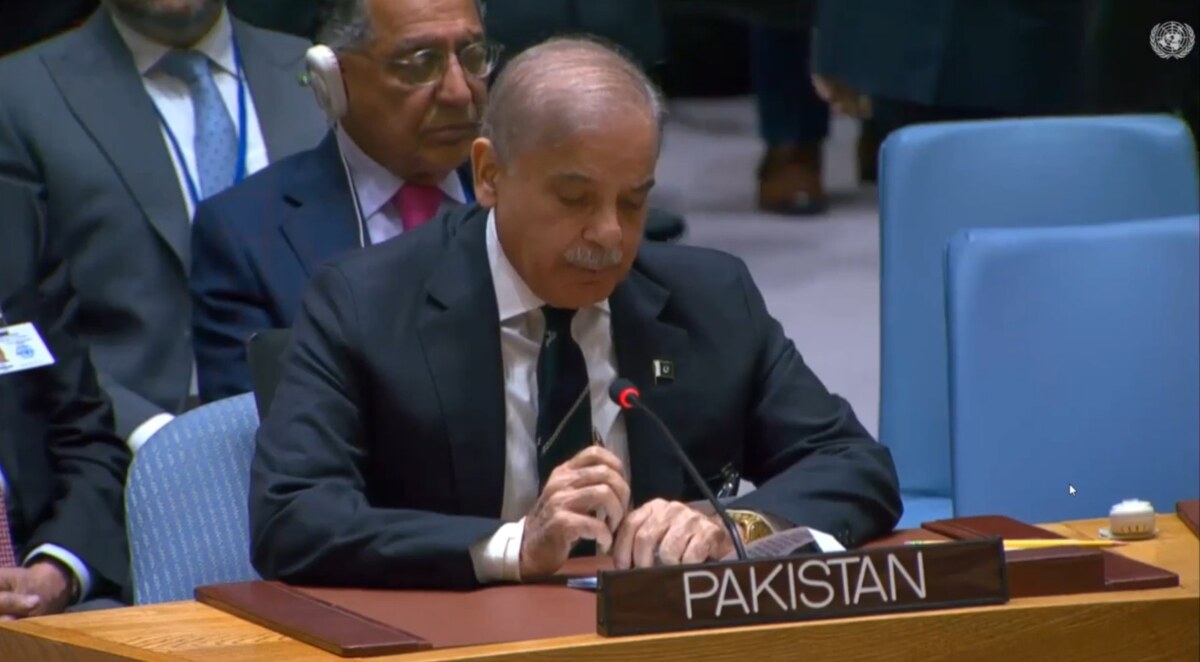


Pakistan Prime Minister Speaks during UN Security Council’s open debate on “Leadership for Peace” on the sidelines of 79th UNGA in New York on September 25, 2024. (Screengrab/UN)

The prime minister noted that proliferating wars in the Middle East and Europe along with great power rivalries and growing poverty were threating the foundations of world order.
He urged the Security Council to develop an impartial plan for a ceasefire and peaceful solution for the war in Ukraine and not allow its prolongation or escalation.
Sharif also discussed the situation in Indian-administered Kashmir, saying the UN could no longer ignore the “festering” dispute.
“It poses an ever present threat to international peace and security,” he maintained. “The Council must call for a halt to the massive violations of the fundamental rights of the Kashmiri people and implement its own resolutions that demand a plebiscite for self-determination in Kashmir.”
The prime minister expressed concern over the regional security situation, asking the world body to “effectively address the resurgence of the threat of terrorism from Afghanistan” while mentioning Daesh and Tehreek-e-Taliban Pakistan.
He called for “zero tolerance” for the illegal use of force and revival of global efforts to halt and reverse the arms race in nuclear and conventional weapons, promising his country’s full cooperation with other member states to pursue these objectives.

The prime minister later met with Palestinian President Mahmoud Abbas and later told the media that ” the sacrifices of Palestinian brothers and sisters, their patience, their bravery will not go [to] waste and Insha’Allah it will result in [the] independent State of Palestine.”
Abbas also acknowledged Pakistan’s unstinting support, saying it began even before 1948.
“Their [the Pakistani] position is fully with the Palestinian people and they help the Palestinian people as much as they can,” he added.


Pakistan offers Kyrgyzstan Arabian Sea access as two states sign 15 cooperation accords

Updated 05 December 2025
Follow

Pakistan offers Kyrgyzstan Arabian Sea access as two states sign 15 cooperation accords

  • Pakistan and Kyrgyzstan sign MOUs spanning trade, energy, agriculture, ports, education, security cooperation
  • Kyrgyz president is on first visit to Pakistan in 20 years as both sides push connectivity and CASA-1000 power links

ISLAMABAD: Pakistan on Thursday offered Kyrgyzstan the shortest and most economical route to the Arabian Sea as the two countries signed 15 agreements and memoranda of understanding aimed at boosting cooperation across trade, energy, agriculture, education, customs data-sharing and port logistics.

The accords were signed during a visit to Islamabad by President Sadyr Zhaparov, the first by a Kyrgyz head of state to Pakistan in two decades, and part of Islamabad’s renewed push to link South Asia with landlocked Central Asian economies through ports, power corridors and transport routes.

For Pakistan, Kyrgyzstan offers access to hydropower through CASA-1000, a $1.2 billion regional electricity transmission project designed to carry surplus summer electricity from Kyrgyzstan and Tajikistan through Afghanistan into Pakistan. For Bishkek, Pakistan provides overland access to warm-water ports on the Arabian Sea, creating a shorter commercial route to global markets.

“President Asif Ali Zardari has reiterated Pakistan’s readiness to offer Kyrgyzstan the shortest and most economical route to the Arabian Sea,” Radio Pakistan reported after Zhaparov met the Pakistani president. 

The two leaders also discussed expanding direct flights to deepen business, tourism and people-to-people ties.

Zardari welcomed Kyrgyzstan’s completion of its segment of the CASA-1000 project and “reaffirmed Pakistan’s commitment to completing its part of the project, which is now at an advanced stage,” the state broadcaster said. 

Zhaparov thanked Islamabad for supporting Bishkek’s candidacy for a non-permanent UN Security Council seat and invited Zardari to visit Kyrgyzstan at a time of his convenience. Both sides expressed satisfaction with progress under the Quadrilateral Traffic in Transit Agreement, designed to facilitate road movement between Pakistan, Kyrgyzstan, Kazakhstan and China.

Earlier, both governments exchanged 15 sectoral cooperation documents covering commerce, mining, geosciences, power, agriculture, youth programs, the exchange of convicted persons, customs electronic data systems and a sister-city linkage between Islamabad and Bishkek.

According to APP, the MOUs were signed by ministers representing foreign affairs, commerce, economy, energy, power, railways, interior, culture, health and tourism. Agreements also covered cooperation between Pakistan’s Foreign Service Academy and the Diplomatic Academy of Kyrgyzstan, as well as collaboration between universities, youth ministries and cultural institutions.

“Our present mutual trade, comprising of about $15–16 million will be enhanced to $200 million in the next two years,” Prime Minister Shehbaz Sharif said after the agreements were signed, calling them “a framework for structured, result-oriented engagement and closer institutional linkages.”

Sharif said Pakistan was ready to serve as a maritime outlet for the landlocked Central Asian republic, offering access to Karachi, Port Qasim and Gwadar to help Kyrgyz goods reach regional and global markets.