Turkiye’s Erdogan tells Lebanese PM urgent international solution needed to stop Israel

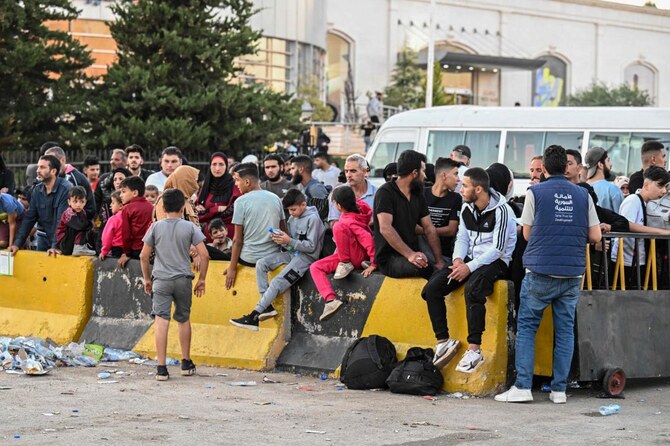
People fleeing from Lebanon arrive on the Syrian side of the border with Lebanon in Jdeidat Yabus in southwestern Syria on Sept. 25, 2024. (AFP)
Short Url
Updated 25 September 2024
Follow

Turkiye’s Erdogan tells Lebanese PM urgent international solution needed to stop Israel

  • Erdogan has previously condemned Israeli attacks on Lebanese territory
  • He called for international steps to halt Israel’s war in Gaza and cross-border fire with Hezbollah

ANKARA: Turkish President Tayyip Erdogan told Lebanese Prime Minister Najib Mikati on Wednesday that the international community must urgently implement a solution to stop Israel’s aggression, the Turkish presidency said, adding he had also voiced support for Lebanon.
A NATO member, Turkiye has denounced Israel’s devastating military offensive in Gaza prompted by Palestinian militant group Hamas’ cross-border attack last Oct. 7.
Turkiye halted all trade with Israel and applied to join a genocide case against Israel at the World Court. Israel has said the genocide accusations are baseless and has repeatedly denied targeting civilians.
Erdogan has previously condemned Israeli attacks on Lebanese territory, which Israel says are targeting Hezbollah fighters and infrastructure, and has called for international steps to halt Israel’s war in Gaza and cross-border fire with Hezbollah.
Turkiye’s presidency said Erdogan told Mikati in a meeting on the sidelines of the UN General Assembly in New York that the international community must urgently implement a solution to stop “Israel’s aggression.”
“President Erdogan said Israel was disregarding fundamental human rights, committing a genocide in front of the world, noting that stopping this and the humanitarian crisis that emerged as a result of the attacks was a humanitarian duty,” the presidency said in a statement.
Earlier, Turkish Foreign Minister Hakan Fidan told Lebanese counterpart Abdallah Bou Habib in New York that Israel’s attacks in Lebanon were “unacceptable” and meant to “drag the region into chaos,” according to the Turkish diplomatic source.
Bou Habib thanked Fidan for a Turkish shipment of medicine that arrived in Lebanon on Wednesday, the source added, and also briefed Fidan on the latest developments in Lebanon.
Separately, Fidan told a G20 foreign ministers meeting in New York that it was unclear whether the fighting between Israel and Hezbollah would spread further, though the world was facing a wider conflict.
Fidan also reiterated Ankara’s long-standing call to reform the UN Security Council to make it “fully effective,” adding Turkiye wanted to see a structure in which “one country’s veto does not determine another’s destiny,” the source added.
The United States, Russia, China, France and Britain are the permanent, veto-wielding members of the Security Council. There are 10 non-permanent members that serve two-year terms.


Why did Xi hold back-to-back calls with Putin, Trump?

Updated 4 sec ago
Follow

Why did Xi hold back-to-back calls with Putin, Trump?

BEIJING: China’s leader Xi Jinping held back-to-back calls with Russia’s Vladimir Putin and US President Donald Trump this week, timing analysts said on Thursday was rare and significant as Beijing positions itself as a stable global power.
Here is what to know about the talks:
Why on the same day?
Xi’s video call with Putin on Wednesday afternoon was followed just hours later by a phone call with Trump.
“The timing of the call is rare and interesting. It is not common for Xi to have two calls with Putin and Trump,” George Chen, a partner at The Asia Group wrote in an online commentary.
Xi and Putin spoke for 1.5 hours, according to the Kremlin’s foreign policy aide, while Trump said they had a “long and thorough” conversation.
“It does demonstrate that Xi can hold court and easily pick up the phone to speak with the two ‘strong’ leaders of the world,” said Dylan Loh, an associate professor at Singapore’s Nanyang Technological University.
Russia and the United States are two of the “most consequential” countries to China, Loh said, though he cautioned that the timing could have been “a simple scheduling issue.”
What was discussed?
Trump said he and Xi discussed trade, Russia’s war in Ukraine and Iran.
He also said that China had committed to increasing soybean purchases from the United States to 20 million tons in the current season.
The call confirmed that “in spite of what’s happened around the world, there is going to be a short-term tactical stabilization of US-China relations,” Loh said.
The purchase of soybeans, he said, is a “low-hanging fruit.”
On Taiwan, however, Xi warned Washington to exercise caution in arms sales to the self-ruled island, which Beijing claims as its own territory and has vowed to retake by force if necessary.
Taiwan’s Deputy Foreign Minister Chen Ming-chi told AFP that “we don’t worry too much about this whole telephone communication.”
“In fact, we believe that it will contribute to stabilize the situation,” he said.
Meanwhile, Xi and Putin hailed the strengthening of Chinese-Russian ties as they try to present a united front against the West.
The two countries have drawn closer since Russia’s 2022 invasion of Ukraine, which left Moscow diplomatically isolated.
The calls took place as Russian, Ukrainian and US negotiators met in Abu Dhabi for a new round of talks on ending the almost four-year war.
Putin and Xi discussed their “opinions” on the United States, and “special attention was given to the tense situation in Iran,” the Kremlin said.
How important were the talks?
Xi is seeking to position himself as equidistant from Putin and Trump, Ho said.
“China is trying to seek international maneuver space to ensure that whatever happens globally, it does not get fenced into a corner,” he told AFP.
Domestically, China is reeling from a recent corruption probe into Zhang Youxia, a top military general in the People’s Liberation Army, which sent shockwaves through defense observers.
Analysts said that while Zhang’s investigation would likely not have been discussed with Putin and Trump, the timing of the calls could be a way for Xi to project confidence domestically.
Faced with uncertain and fragile domestic conditions, the “two-timing” calls were “probably for domestic posturing to demonstrate Xi’s political standing in the global theater,” Ho said.
What do the calls mean for ties?
Putin accepted invitations during the call to visit China in the first half of 2026, according to the Kremlin, while Trump said he was looking forward to his previously announced trip to Beijing in April.
Putin will also attend the APEC regional summit hosted by Xi in November.
The calls follow a slew of recent meetings between Xi and various leaders, as he seeks to present China as a stable alternative to Washington.
Some analysts cautioned that China-Russia relations “are not ironclad” while both Beijing and the mercurial Trump administration could yet make unattainable demands of each other.
Neither the US nor China will fully commit to Russia, as “both are primarily focused on stabilising their bilateral relationship,” said Yue Su at the Economist Intelligence Unit.
“Meaningful Chinese cooperation would likely require a very attractive deal from the US in exchange.”