

Lebanese celebrities and entrepreneurs speak out for Lebanon

Lebanese celebrities and entrepreneurs including Razane Jammal, Karen Wazen and Jessica Kahawaty have taken to social media to raise awareness and express their concerns over Lebanon. (Instagram)
Short Url
Updated 25 September 2024
Follow

Lebanese celebrities and entrepreneurs speak out for Lebanon

DUBAI: Amid the ongoing Israeli assault on Lebanon, Lebanese celebrities and entrepreneurs including Razane Jammal, Karen Wazen and Jessica Kahawaty have taken to social media to raise awareness and express their concerns.

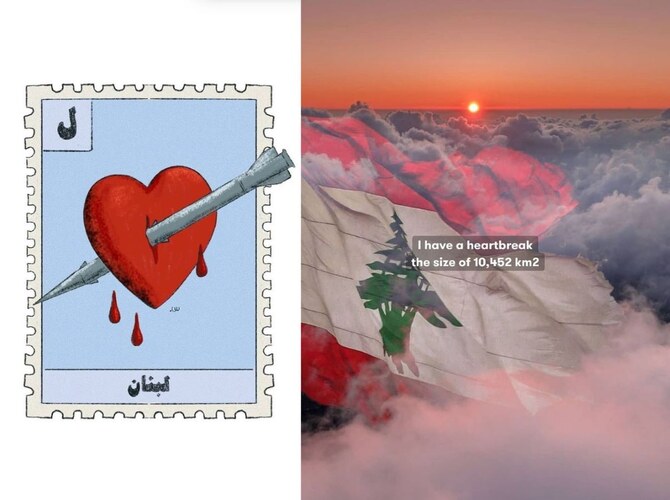
British Lebanese actress Jammal, who played Lyta Hall in the 2022 Netflix adaptation of Neil Gaiman’s “The Sandman,” took to Instagram to share a piece of art that depicted a bleeding heart on a stamp of Lebanon, captioning the post, “No words. Just bleeding.”

She also posted a video from an earlier interview with Elle Arabia where she talks about the resilience of Lebanese people. She captioned the post with a quote from her interview, “I really have hope for us. I know it’s very dark, but I have hope for my people, and I have hope for my country. There is no other way… life is hope.”

 Dubai-based Lebanese influencer and entrepreneur Karen Wazen also took to Instagram to share a lengthy statement.

“From the moment we were born, war has been a reality,” she wrote. “Being Lebanese means distinguishing the sounds of an explosion, from the roar of fighter jets, the crackle of fireworks, and the breaking of sound barriers.

“Do not normalize Lebanese’ suffering. Despite our strength, we are not okay, and should not be okay,” she continued. “Do not normalize forced displacement, war crimes and human rights violations.

“Today we are all Lebanese, we are all victims of injustice, dirty politics, terrorism, racism and impunity… until when?”

 Australian Lebanese model and entrepreneur Kahawaty took to Instagram to address her more than 1.5 million followers.

“For my non-Lebanese friends, I want to tell you a little story about Lebanon. It is a small country, only 10,452 km squared which is roughly the size of New York or Tokyo. A whole country, the size of one of these popular cities. For as long as I can remember and for many years before my arrival to this world, Lebanon has been a pawn in a greater fight. My country hasn’t known peace… ever,” she began.

“I ask you all to pray for Lebanon. Our people are suffering immensely, and our hearts are broken,” she added, as she requested readers to listen to her all-time favourite excerpts of a speech by American political scientist, Michael Parenti, which she posted on social media. “This is relevant to not just Lebanon but so many countries in the world subject to the evils of… you know who.”

The speech slammed former colonial powers, saying “poor countries are not ‘under-developed,’ they are over-exploited.”


Review: ‘Sorry, Baby’ by Eva Victor

Eva Victor appears in Sorry, Baby by Eva Victor, an official selection of the 2025 Sundance Film Festival. (Supplied)
Updated 27 December 2025
Follow

Review: ‘Sorry, Baby’ by Eva Victor

  • Victor makes a deliberate narrative choice; we never witness the violence of what happens to her character

There is a bravery in “Sorry, Baby” that comes not from what the film shows, but from what it withholds. 

Written, directed by, and starring Eva Victor, it is one of the most talked-about indie films of the year, winning the Waldo Salt Screenwriting Award at Sundance and gathering momentum with nominations, including nods at the Golden Globes and Gotham Awards. 

The film is both incisive and tender in its exploration of trauma, friendship, and the long, winding road toward healing. It follows Agnes, a young professor of literature trying to pick up the pieces after a disturbing incident in grad school. 

Victor makes a deliberate narrative choice; we never witness the violence of what happens to her character. The story centers on Agnes’ perspective in her own words, even as she struggles to name it at various points in the film. 

There is a generosity to Victor’s storytelling and a refusal to reduce the narrative to trauma alone. Instead we witness the breadth of human experience, from heartbreak and loneliness to joy and the sustaining power of friendship. These themes are supported by dialogue and camerawork that incorporates silences and stillness as much as the power of words and movement. 

The film captures the messy, beautiful ways people care for one another. Supporting performances — particularly by “Mickey 17” actor Naomi Ackie who plays the best friend Lydia — and encounters with strangers and a kitten, reinforce the story’s celebration of solidarity and community. 

“Sorry, Baby” reminds us that human resilience is rarely entirely solitary; it is nurtured through acts of care, intimacy and tenderness.

A pivotal scene between Agnes and her friend’s newborn inspires the film’s title. A single, reassuring line gently speaks a pure and simple truth: “I know you’re scared … but you’re OK.” 

It is a reminder that in the end, no matter how dark life gets, it goes on, and so does the human capacity to love.