Shakib available for second India Test, says Bangladesh coach

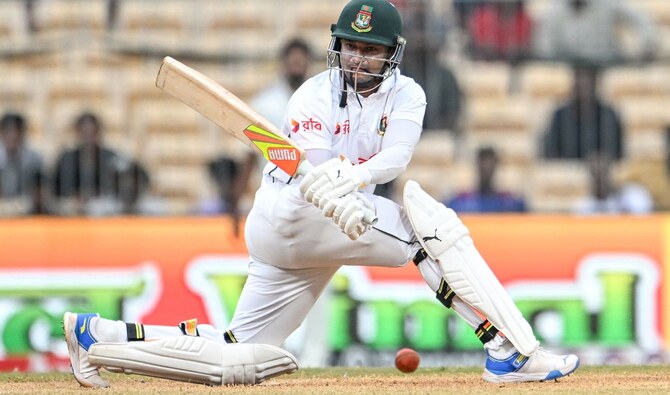
Bangladesh's Shakib Al Hasan plays a shot during the third day of the first Test cricket match between India and Bangladesh at the M.A. Chidambaram Stadium in Chennai on September 21, 2024. (AFP/File)
Short Url
Updated 25 September 2024
Follow

Shakib available for second India Test, says Bangladesh coach

  • Media reports suggested Shakib Al Hasan played first Test with finger injury
  • Shakib faces alleged murder case at home after Bangladesh plunged into political crisis

KANPUR, India: Star Bangladesh all-rounder Shakib Al Hasan has no injury concerns and remains in line to play the second Test against India, coach Chandika Hathurusinghe said on Wednesday.

Media reports suggested Shakib played the first of two Tests with a finger injury when India handed Bangladesh a 280-run thrashing in Chennai.

Former Sri Lanka all-rounder Hathurusinghe said “there was no doubt” over Shakib’s participation in the second Test, which begins on Friday.

“At the moment I have not heard anything about any sort of injury — neither from the physio nor from anyone else,” Hathurusinghe told reporters in Kanpur, where the Test will be played.

“And he is eligible for selection. If there are any changes (in the team) then it’s depending on the surface.”

The heat has been on Shakib, a 37-year-old former lawmaker who faces a case of alleged murder back home after Bangladesh was plunged into political crisis by student-led protests that led to the ouster of autocratic former leader Sheikh Hasina.

The left-hander, who bats in the middle-order and bowls spin, played a key role in his team’s historic Test series sweep in Pakistan.

He then went back to England to play county cricket for Surrey instead of returning home ahead of the India tour.

Shakib made 32 and 25 with the bat in the first Test but went wicketless with the ball.

“I’m not upset about his performance, but our overall performance. I am sure he also thinks he can perform better. We all know what he is capable of,” Hathurusinghe said.

“I think he batted really well in the second innings. He couldn’t go on, not because of lack of pride but for the sheer quality of the opposition.”

Bangladesh were bowled out for 149 and then 234 to lose the match inside four days.

India, led by Rohit Sharma, will be looking to extend their advantage at the top of the World Test Championship rankings after their emphatic first Test performance.

They will host New Zealand for three Tests starting next month before their high-profile tour of Australia, where they will play five matches.

But Rookie Akash Deep — a new addition to India’s fast bowling riches of Jasprit Bumrah and Mohammed Siraj — said he was focused on the task at hand.

“As a player, you need to understand yourself and know your strengths,” said Deep, who took two wickets in the previous match, which was just his second Test.

“What can we add to the bowling? Just simple stuff and no added pressure about going to Australia and all that.”

“It is a huge responsibility to deliver the goods like the bowlers who have contributed for India before you,” he said.

The pitch at Kanpur’s Green Park stadium is expected to be slow and low, with spin expected to play a part by day three.

Irrespective of the surface, Deep said his job would be to “keep the ball in good areas and get wickets.”


MESIF 2026 wraps up in Riyadh with spotlight on legacy, fans and sustainable sports growth

Updated 28 January 2026
Follow

MESIF 2026 wraps up in Riyadh with spotlight on legacy, fans and sustainable sports growth

  • A recurring theme in panel discussions was the importance of moving beyond siloed planning toward connected strategies
  • Abdullah Aldrees: I believe Saudi is a sleeping giant within the football ecosystem because of the high demand that exists

RIYADH: The sixth edition of the Middle East Sports Investment Forum concluded on Jan. 28 in Riyadh, reinforcing the need for long-term legacy planning, integrated infrastructure development and fan-centric strategies as the region’s sports ecosystem continues to mature.

Held over two days — Jan. 27-28 — at the ministry of investment headquarters and the Kingdom Arena, the forum brought together senior government officials, global sports executives, investors and technology leaders to assess how the Middle East — and Saudi Arabia in particular — can translate major event hosting and increased investment into sustainable impact.

A recurring theme in panel discussions was the importance of moving beyond siloed planning toward connected strategies that link infrastructure, finance, fan engagement and legacy from the earliest stages of project development.

Dr. Sakis Batsilas, deputy CEO of FIFA World Cup Qatar 2022, stressed that while international expertise has played a key role in the region’s rapid progress, long-term success depends on knowledge transfer and talent development.

“Yes, we do need experts and consultants and expatriates to help,” he said. “But the main, I would say, focus, is how we ensure that we transfer this knowledge and we build talent … to make sure we have the right talent.”

Drawing on his experience delivering major global events, Batsilas highlighted the need to embed legacy considerations during the bidding phase.

“Talking now from an operational point of view … I think everything starts with a bidding phase,” he said, adding that stronger legacy metrics would encourage greater long-term planning from host nations and rights holders alike.

Fan experience and commercialization also featured prominently, particularly as Saudi Arabia continues to expand its domestic leagues and host major international competitions. David Davies, chief experience officer of Catapult, said the Kingdom’s challenge lies in converting strong digital fandom into sustained in-stadium engagement.

“Saudi Arabia is … ranked consistently in the highest in the world” in terms of football fandom, Davies said. “However, attendance in-stadium is still developing.” He noted that younger, digitally native audiences require tailored engagement strategies. “The days of being able to ask them to come to you have gone,” he said.

From a government and delivery perspective, Abdullah Aldrees, chief of staff at the vice minister’s executive office at the ministry of sport, said MESIF highlighted the scale of opportunity ahead — and the importance of a joined-up approach.

“I believe Saudi is a sleeping giant within the football ecosystem because of the high demand that exists, the government support and the anchor IPs that we’re hosting,” Aldrees said. “So all of this can create a lot of opportunities for football to grow in Saudi.”

He said the Kingdom has entered a critical preparation phase as it gears up for a packed calendar of major events. “We are now living in the preparation phase. We’re preparing for all these IPs, we’re preparing for all these big events coming up,” Aldrees said. “So how do you make sure that you really reap the right benefit from them and have the right legacy?”

Pointing to upcoming milestones such as the AFC Asian Cup Saudi Arabia 2027 and the FIFA World Cup 2034, Aldrees emphasized the need to think beyond hosting.

“Yes, we’re hosting World Cup. We’re hosting Asia 2027, but how do you make sure that they have a long, lasting impact on the ecosystem?” he said.

Echoing a key message from the forum, Aldrees concluded: “The effective strategy is to be looking at these things together. We no longer can be looking at them as silos and test cycles.”

The transformation of Saudi football was also highlighted as a reflection of broader cultural and structural change. Juan Esteban Gomez, a football expert specializing in digitalization and artificial intelligence, said the shift has been tangible in recent years. “The people here are breathing football,” he said, describing the Saudi league as “one of the most enjoyable competitions in the world.”

As MESIF 2026 drew to a close, participants agreed that the next phase of sports investment in the Middle East will be defined by execution — ensuring that capital, policy and innovation align to deliver measurable legacy, deeper fan engagement and resilient ecosystems capable of sustaining growth well beyond headline events.