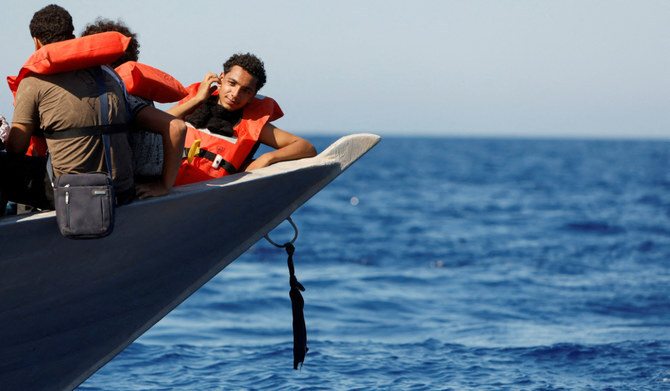
TUNIS: Thirteen bodies believed to be of sub-Saharan African migrants have been found dead off Tunisia’s eastern coast, a judicial official told AFP on Wednesday.
The bodies were found Tuesday and Wednesday off the coastal towns of Salakta and Chebba, said Farid Ben Jha, the spokesman for the public prosecution in the Monastir and Mahdia governorates.
He added that an investigation has been opened but provided no further details.
Tunisia and neighboring Libya have become key departure points for migrants, often from other countries, who risk perilous Mediterranean Sea journeys in the hopes of reaching better lives in Europe.
Each year, tens of thousands of people attempt to make the crossing, with Italy — whose Lampedusa island is only 150 kilometers (90 miles) from Tunisia — often their first port of call.
Since January 1, at least 103 makeshift boats have capsized, and 341 bodies have been recovered off Tunisia’s coast, according to the interior ministry.
More than 1,300 people died or disappeared last year in shipwrecks off the North African country, according to the Tunisian FTDES rights group.
The International Organization for Migration has said that more than 30,309 migrants have died in the Mediterranean in the past decade, including more than 3,000 last year.

13 migrants found dead off Tunisia: official
https://arab.news/w7qay
13 migrants found dead off Tunisia: official
- The bodies were found Tuesday and Wednesday off the coastal towns of Salakta and Chebba
- Since January 1, at least 103 makeshift boats have capsized, and 341 bodies have been recovered off Tunisia’s coast
Algeria inaugurates strategic railway to giant Sahara mine
- The mine is expected to produce 4 million tons per year during the initial phase, with production projected to triple to 12 million tons per year by 2030
- The project is financed by the Algerian state and partly built by a Chinese consortium
ALGEIRS: Algerian President Abdelmadjid Tebboune on Sunday inaugurated a nearly 1,000-kilometer (621-mile) desert railway to transport iron ore from a giant mine, a project he called one of the biggest in the country’s history.
The line will bring iron ore from the Gara Djebilet deposit in the south to the city of Bechar located 950 kilometers north, to be taken to a steel production plant near Oran further north.
The project is financed by the Algerian state and partly built by a Chinese consortium.
During the inauguration, Tebboune described it as “one of the largest strategic projects in the history of independent Algeria.”
This project aims to increase Algeria’s iron ore extraction capacity, as the country aspires to become one of Africa’s leading steel producers.
The iron ore deposit is also seen as a key driver of Algeria’s economic diversification as it seeks to reduce its reliance on hydrocarbons, according to experts.
President Tebboune attended an inauguration ceremony in Bechar, welcoming the first passenger train from Tindouf in southern Algeria and sending toward the north a first charge of iron ore, according to footage broadcast on national television.
The mine is expected to produce 4 million tons per year during the initial phase, with production projected to triple to 12 million tons per year by 2030, according to estimates by the state-owned Feraal Group, which manages the site.
It is then expected to reach 50 million tons per year in the long term, it said.
The start of operations at the mine will allow Algeria to drastically reduce its iron ore imports and save $1.2 billion per year, according to Algerian media.


