

Pakistani PM meets UN chief, condemns Israel’s ‘genocidal campaign’ against Palestine

Prime Minister Muhammad Shehbaz Sharif meets with Secretary General of the United Nations Antonio Guetrres on the sidelines of 79th session of United Nations General Assembly in New York on September 25, 2024. (PMO)
Short Url
Updated 25 September 2024
Follow

Pakistani PM meets UN chief, condemns Israel’s ‘genocidal campaign’ against Palestine

  • Shehbaz Sharif condemns Israel’s ‘catastrophic’ airstrikes on Lebanon, urges immediate ceasefire
  • Sharif discusses ‘mutually beneficial economic investments’ in a meeting with crown prince of Kuwait

ISLAMABAD: Pakistani Prime Minister Shehbaz Sharif on Wednesday met UN Secretary-General António Guterres on the side-lines of the 79th Session of the UN General Assembly and urged the international community to hold Israel accountable for its “genocidal campaign” against Palestine. 

The nearly year-long war between Israel and Palestinian group Hamas in the besieged Gaza Strip now threatens to engulf Lebanon, where Israel targeted more than a thousand Hezbollah targets this week. Since Monday, Lebanon’s deadliest day of violence in decades, the health ministry says more than 560 people, among them 50 children, have died in air barrages.

In Gaza, the latest death toll stands at over 42,183 Palestinians killed since Oct. 7.

“The Prime Minister condemned Israel’s genocidal campaign against the Palestinians, and called for an immediate and unconditional ceasefire,” Sharif’s office said in a statement after his meeting with the UN chief. 

“He also urged the international community to hold Israel accountable. He reaffirmed Pakistan’s support for the establishment of a viable and sovereign State of Palestine.”

Earlier, while speaking to media, Sharif condemned Israel’s “catastrophic” airstrikes on Lebanon and called for an immediate ceasefire.

“The recent attack launched in Beirut is nothing but a ploy to expand this war theater, which will be catastrophic for this peace-loving world,” the prime minister told reporters. “And I think we must all condemn this act on the part of Israelis.”

“Two-state solution [to the Palestine-Israel conflict] is the only answer,” he added. “Immediate ceasefire and then a two-state solution. There is no other option.”

The Israeli airstrike on Beirut killed a senior Hezbollah commander on Sept. 24 as cross-border rocket attacks by both sides increased fears of a full-fledged war in the Middle East and Lebanon said only Washington could help end the fighting. 

The UN Security Council is expected to meet later today to discuss the conflict.

BILATERAL MEETING

On Wednesday, Sharif also met with Crown Prince of Kuwait Sheikh Sabah Al-Khaled Al-Sabah and reviewed the spectrum of bilateral relations, ranging from political, economic and defense cooperation to people-people exchanges.
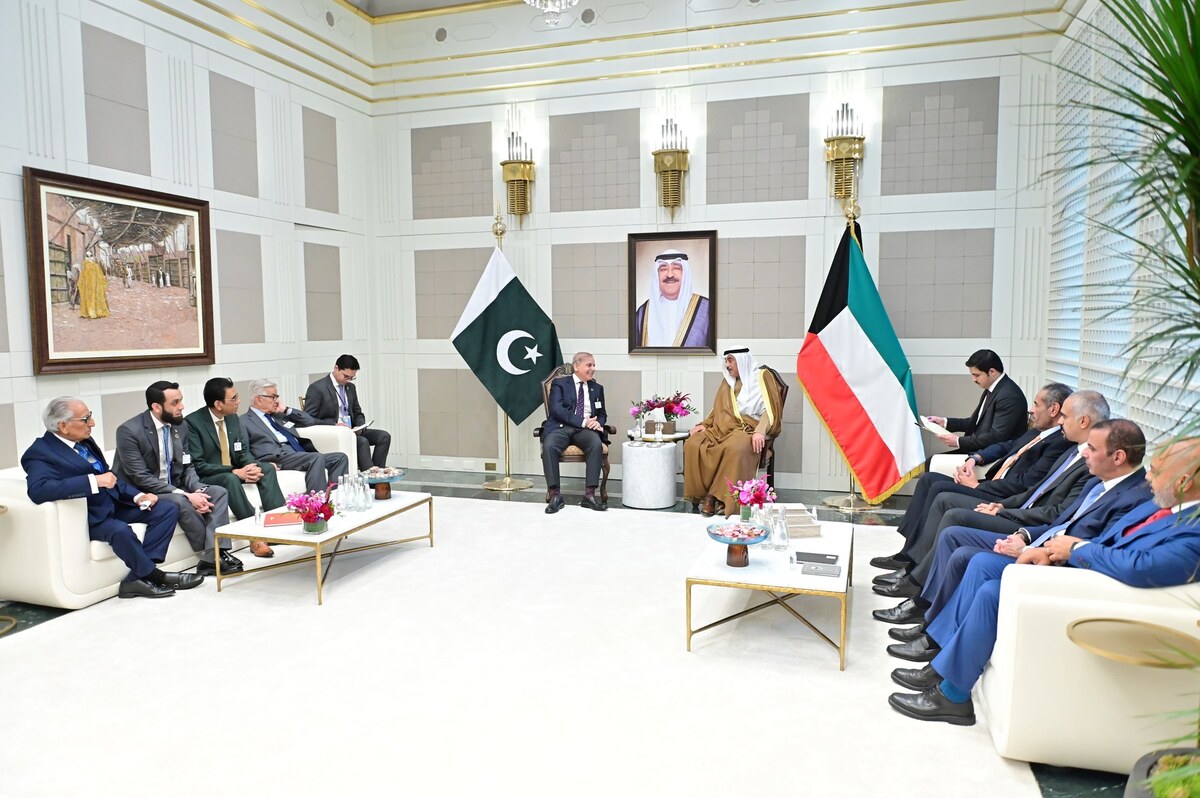


Pakistan Prime Minister Shehbaz Sharif holds a meeting with the Crown Prince of Kuwait Sheikh Sabah Al-Khaled Al-Hamad Al-Mubarak Al-Sabah on the sidelines of the 79th United Nations General Assembly Session in New York on September 25, 2024. (PMO)

Last year, Pakistan signed 10 multibillion-dollar agreements with Kuwait aimed at boosting cooperation in sectors such as trade, energy, information technology, labor and infrastructure development.

As part of the government’s broader engagement with the Middle East, these agreements included Pakistan’s request for greater recruitment of its workers in Kuwait, particularly in the fields of health, security and construction.

“The Prime Minister of Pakistan expressed his desire to engage with Kuwait in mutually beneficial economic investments under the rubric of Special Investment Facilitation Council,” his office said in a statement issued after the meeting with the crown prince, referring to a hybrid civil-military body set up last year to facilitate foreign businesses.

Both leaders said they would closely collaborate bilaterally as well as on regional and global issues of mutual interest.


World Bank approves $700 million for Pakistan’s economic stability

Updated 20 December 2025
Follow

World Bank approves $700 million for Pakistan’s economic stability

  • Of this, $600 million will go for federal programs and $100 million will ⁠support a provincial program in Sindh
  • The results-based design ensures that resources are only disbursed once program objectives are achieved

ISLAMABAD: The World Bank has approved $700 million in ​financing for Pakistan under a multi-year initiative aimed at supporting the country’s macroeconomic stability and service delivery, the bank said on Friday.

The funds will be released under the bank’s Public ‌Resources for Inclusive ‌Development — Multiphase ‌Programmatic ⁠Approach (PRID-MPA) that ‌could provide up to $1.35 billion in total financing, according to the lender.

Of this amount, $600 million will go for federal programs and $100 million will ⁠support a provincial program in ‌the southern Sindh province. The results-based design ensures that resources are only disbursed once program objectives are achieved.

“Pakistan’s path to inclusive, sustainable growth requires mobilizing more domestic resources and ensuring they are used efficiently and transparently to deliver results for people,” World Bank country director Bolormaa Amgaabazar said in a statement.

“Through this MPA, we are working with the Federal and Sindh governments to deliver tangible impacts— more predictable funding for schools and clinics, fairer tax systems, and stronger data for decision‑making— while safeguarding priority social and climate investments and strengthening public trust.”

The approval ‍follows a $47.9 ‍million World Bank grant ‍in August to improve primary education in Pakistan’s most populous Punjab province.

In November, an IMF-World Bank ​report, uploaded by Pakistan’s finance ministry, said Pakistan’s fragmented ⁠regulation, opaque budgeting and political capture are curbing investment and weakening revenue.

Regional tensions may surface over international financing for Pakistan. In May, Reuters reported that India would oppose World Bank funding for Pakistan, citing a senior government ‌source in New Delhi.

“Strengthening Pakistan’s fiscal foundations is essential to restoring macroeconomic stability, delivering results and strengthening institutions,” said Tobias Akhtar Haque, Lead Country Economist for the World Bank in Pakistan.

“Through the PRID‑MPA, we are launching a coherent nationwide approach to support reforms that expand fiscal space, bolster investments in human capital and climate resilience, and strengthen revenue administration, budget execution, and statistical systems. These reforms will ensure that resources reach the frontline and deliver better outcomes for people across Pakistan with greater efficiency and accountability.”

In Sindh, the program is expected to increase provincial revenues, enhance the speed and transparency of payments, and broaden the use of data to guide provincial decision making. The program will directly support the increase of public resources for inclusive development, including more equitable and responsive financing for primary health care facilities and more funding for schools.