ISLAMABAD: In a cramped guesthouse in Islamabad, Sadiqullah Azizi, a pseudonym for a 59-year-old Afghan refugee, last week hurriedly packed what remained of his family’s belongings. His wife and children, with little choice, helped as they prepared to vacate the premises as a result of a final, devastating blow: rejection of their case for resettlement in Canada.
Azizi’s family, comprising more than a dozen members, did not come to Islamabad by choice. In August 2021, they received an email from the Canadian authorities, instructing them to travel to Kabul’s Hamid Karzai International Airport for evacuation to Canada. That email, reviewed by Arab News, represented a lifeline that has since reduced to three years of uncertainty, fear and disappointment.
Now exhausted, Azizi recounts how he started working with the International Security Assistance Force (ISAF) in 2002, shortly after the US-led coalition toppled the first Taliban regime. Although Azizi and his family are not paying for their accommodation or meals, he says it’s far from sufficient.
“Our children are our top priority and none of them have attended school due to the uncertainty of our future,” Azizi told Arab News, with his voice cracking.
He was involved in construction and logistics, and provided critical support to the US, Canadian, Dutch and Australian forces in Kandahar, Uruzgan and Nangarhar from 2002 till 2013. He still has dozens of certificates and photos of himself alongside Western forces during their deployment in Afghanistan, but his accomplishments feel distant and hollow.
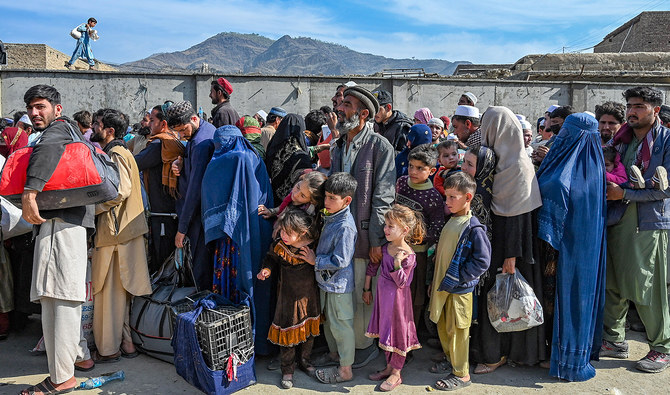
Fearing deportation, the 59-year-old doesn’t even allow his family to visit a nearby public park since the Pakistani authorities launched a crackdown on undocumented foreign nationals last November and has since deported nearly 700,000 people, the majority of whom were Afghans.
“Our [Pakistani] visas have also expired and it feels as though the ground is slipping from beneath my feet,” he shared.
More than 40,000 Afghans are still in Pakistan and awaiting their resettlement abroad, according to the Pakistani foreign office. Pakistan has been in talks with various Western nations to help facilitate the relocation process and the United States has already provided a list of 25,000 Afghans for resettlement. However, the pace of progress remains slow.
For families like Azizi’s, life in Islamabad is one of isolation. The guesthouse where they stay offers no sense of security or future.
Engineer Ahmed, another pseudonym for a 38-year-old father of six who worked as an interpreter for the US and allied forces in Afghanistan from 2009 to 2018, said they were only provided accommodation and meals at the guesthouse and no other essentials.
“In fact, the meals aren’t enough to fill our stomachs,” he said, adding that they had to buy essentials like baby diapers, milk and medicines from their own pockets.
Ahmed shared his family had sold nearly all of their belongings in Kabul as they had burned all bridges in the hope of resettling in Canada.
“We have nothing left, no house, car or motorcycle. Everything was sold at a very cheap rate,” he said.
Another 35-year-old Afghan refugee, who assumed the name Amin Nasiri, awaits his family’s relocation to the US.
“It’s been three years since we arrived in Islamabad. We have no freedom here. We can’t access government hospitals or even buy a SIM card because our visas have expired,” Nasiri, who worked as a warehouse employee at the ISAF headquarters in Kabul from 2009 to 2012, told Arab News.
The 35-year-old lives with another Afghan family along with his wife, three sons and a daughter as he could not secure an accommodation in his own name due to his lack of documentation.
“I don’t know how much longer it will take,” said Nasiri, whose case remains unresolved. “I’ve borrowed a lot of money from friends and my eyes are constantly on my phone, hoping for an email about my case, but that moment hasn’t come yet.”
As Azizi continued packing at his guesthouse in Islamabad, he wrestled with the thought of how to break the news to his grandchildren.
He shared that over the past three years, whenever a bus headed to the airport stopped at the guesthouse’s gate, he would hide it from his grandchildren to avoid their inevitable question: “When will it be our turn to leave?”
Arab News tried to speak with others awaiting resettlement, but most were unable to summon the strength to recount their three years in Islamabad.
Now, with an eviction notice looming, Azizi feels trapped.
“My only question is why did Canadian immigration take so long? If they had rejected my case in the early months, I would have returned to my country. I would have told the Taliban that I had gone for medical treatment and had now come back. But after three long years, I no longer know what excuse I can offer,” he said as his voice tinged with despair.
The Canadian High Commission in Islamabad refused to discuss specific immigration cases but sent an email in response to Arab News queries.
“Immigration, Refugees and Citizenship Canada (IRCC) sympathizes with the people in this extremely difficult situation as we continue to process applications as quickly as possible under the circumstances,” it said.
“Security screening is a complex process involving the decision of IRCC’s Migration Officer and various security partner experts,” it added. “Individuals are normally provided with a procedural fairness letter before negative decisions are made to provide them with an opportunity to provide additional information.”
The letter pointed out that how quickly an Afghan client was processed and subsequently approved depended on a variety of factors, many of which were beyond the control of the Canadian authorities, and were often directly related to where Afghans were located.
It noted that it was difficult to finalize the applications of Afghan nationals still residing in their country, urging them to move to a third country.
Meanwhile, Azizi, who complied with a similar request and arrived in Pakistan, says the fear of returning to Taliban-controlled Afghanistan weighs heavily on him.
“I wonder how Western countries can speak about human rights, yet when I look at my own case, I’m left questioning what world they live in,” he said.
“I can’t return to Afghanistan because the Taliban will think I’ve been sent on another spy mission,” he added. “Pakistan isn’t offering us refuge, and with no options left, I truly wonder where on earth we can find a place to call home.”


![]()

In Pakistan, Afghan refugees face uncertain future amid resettlement rejections
Short Url
https://arab.news/jb4h2
In Pakistan, Afghan refugees face uncertain future amid resettlement rejections
- More than 40,000 Afghans in Pakistan are currently awaiting their resettlement to Western countries, Pakistani foreign office says
- The United States has already provided a list of 25,000 Afghan refugees for resettlement, but the pace of progress remains slow
Latest updates





© 2026 SAUDI RESEARCH & PUBLISHING COMPANY, All Rights Reserved And subject to Terms of Use Agreement.