

Media freedom group sounds alarm on increased security risks for local journalists in Africa’s Sahel

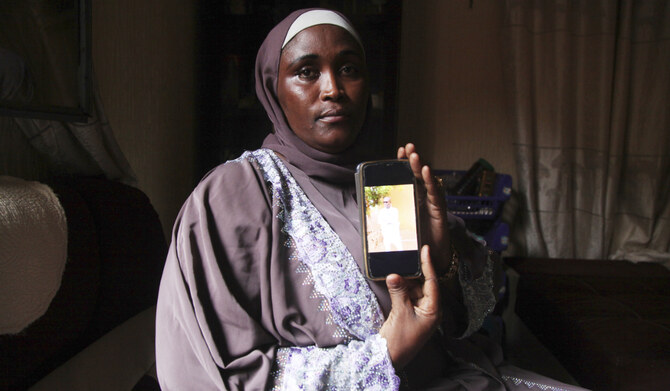
Kadidia Bocoum shows a picture of her brother Yeri Bocoum, a Malian journalist who was kidnapped by what is suspected to be state security forces after covering a march against Mali's electricity crisis, in Bamako, Mali, Tuesday, June 25, 2024. (AP)
Short Url
Updated 24 September 2024
Follow

Media freedom group sounds alarm on increased security risks for local journalists in Africa’s Sahel

  • Over the first six months of this year, 3,064 civilians were killed by the violence, according to the Armed Conflict Location and Event Data Project, a 25 percent increase compared to the previous six months
  • In June, at least three journalists in Burkina Faso disappeared under suspicious circumstances, according to the Committee to Protect Journalists

DAKAR, Senegal: Local journalists in the Sahel region of Africa are facing increased security risks, a media freedom group said Tuesday, as extremist attacks and military coups have shaken the region in recent years.
At least two community radio journalists were killed and two kidnapped by armed groups in Mali and Chad since November last year, Reporters Without Borders said in a statement calling for the protection of local journalists.
“These crimes illustrate once again the deteriorating security context in which journalists in the Sahel are working,” Anne Bocandé, the organization’s editorial director, said.
“They are still present in these territories, to which no other information professional has access any more,” she added.
Three nations in the Sahel, an arid swath of land south of the Sahara, have been wracked by coups in recent years. Mali, Niger and Burkina Faso are now ruled by military leaders who took power by force, pledging to provide more security to citizens.
But the security situation in the Sahel has worsened since the juntas took power, analysts say, with a record number of attacks and a record number of civilians killed both by militants and government forces. Over the first six months of this year, 3,064 civilians were killed by the violence, according to the Armed Conflict Location and Event Data Project, a 25 percent increase compared to the previous six months.
Meanwhile, the ruling juntas have cracked down on political dissent and journalists. Earlier this year, Malian authorities banned the media from reporting on the activities of political parties and associations. Burkina Faso suspended the BBC and Voice of America radio stations for their coverage of a mass killing of civilians carried out by the country’s armed forces.
In June, at least three journalists in Burkina Faso disappeared under suspicious circumstances, according to the Committee to Protect Journalists.
“Generally speaking, the three juntas censor the media as soon as the security situation in the country is addressed in an unpleasant manner or when abuses are revealed,” Sadibou Marong, head of the sub-Saharan Africa office of Reporters Without Borders, told The Associated Press.
“Finding reliable and neutral information on government activities has become extremely complex, as has covering security situation in these countries,” Marong added.


Malaysia, Indonesia become first to block Musk’s Grok over AI deepfakes

Updated 12 January 2026
Follow

Malaysia, Indonesia become first to block Musk’s Grok over AI deepfakes

  • Authorities in both countries acted over the weekend, citing concerns about non-consensual and sexual deepfakes
  • Regulators say existing controls cannot prevent fake pornographic content, especially involving women and minors

KUALA LUMPUR: Malaysia and Indonesia have become the first countries to block Grok, the artificial intelligence chatbot developed by Elon Musk’s xAI, after authorities said it was being misused to generate sexually explicit and non-consensual images.
The moves reflect growing global concern over generative AI tools that can produce realistic images, sound and text, while existing safeguards fail to prevent their abuse. The Grok chatbot, which is accessed through Musk’s social media platform X, has been criticized for generating manipulated images, including depictions of women in bikinis or sexually explicit poses, as well as images involving children.
Regulators in the two Southeast Asian nations said existing controls were not preventing the creation and spread of fake pornographic content, particularly involving women and minors. Indonesia’s government temporarily blocked access to Grok on Saturday, followed by Malaysia on Sunday.
“The government sees non-consensual sexual deepfakes as a serious violation of human rights, dignity and the safety of citizens in the digital space,” Indonesia’s Communication and Digital Affairs Minister Meutya Hafid said in a statement Saturday.
The ministry said the measure was intended to protect women, children and the broader community from fake pornographic content generated using AI.
Initial findings showed that Grok lacks effective safeguards to stop users from creating and distributing pornographic content based on real photos of Indonesian residents, Alexander Sabar, director general of digital space supervision, said in a separate statement. He said such practices risk violating privacy and image rights when photos are manipulated or shared without consent, causing psychological, social and reputational harm.
In Kuala Lumpur, the Malaysian Communications and Multimedia Commission ordered a temporary restriction on Grok on Sunday after what it said was “repeated misuse” of the tool to generate obscene, sexually explicit and non-consensual manipulated images, including content involving women and minors.
The regulator said notices issued this month to X Corp. and xAI demanding stronger safeguards drew responses that relied mainly on user reporting mechanisms.
“The restriction is imposed as a preventive and proportionate measure while legal and regulatory processes are ongoing,” it said, adding that access will remain blocked until effective safeguards are put in place.
Launched in 2023, Grok is free to use on X. Users can ask it questions on the social media platform and tag posts they’ve directly created or replies to posts from other users. Last summer the company added an image generator feature, Grok Imagine, that included a so-called “spicy mode” that can generate adult content.
The Southeast Asian restrictions come amid mounting scrutiny of Grok elsewhere, including in the European Union, Britain, India and France. Grok last week limited image generation and editing to paying users following a global backlash over sexualized deepfakes of people, but critics say it did not fully address the problem.