LONDON: As world leaders gather in New York for the UN General Assembly, global attention is glued to the latest escalation taking place in the Middle East between Israel and Hezbollah, which has brought the region yet another step closer to all-out war.
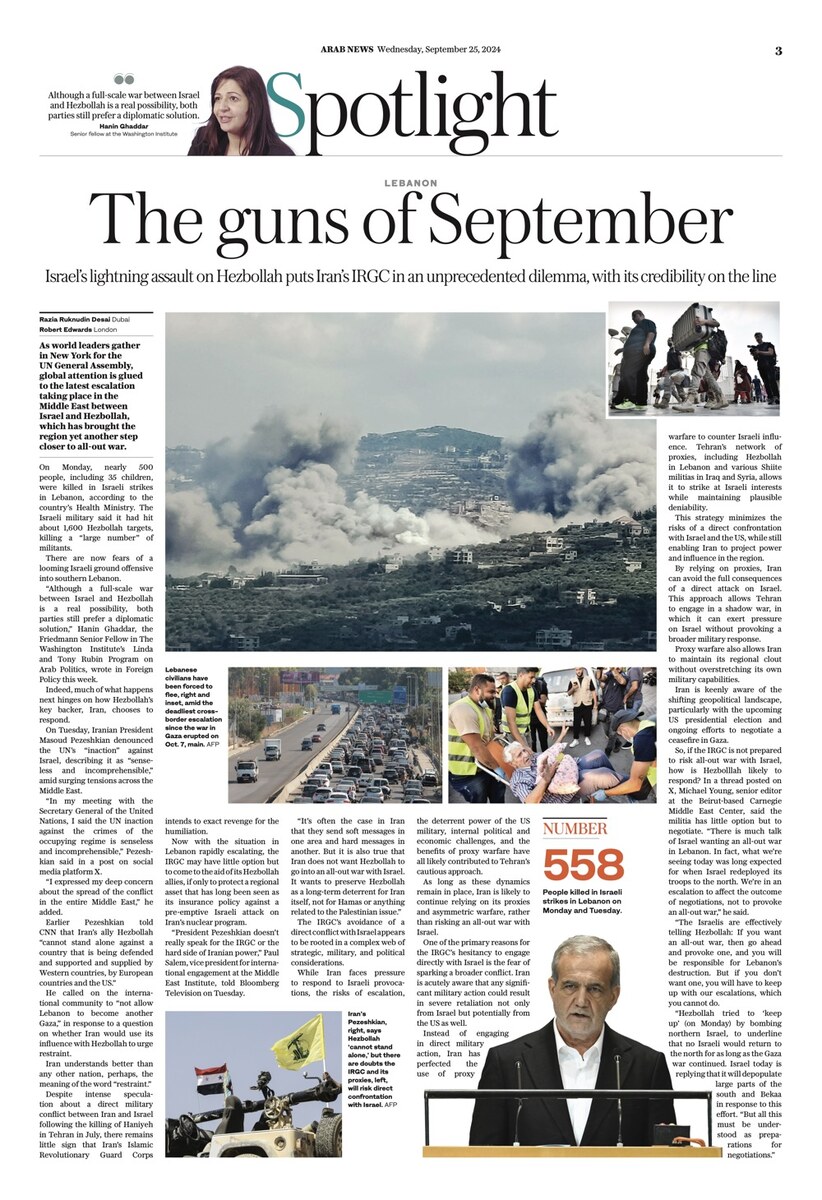
On Monday, nearly 500 people, including 35 children, were killed in Israeli strikes in Lebanon, according to the country’s Health Ministry. The Israeli military said it had hit about 1,600 Hezbollah targets, killing a “large number” of militants.
Further strikes were carried out on Tuesday, making these the deadliest attacks Israel has carried out on Lebanon since the 2006 war.
The Israeli strikes came less than a week after coordinated sabotage attacks targeting Hezbollah’s communication devices killed 39 people and wounded almost 3,000. Hezbollah has responded with fresh rocket attacks deep into Israeli territory.

On Monday, nearly 500 people, including 35 children, were killed in Israeli strikes in Lebanon. (AFP)
There are now fears of a looming Israeli ground offensive into southern Lebanon.
“Although a full-scale war between Israel and Hezbollah is a real possibility, both parties still prefer a diplomatic solution,” Hanin Ghaddar, the Friedmann Senior Fellow in The Washington Institute’s Linda and Tony Rubin Program on Arab Politics, wrote in Foreign Policy this week.
“Israel is trying to keep its attacks targeted, and Hezbollah is trying hard not to provoke Israel or be forced to use and waste its most valuable military assets — namely, precision missiles — which Iran regards as an insurance policy.”
Indeed, much of what happens next hinges on how Hezbollah’s key backer, Iran, chooses to respond.
On Tuesday, Iranian President Masoud Pezeshkian denounced the UN’s “inaction” against Israel, describing it as “senseless and incomprehensible,” amid surging tensions across the Middle East.

People gather at the site of an Israeli strike in Beirut's southern suburbs. (Reuters)
“In my meeting with the Secretary General of the United Nations, I said the UN inaction against the crimes of the occupying regime is senseless and incomprehensible,” Pezeshkian said in a post on social media platform X.
“I expressed my deep concern about the spread of the conflict in the entire Middle East,” he added.
Earlier, Pezeshkian told CNN that Iran’s ally Hezbollah “cannot stand alone against a country that is being defended and supported and supplied by Western countries, by European countries and the US.”
He called on the international community to “not allow Lebanon to become another Gaza,” in response to a question on whether Iran would use its influence with Hezbollah to urge restraint.
Iran understands better than any other nation, perhaps, the meaning of the word “restraint.”

There are now fears of a looming Israeli ground offensive into southern Lebanon. (AP)
Despite intense speculation about a direct military conflict between Iran and Israel following the killing of Ismail Haniyeh in Tehran in July, there remains little sign that Iran’s Islamic Revolutionary Guard Corps intends to exact revenge for the humiliation.
Now with the situation in Lebanon rapidly escalating, the IRGC may have little option but to come to the aid of its Hezbollah allies, if only to protect a regional asset that has long been seen as its insurance policy against a pre-emptive Israeli attack on Iran’s nuclear program.
“President Pezeshkian doesn’t really speak for the IRGC or the hard side of Iranian power,” Paul Salem, vice president for international engagement at the Middle East Institute, told Bloomberg Television on Tuesday.

Israel’s advanced missile defense systems make a successful large-scale Iranian attack unlikely. (AP)
“It’s often the case in Iran that they send soft messages in one area and hard messages in another. But it is also true that Iran does not want Hezbollah to go into an all-out war with Israel. It wants to preserve Hezbollah as a long-term deterrent for Iran itself, not for Hamas or anything related to the Palestinian issue.
“I think it’s trying to calm the situation, de-escalate the situation. I doubt very much that they would join any escalation of fighting between Israel and Hezbollah. I think they will keep their powder dry and to avoid being dragged into it, although they would certainly try to resupply and support Hezbollah.”

On Tuesday, Iranian President Masoud Pezeshkian denounced the UN’s “inaction” against Israel. (AP)
The IRGC’s avoidance of a direct conflict with Israel appears to be rooted in a complex web of strategic, military, and political considerations.
While Iran faces pressure to respond to Israeli provocations, the risks of escalation, the deterrent power of the US military, internal political and economic challenges, and the benefits of proxy warfare have all likely contributed to Tehran’s cautious approach.
As long as these dynamics remain in place, Iran is likely to continue relying on its proxies and asymmetric warfare, rather than risking an all-out war with Israel.
INNUMBERS
• 558 People killed in Israeli strikes in Lebanon on Monday and Tuesday, including at least 50 children and 94 women, and a further 1,835 injured, according to the Lebanese health ministry.
One of the primary reasons for the IRGC’s hesitancy to engage directly with Israel is the fear of sparking a broader conflict. Iran is acutely aware that any significant military action could result in severe retaliation not only from Israel but potentially from the US as well.
Moreover, Israeli military superiority is a major consideration. Israel’s advanced missile defense systems, such as the Iron Dome and the David’s Sling, make a successful large-scale Iranian attack unlikely.

The IRGC may have little option but to come to the aid of its Hezbollah allies. (AFP)
Past experiences, such as Israel’s interception of Iranian drones and missiles in April, highlight the difficulties Iran faces in overcoming Israeli defenses. The Iranian leadership, particularly the IRGC, understands that a failed or underwhelming attack would further embarrass the regime and weaken its regional standing.
Instead of engaging in direct military action, Iran has perfected the use of proxy warfare to counter Israeli influence. Tehran’s network of proxies, including Hezbollah in Lebanon and various Shiite militias in Iraq and Syria, allows it to strike at Israeli interests while maintaining plausible deniability.
This strategy minimizes the risks of a direct confrontation with Israel and the US, while still enabling Iran to project power and influence in the region.

Ultra-Orthodox Jewish children watch as smoke billows following rocket fire from Lebanon into Israel. (Reuters)
By relying on proxies, Iran can avoid the full consequences of a direct attack on Israel. This approach allows Tehran to engage in a shadow war, in which it can exert pressure on Israel without provoking a broader military response.
Proxy warfare also allows Iran to maintain its regional clout without overstretching its own military capabilities.
Iran is keenly aware of the shifting geopolitical landscape, particularly with the upcoming US presidential election and ongoing efforts to negotiate a ceasefire in Gaza. Iranian leaders may believe that a direct attack on Israel could undermine their diplomatic efforts and isolate the country further on the international stage.

Iran is keenly aware of the shifting geopolitical landscape, particularly with the upcoming US presidential election and ongoing efforts to negotiate a ceasefire in Gaza. (AFP)
Tehran is also cautious about giving former US President Donald Trump a reason to re-enter the political fray. Many in Iran’s leadership see Trump as a dangerous adversary, whose return to power could spell the end of any diplomatic progress made under the administration of Joe Biden.
So, if the IRGC is not prepared to risk all-out war with Israel, how is Hezbollah likely to respond? In a thread posted on X, Michael Young, senior editor at the Beirut-based Carnegie Middle East Center, said the militia has little option but to negotiate.
“There is much talk of Israel wanting an all-out war in Lebanon. In fact, what we’re seeing today was long expected for when Israel redeployed its troops to the north. We’re in an escalation to affect the outcome of negotiations, not to provoke an all-out war,” he said.

A woman who fled from southern Lebanon sits inside a shelter in Beirut. (Reuters)
“The Israelis are effectively telling Hezbollah: If you want an all-out war, then go ahead and provoke one, and you will be responsible for Lebanon’s destruction. But if you don’t want one, you will have to keep up with our escalations, which you cannot do.
“Hezbollah tried to ‘keep up’ (on Monday) by bombing northern Israel, to underline that no Israeli would return to the north for as long as the Gaza war continued. Israel today is replying that it will depopulate large parts of the south and Beqaa in response to this effort.
“But all this must be understood as preparations for negotiations.”