

FII to host summits on Africa, women empowerment ahead of 8th edition

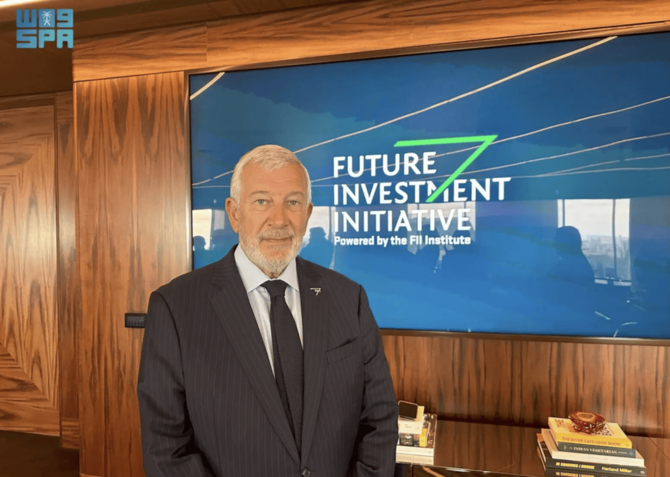
Richard Attias, CEO and board member of the FII, at a media briefing in New York. SPA
Short Url
Updated 24 September 2024
Follow

FII to host summits on Africa, women empowerment ahead of 8th edition

  • CEO and board member of the FII said that the future of jobs and health care will also be in the spotlight at the event
  • Richard Attias highlighted the significance of these summits during a recent media briefing in New York on the sidelines of the UN General Assembly

JEDDAH: Saudi Arabia’s Future Investment Initiative has announced that it will host two summits prior to its eighth edition, set to take place in Riyadh from Oct 29 to 31.

Both being held for the first time, one gathering will center on Africa, while the second, titled the “Horizon Summit,” occurring on Oct. 28, will focus on women empowerment and will be chaired by Princess Reema bint Bandar bin Sultan, the Saudi ambassador to the US.

Richard Attias, CEO and board member of the FII, said that the future of jobs and health care will also be in the spotlight at the event, which will be hosted at the King Abdulaziz International Conference Center, as per the Saudi Press Agency.

Under the theme “Infinite Horizons: Investing Today, Shaping Tomorrow,” this edition of the forum will facilitate discussions on how investments can drive a thriving and sustainable future, pushing the boundaries of what is possible for humanity.

This aligns with FII’s mission to create a purposeful present and a promising future, as well as its vision to bring together the brightest minds and most promising solutions to serve humanity. 

Attias highlighted the significance of these summits during a recent media briefing in New York on the sidelines of the UN General Assembly, where he emphasized that the events are designed to foster dialogue and collaboration on critical issues affecting global investment and development.

In a statement to SPA, Attias said: “We invited all international media outlets to take a closer look and learn more about the prepared program, speakers, and initiatives. We also explained what FII will offer in its eighth edition in Riyadh, based on indicators collected through a global survey of people’s priorities around the world.”

He added that FII’s eighth conference, with about 450 registered international media outlets and more than 40 media networks as partners, is expected to witness engaging dialogues.

He also said that more than 520 speakers, including global CEOs, have confirmed attending the event.

Attias further said that, for the first time, the Future of Jobs Index and the Healthcare Index were introduced, all under the umbrella of the FII, aiming to support humanity in the fields of health, sustainable development, and education, as well as in artificial intelligence and robotics.


GCC growth set to accelerate to 4.4% in 2026 on non-oil strength: World Bank 

Updated 6 sec ago
Follow

GCC growth set to accelerate to 4.4% in 2026 on non-oil strength: World Bank 

RIYADH: Economies across the Gulf Cooperation Council are forecast to grow 4.4 percent in 2026, accelerating to 4.6 percent in 2027, driven by rising non-oil activity in countries including Saudi Arabia, according to an analysis. 

In its Global Economic Prospects report, the World Bank said the Kingdom’s real gross domestic product is projected to grow 4.3 percent in 2026 and 4.4 percent in 2027, up from an expected 3.8 percent in 2025. 

Earlier this month, a separate analysis by Standard Chartered echoed similar expectations, forecasting the Kingdom’s GDP to expand by 4.5 percent in 2026, outperforming the projected global growth average of 3.4 percent, supported by momentum in both hydrocarbon and non-oil sectors. 

The World Bank’s latest forecast broadly aligns with the International Monetary Fund’s October outlook, which projects Saudi Arabia’s GDP to grow by about 4 percent in both 2025 and 2026. 

In its latest report, the World Bank said: “Growth in GCC countries is forecast to increase to 4.4 percent in 2026 and 4.6 percent in 2027, mainly reflecting a steady expansion of non-hydrocarbon activity, in addition to a further rise in hydrocarbon production.” 

It added: “The strengthening of non-hydrocarbon activity — accounting for more than 60 percent of GCC countries’ total GDP — is projected to be supported by expected large-scale investments, including in Kuwait and Saudi Arabia.” 

Expanding the non-oil sector remains a core objective of Saudi Arabia’s Vision 2030 agenda, as the Kingdom continues efforts to reduce its long-standing reliance on crude revenues. 

Highlighting the strength of Saudi Arabia’s non-oil momentum, S&P Global said the Kingdom recorded the highest purchasing managers’ index reading in the region in December, at 57.4, supported by rising new orders, continued growth in non-energy business activity, and expanding employment.

At the country level, the UAE’s economy is projected to grow by 5 percent in 2026, before accelerating to 5.1 percent in 2027. 

Oman’s GDP is forecast to expand by 3.6 percent in 2026 and 4 percent in 2027, while Qatar is expected to record growth of 5.3 percent next year, rising sharply to 6.8 percent in 2027. 

In Kuwait and Bahrain, GDP growth is projected at 2.6 percent and 3.5 percent, respectively, in 2026. 

Across the broader Middle East, North Africa, Afghanistan and Pakistan region, growth is estimated to have reached 3.1 percent in 2025 and is projected to strengthen further to 3.6 percent in 2026 and 3.9 percent in 2027, largely driven by improving performance among oil-exporting economies. 

Potential growth challenges 

The World Bank also outlined several downside risks that could weigh on economic growth across the region. 

These include a re-escalation of armed conflicts, heightened violence or social unrest, which could disrupt economic activity and weaken confidence. 

Other risks include tighter global financial conditions, further increases in trade restrictions and tensions, greater uncertainty over global trade policies, and more frequent or severe natural disasters. 

For oil exporters, lower-than-expected oil prices or heightened price volatility could also dampen growth. 

“A re-escalation of armed conflicts in the region could cause a significant deterioration in consumer and business sentiment, not only in the economies directly affected but also in neighboring economies,” the World Bank said.  

It added: “It could spill over into a broader increase in policy uncertainty and a tightening of financial conditions, dampening investment and economic activity.” 

Global outlook 

The World Bank said the global economy has proved more resilient than expected despite last year’s escalation in trade tensions and policy uncertainty. 

Global economic growth is projected at 2.6 percent in 2026, easing from an estimated 2.7 percent in 2025. 

“The modest slowdown comes on the heels of a post-pandemic rebound over 2021–25 that represented the strongest recovery from a global recession in more than six decades,” the World Bank said, adding that the rebound was uneven and came at the cost of higher inflation and rising debt. 

Among advanced economies, US GDP is projected to grow by 1.6 percent in both 2026 and 2027. 

China’s economy is expected to expand by 4.4 percent in 2026 before slowing to 4.2 percent in 2027, while India’s GDP is forecast to grow by 6.5 percent and 6.6 percent over the same period.