50 children among hundreds of Lebanese killed in 2 days of Israeli strikes

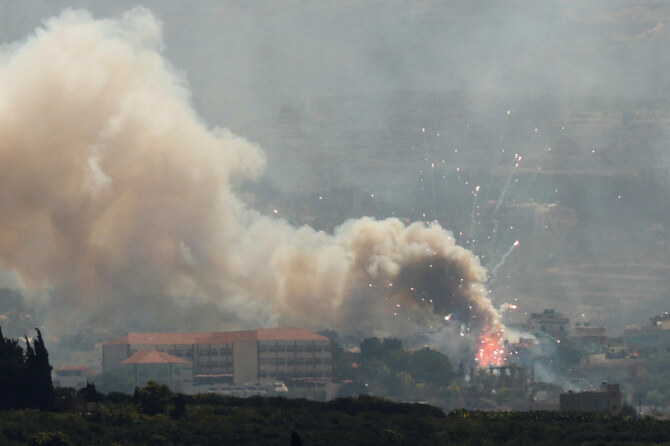
Smoke billows over southern Lebanon following Israeli strikes, amid ongoing cross-border hostilities between Hezbollah and Israeli forces, as seen from Tyre, southern Lebanon. (Reuters)
Short Url
Updated 24 September 2024
Follow

50 children among hundreds of Lebanese killed in 2 days of Israeli strikes

  • Human remains seen on vehicles parked in front of building targeted on Tuesday
  • The sources identified the commander who was killed as Ibrahim Qubaisi

BEIRUT: The Israeli military resumed its attacks on the southern suburbs of Beirut on Tuesday, targeting a building in the Ghobeiry area a day after hundreds of airstrikes across various regions in Lebanon killed over 550 people, including 50 children.

Tuesday’s operation, which was intended to eliminate Abu Jawad Haraka, the commander of the Iran-backed Hezbollah’s missile unit, resulted in the deaths of two people and a further 11, including Iraqis, sustaining injuries, along with the destruction of part of a six-story residential building.

Israeli army radio announced that the airstrike was carried out by F-35 aircraft.

Images circulated from the site of the attack showed human remains on the vehicles parked in front of the targeted building, along with the significant destruction of property.

Further Israeli assaults targeted paramedics associated with the Islamic Health Organization, linked to Hezbollah in the Nabatieh area, as well as the Sajjad food supply establishment, which is also connected to Hezbollah, in Sarein in the Bekaa region.

Following a day of deadly strikes on southern Lebanon and the Bekaa Valley, Israeli Chief of Staff Herzi Halevi said that the Israeli military would “accelerate the offensive operation today,” and added that “we should not give Hezbollah a rest.”

Lebanon’s Health Minister Firas Abiad reported that hundreds of Israeli airstrikes across various regions of the country on Monday resulted in 558 fatalities, including 50 children.

It marked the most intense airstrikes against Lebanon since Hezbollah initiated operations on the southern front about a year ago.

A UNICEF official spoke of “children missing under rubble.”

The intensity in the fighting between Hezbollah and Israel escalated last week following explosions that targeted pagers and wireless devices used by Hezbollah members and civilian employees.

Hezbollah accused Israel of carrying out the attacks, which resulted in the deaths of 39 people and injuries to 2,931 others, according to the Lebanese Ministry of Health.

The Israeli airstrikes impacted residential areas in the southern regions up to Mount Hermon, as well as the western Bekaa and a significant portion of the villages and towns in central and eastern Bekaa.

The attacks also affected an area adjacent to the archaeological site in Baalbek.

Displaced people who managed to reach Beirut spread out along the roads with their belongings and at the front of mosques, while the Ministry of Education opened public schools to accommodate them.

The Masnaa Border Crossing witnessed severe traffic congestion due to the significant movement of displaced people from Lebanon to Syria, including both Lebanese citizens and Syrian workers.

Heavy traffic jams meanwhile continued on roads in south Beirut.

People remained trapped in their cars without food or water due to the chaos in organizing the flow of tens of thousands of cars, especially between Ghazieh and Sidon, and Sidon and Beirut.

Displaced people expressed concerns about the “absence of state institutions in resolving this tragedy.”

They also lamented the “lack of organizational support from Hezbollah during such critical times, leaving people to face their fate alone.”

The health minister told a press conference that “the number of hospitals that received casualties on Monday reached 54,” noting that “four paramedics lost their lives.”

He mentioned “a significant number of remains that the security forces are working to identify.”

As the Israeli strikes on the neighborhoods of southern Beirut have intensified, an increasing number of people have decided to evacuate their homes, in contrast to the situation in 2006 when Hezbollah instructed residents to leave the area within hours of the onset of Israeli aggression.

Numerous neighborhoods have appeared deserted, with shops, restaurants, and gas stations closed, resulting in an almost complete lack of activity.

Meanwhile, both Arab and foreign airlines have suspended all flights to Beirut until further notice.

Minister of Education Abbas Halabi announced the death of Suzi Kojok, director of Kawthariyet El Seyad Intermediate Public School; Layali Ayach, a teacher at the Ansar Public High School, who was killed along with her husband and their two children; and Zeinab and Fatimah Hreibi, teachers at the Shoukin Public School.

Halabi said the victims had died “following the aggressive Israeli shelling that targeted their houses or killed them while they were carrying out their work at school.”

The state-owned Electricite du Liban announced the death of Farah Kojok, an engineer at the Zahrani thermal power plant who died along with her husband, children, father, mother and sister in an Israeli raid that targeted their home.

The Lebanese TV channel Al-Mayadeen announced the death of journalist Hadi Al-Sayed, who was killed in an Israeli raid that targeted his house in southern Lebanon.

The Israeli military again dropped leaflets over southern Lebanon, calling on people to avoid Hezbollah members, following voice messages telling residents to evacuate their houses.

The leaflets said that “whoever stays near Hezbollah members or weapons is putting their life at risk.”

In a series of strikes targeting Israeli outposts, Hezbollah retaliated while affirming that its firepower had not been affected by Israeli attacks.

The group announced that it had “bombarded the Eliakim military camp of the Israeli Northern Command, south of Haifa, with a barrage of Fadi-2 rockets.”

Hezbollah’s operations targeted “the Megiddo Military Airport, west of Afula, with a barrage of Fadi-1 missiles in the first round, and a barrage of Fadi-2 missiles in the second and third rounds.”

It also bombed “the explosive materials factory in the Zikhron area, 60 km from the border, with a barrage of Fadi-2 rockets.”

Hezbollah also targeted “the Amos base — the main logistical support and transportation hub for the northern region — with a salvo of Fadi-1 rockets, as well as the Ramat David base and airport with a salvo of Fadi-2 missiles.”

The group also targeted “the logistical warehouses of the 146th Division at the Naftali base with a rocket salvo, in addition to the Samson base and the Rosh Pina settlement with a rocket salvo.”

According to the Israeli side, Hezbollah’s strikes also reached Safad, while Israel called on “residents in Kiryat Shmona and its surroundings to stay near fortified areas.”

On the diplomatic front, Jean-Yves Le Drian, the French presidential envoy, met in Beirut several Lebanese officials, including Prime Minister Najib Mikati; Nabih Berri, parliamentary speaker; Gen. Joseph Aoun, commander of the Lebanese Armed Forces; Samir Geagea, head of the Lebanese Forces Party; and Gebran Bassil, head of the Free Patriotic Movement.

Le Drian said that “France stands by Lebanon in all circumstances,” and added he hoped that “diplomatic calls would lead to a resolution that halts the cycle of violence.”


Iraq’s political future in limbo as factions vie for power

Updated 58 min 20 sec ago
Follow

Iraq’s political future in limbo as factions vie for power

  • The government that eventually emerges will be inheriting a security situation that has stabilized in recent years

BAGHDAD: Political factions in Iraq have been maneuvering since the parliamentary election more than a month ago to form alliances that will shape the next government.
The November election didn’t produce a bloc with a decisive majority, opening the door to a prolonged period of negotiations.
The government that eventually emerges will be inheriting a security situation that has stabilized in recent years, but it will also face a fragmented parliament, growing political influence by armed factions, a fragile economy, and often conflicting international and regional pressures, including the future of Iran-backed armed groups.
Uncertain prospects
Prime Minister Mohammed Shia Al-Sudani’s party took the largest number of seats in the election. Al-Sudani positioned himself in his first term as a pragmatist focused on improving public services and managed to keep Iraq on the sidelines of regional conflicts.
While his party is nominally part of the Coordination Framework, a coalition of Iran-backed Shiite parties that became the largest parliamentary bloc, observers say it’s unlikely that the Coordination Framework will support Al-Sudani’s reelection bid.
“The choice for prime minister has to be someone the Framework believes they can control and doesn’t have his own political ambitions,” said Sajad Jiyad, an Iraqi political analyst and fellow at The Century Foundation think tank.
Al-Sudani came to power in 2022 with the backing of the Framework, but Jiyad said that he believes now the coalition “will not give Al-Sudani a second term as he has become a powerful competitor.”
The only Iraqi prime minister to serve a second term since 2003 was Nouri Al-Maliki, first elected in 2006. His bid for a third term failed after being criticized for monopolizing power and alienating Sunnis and Kurds.
Jiyad said that the Coordination Framework drew a lesson from Al-Maliki “that an ambitious prime minister will seek to consolidate power at the expense of others.”
He said that the figure selected as Iraq’s prime minister must generally be seen as acceptable to Iran and the United States — two countries with huge influence over Iraq — and to Iraq’s top Shiite cleric, Grand Ayatollah Ali Al-Sistani.
Al-Sudani in a bind
In the election, Shiite alliances and lists — dominated by the Coordination Framework parties — secured 187 seats, Sunni groups 77 seats, Kurdish groups 56 seats, in addition to nine seats reserved for members of minority groups.
The Reconstruction and Development Coalition, led by Al-Sudani, dominated in Baghdad, and in several other provinces, winning 46 seats.
Al-Sudani’s results, while strong, don’t allow him to form a government without the support of a coalition, forcing him to align the Coordination Framework to preserve his political prospects.
Some saw this dynamic at play earlier this month when Al-Sudani’s government retracted a terror designation that Iraq had imposed on the Lebanese Hezbollah militant group and Yemen’s Houthi rebels — Iran-aligned groups that are allied with Iraqi armed factions — just weeks after imposing the measure, saying it was a mistake.
The Coalition Framework saw its hand strengthened by the absence from the election of the powerful Sadrist movement led by Shiite cleric Muqtada Sadr, which has been boycotting the political system since being unable to form a government after winning the most seats in the 2021 election.
Hamed Al-Sayed, a political activist and official with the National Line Movement, an independent party that boycotted the election, said that Sadr’s absence had a “central impact.”
“It reduced participation in areas that were traditionally within his sphere of influence, such as Baghdad and the southern governorates, leaving an electoral vacuum that was exploited by rival militia groups,” he said, referring to several parties within the Coordination Framework that also have armed wings.
Groups with affiliated armed wings won more than 100 parliamentary seats, the largest showing since 2003.
Other political actors
Sunni forces, meanwhile, sought to reorganize under a new coalition called the National Political Council, aiming to regain influence lost since the 2018 and 2021 elections.
The Kurdish political scene remained dominated by the traditional split between the Kurdistan Democratic Party and Patriotic Union of Kurdistan parties, with ongoing negotiations between the two over the presidency.
By convention, Iraq’s president is always a Kurd, while the more powerful prime minister is Shiite and the parliamentary speaker Sunni.
Parliament is required to elect a speaker within 15 days of the Federal Supreme Court’s ratification of the election result, which occurred on Dec. 14.
The parliament should elect a president within 30 days of its first session, and the prime minister should be appointed within 15 days of the president’s election, with 30 days allotted to form the new government.
Washington steps in
The incoming government will face major economic and political challenges.
They include a high level of public debt — more than 90 trillion Iraqi dinars ($69 billion) — and a state budget that remains reliant on oil for about 90 percent of revenues, despite attempts to diversify, as well as entrenched corruption.
But perhaps the most delicate question will be the future of the Popular Mobilization Forces, a coalition of militias that formed to fight the Daesh group as it rampaged across Iraq more than a decade ago.
It was formally placed under the control of the Iraqi military in 2016 but in practice still operates with significant autonomy. After the Hamas-led attack in southern Israel on Oct. 7, 2023 sparked the devastating war in Gaza, some armed groups within the PMF launched attacks on US bases in the region in retaliation for Washington’s backing of Israel.
The US has been pushing for Iraq to disarm Iran-backed groups — a difficult proposition, given the political power that many of them hold and Iran’s likely opposition to such a step.
Two senior Iraqi political officials, who spoke on condition of anonymity because they weren’t authorized to comment publicly, said that the United States had warned against selecting any candidate for prime minister who controls an armed faction and also cautioned against letting figures associated with militias control key ministries or hold significant security posts.
“The biggest issue will be how to deal with the pro-Iran parties with armed wings, particularly those... which have been designated by the United States as terrorist entities,” Jiyad said.