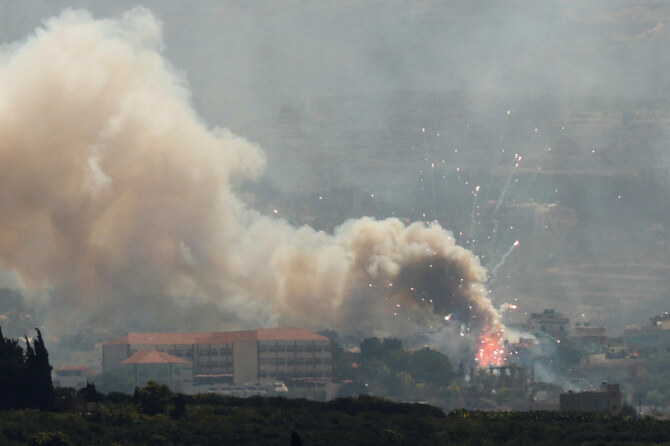

BEIRUT: The Israeli military resumed its attacks on the southern suburbs of Beirut on Tuesday, targeting a building in the Ghobeiry area a day after hundreds of airstrikes across various regions in Lebanon killed over 550 people, including 50 children.
Tuesday’s operation, which was intended to eliminate Abu Jawad Haraka, the commander of the Iran-backed Hezbollah’s missile unit, resulted in the deaths of two people and a further 11, including Iraqis, sustaining injuries, along with the destruction of part of a six-story residential building.
Israeli army radio announced that the airstrike was carried out by F-35 aircraft.
Images circulated from the site of the attack showed human remains on the vehicles parked in front of the targeted building, along with the significant destruction of property.
Further Israeli assaults targeted paramedics associated with the Islamic Health Organization, linked to Hezbollah in the Nabatieh area, as well as the Sajjad food supply establishment, which is also connected to Hezbollah, in Sarein in the Bekaa region.
Following a day of deadly strikes on southern Lebanon and the Bekaa Valley, Israeli Chief of Staff Herzi Halevi said that the Israeli military would “accelerate the offensive operation today,” and added that “we should not give Hezbollah a rest.”
Lebanon’s Health Minister Firas Abiad reported that hundreds of Israeli airstrikes across various regions of the country on Monday resulted in 558 fatalities, including 50 children.
It marked the most intense airstrikes against Lebanon since Hezbollah initiated operations on the southern front about a year ago.
A UNICEF official spoke of “children missing under rubble.”
The intensity in the fighting between Hezbollah and Israel escalated last week following explosions that targeted pagers and wireless devices used by Hezbollah members and civilian employees.
Hezbollah accused Israel of carrying out the attacks, which resulted in the deaths of 39 people and injuries to 2,931 others, according to the Lebanese Ministry of Health.
The Israeli airstrikes impacted residential areas in the southern regions up to Mount Hermon, as well as the western Bekaa and a significant portion of the villages and towns in central and eastern Bekaa.
The attacks also affected an area adjacent to the archaeological site in Baalbek.
Displaced people who managed to reach Beirut spread out along the roads with their belongings and at the front of mosques, while the Ministry of Education opened public schools to accommodate them.
The Masnaa Border Crossing witnessed severe traffic congestion due to the significant movement of displaced people from Lebanon to Syria, including both Lebanese citizens and Syrian workers.
Heavy traffic jams meanwhile continued on roads in south Beirut.
People remained trapped in their cars without food or water due to the chaos in organizing the flow of tens of thousands of cars, especially between Ghazieh and Sidon, and Sidon and Beirut.
Displaced people expressed concerns about the “absence of state institutions in resolving this tragedy.”
They also lamented the “lack of organizational support from Hezbollah during such critical times, leaving people to face their fate alone.”
The health minister told a press conference that “the number of hospitals that received casualties on Monday reached 54,” noting that “four paramedics lost their lives.”
He mentioned “a significant number of remains that the security forces are working to identify.”
As the Israeli strikes on the neighborhoods of southern Beirut have intensified, an increasing number of people have decided to evacuate their homes, in contrast to the situation in 2006 when Hezbollah instructed residents to leave the area within hours of the onset of Israeli aggression.
Numerous neighborhoods have appeared deserted, with shops, restaurants, and gas stations closed, resulting in an almost complete lack of activity.
Meanwhile, both Arab and foreign airlines have suspended all flights to Beirut until further notice.
Minister of Education Abbas Halabi announced the death of Suzi Kojok, director of Kawthariyet El Seyad Intermediate Public School; Layali Ayach, a teacher at the Ansar Public High School, who was killed along with her husband and their two children; and Zeinab and Fatimah Hreibi, teachers at the Shoukin Public School.
Halabi said the victims had died “following the aggressive Israeli shelling that targeted their houses or killed them while they were carrying out their work at school.”
The state-owned Electricite du Liban announced the death of Farah Kojok, an engineer at the Zahrani thermal power plant who died along with her husband, children, father, mother and sister in an Israeli raid that targeted their home.
The Lebanese TV channel Al-Mayadeen announced the death of journalist Hadi Al-Sayed, who was killed in an Israeli raid that targeted his house in southern Lebanon.
The Israeli military again dropped leaflets over southern Lebanon, calling on people to avoid Hezbollah members, following voice messages telling residents to evacuate their houses.
The leaflets said that “whoever stays near Hezbollah members or weapons is putting their life at risk.”
In a series of strikes targeting Israeli outposts, Hezbollah retaliated while affirming that its firepower had not been affected by Israeli attacks.
The group announced that it had “bombarded the Eliakim military camp of the Israeli Northern Command, south of Haifa, with a barrage of Fadi-2 rockets.”
Hezbollah’s operations targeted “the Megiddo Military Airport, west of Afula, with a barrage of Fadi-1 missiles in the first round, and a barrage of Fadi-2 missiles in the second and third rounds.”
It also bombed “the explosive materials factory in the Zikhron area, 60 km from the border, with a barrage of Fadi-2 rockets.”
Hezbollah also targeted “the Amos base — the main logistical support and transportation hub for the northern region — with a salvo of Fadi-1 rockets, as well as the Ramat David base and airport with a salvo of Fadi-2 missiles.”
The group also targeted “the logistical warehouses of the 146th Division at the Naftali base with a rocket salvo, in addition to the Samson base and the Rosh Pina settlement with a rocket salvo.”
According to the Israeli side, Hezbollah’s strikes also reached Safad, while Israel called on “residents in Kiryat Shmona and its surroundings to stay near fortified areas.”
On the diplomatic front, Jean-Yves Le Drian, the French presidential envoy, met in Beirut several Lebanese officials, including Prime Minister Najib Mikati; Nabih Berri, parliamentary speaker; Gen. Joseph Aoun, commander of the Lebanese Armed Forces; Samir Geagea, head of the Lebanese Forces Party; and Gebran Bassil, head of the Free Patriotic Movement.
Le Drian said that “France stands by Lebanon in all circumstances,” and added he hoped that “diplomatic calls would lead to a resolution that halts the cycle of violence.”