

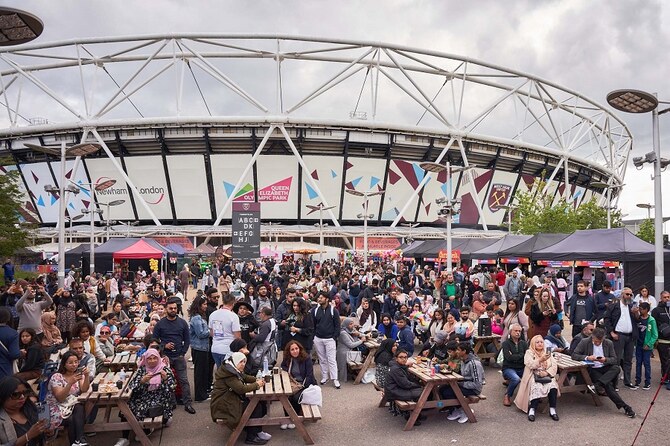
World Halal Food Festival returns to London for ninth year

The World Halal Food Festival will take place at the London Stadium. (Supplied)
Short Url
Updated 23 September 2024
Follow

World Halal Food Festival returns to London for ninth year

LONDON: The world’s largest halal food festival returns to London for its ninth year, with organizers anticipating more than 20,000 visitors.

The World Halal Food Festival will take place from Sept. 28-29 at the London Stadium, displaying a wide range of cuisines from around the globe.

The event features a carefully selected lineup of vendors, chefs and food stalls representing countries such as Pakistan, Turkey, Morocco and Indonesia, among others.

Event director Waleed Jahangir spoke to Arab News, noting the growing demand for halal-certified products as the global Muslim population continues to expand.

“The growing interest in ethical, sustainable and high-quality food sources has attracted not just Muslim consumers, but people from all backgrounds to halal food,” Jahangir said.

A new addition this year is the Celebrity Chef Cookery Theatre, hosted by Shelina Permalloo, known for her appearances on ITV’s “Cooking with the Stars.” She will be joined by other top chefs in leading interactive cooking demonstrations. Celebrities such as Nadiya Hussain and Big Zuu, as well as actors from Netflix, are expected to attend the event.

The festival has expanded its family-friendly offerings with an enlarged childrens’ zone and bazaar. It has also partnered with Our Future Health to provide a mobile health clinic on-site, giving attendees the opportunity to participate in health research and have checkups.

“We also encourage discussions and conversations at the festival through interactive panels, giving people from all walks of life a space to connect over shared values of food, culture and community,” Jahangir added.

Organizers emphasized their commitment to supporting a diverse range of businesses, offering smaller, local vendors prime spaces at the festival to ensure they have high visibility.

The “Local Flavours” will focus on artisanal food producers, giving them a platform to show their products to thousands of festival visitors eager to explore new tastes.


Sotheby’s ‘Origins II’: Local heroes go under the hammer 

Updated 15 January 2026
Follow

Sotheby’s ‘Origins II’: Local heroes go under the hammer 

  • Regional highlights from Sotheby’s ‘Origins II’ auction, which takes place Jan. 31 in Diriyah 

DUBAI: Here are some of the regional highlights from Sotheby’s ‘Origins II’ auction, which takes place Jan. 31 in Diriyah.

Mohamed Siam 

‘Untitled (Camel Race)’ 

Siam is described by Sotheby’s as “one of the most significant voices of the Kingdom’s second generation of modern artists.” His “highly discernible visual aesthetic,” the auction catalogue states, references European cubists and Italian Futurism, using “multiple overlapping planes to create an endless sense of movement” — an approach that “fragments visual reality, enabling the viewer to experience multiple viewpoints simultaneously.” This work from the late 1980s “shrewdly captures through a fractured, shifting perspective two camel riders in an enthralling, head-to-head race.” It marks Siam’s auction debut and is expected to fetch between $70,000 and $90,000.  


Abdulhalim Radwi 

‘Untitled (Hajj Arafah)’ 

The Makkah-born artist is one of Saudi modernism’s most significant figures. His “multifaceted practice was shaped by a profound engagement with regional heritage and the evolving aesthetic currents of the 20th century,” the catalogue notes. This 1967 oil painting is hailed by Sotheby’s as “a vibrant example of Radwi’s practice (at the time), depicting a bustling arrangement of tented structures rendered in his characteristic Cubist-inflected idiom. The tightly interlocking forms, rhythmic repetitions, and cool, airy palette evoke the temporal architecture of the Hajj pilgrimage, distilled into a kaleidoscopic composition that celebrates the textures and visual poetry of life in Makkah.” 


Mohammed Al-Saleem 

‘Untitled’ 

Another of the Kingdom’s modern-art pioneers, Al-Saleem was born in 1939 in Al-Marat province. His work, Sotheby’s says, “is celebrated for its distinct visual language, a style which the artist coined ‘Horizonism.’ Drawing inspiration from the shifting sands and gradating skyline of Riyadh as seen from the desert, as well as the intensity of the Saudi sun, Al-Saleem reimagined his beloved landscape through the prism of abstraction.” In works such as this 1989 oil painting, he “replaced the traditional horizon line with stylized forms resembling organic forms and Arabic calligraphy … a fusion of modernist abstraction and cultural identity.” 


Taha Al-Sabban  

‘Untitled’ 

This mixed-media-on-canvas work from 2005 typifies the Makkah-born artist’s modernist approach, which, Sotheby’s states “has been described as both an act of conservation and a homage to the nature and culture of his homeland.” The artist “used expressive color and form to preserve local memory — palm groves, open waters, and traditional architecture — while transforming the traditional cityscape into ascending, abstracted rhythms.” His work is often described as “nostalgic,” but the Al-Sabban is quoted by the Al-Mansouria Foundation as saying: “Although I am acutely aware of the passage of time, my aim is not nostalgia; instead I seek to capture the moment and reveal the life in the world.” 


Zeinab Abd El-Hamid 


‘Untitled (Shisha Shop)’ 

This 1987 watercolor is the work of one of Egypt’s most significant female artists of the modern era who belonged, Sotheby’s says “to a generation of artists who came of age during the cultural reawakening that followed Egypt’s independence.” Abd El-Hamid, the catalogue states, “painted with a refined sensibility, grounded in her belief in humanity’s ability to transcend hardship. She did not seek to romanticize the past, but to distill its forms and emotions into something enduring. Her work carries a sense of nostalgia for a rhythm of life rooted in shared dignity and poetic structure … rooftops, cafés, and courtyards become vessels of memory, harmony, and inner light.” 


Samia Halaby 

‘Copper’ 

Central to the Palestinian artist’s practice was the belief that “abstraction, like any visual language, is shaped by social forces and reflects the movements of working people and revolutionary ideas,” Sotheby’s states. This 1976 oil painting combines Halaby’s exploration of the diagonal as “a dynamic formal element” and of the reflective properties of metals. The work “eschews traditional linear perspective in favor of a compositional strategy that flattens and destabilizes the viewer’s gaze. Halaby achieves a sense of spatial infinity — not through illusion, but through repetition and variation.” 


Mahmoud Sabri 

‘Demonstration’ 

The Iraqi painter’s career, Sotheby’s says, was unique among his peers in his homeland. “He simultaneously explored Arab and European cultures, studied the history of painting, and created his own unique art language and style.” That language arrived after this particular oil painting from the early Sixties, a time in which “Sabri often returned to the subject of revolutionary martyrdom and probably referring to the events of the 1963 coup d’état.” In the foreground, a group of women surround a bereaved mother, who is weeping for her murdered son.