

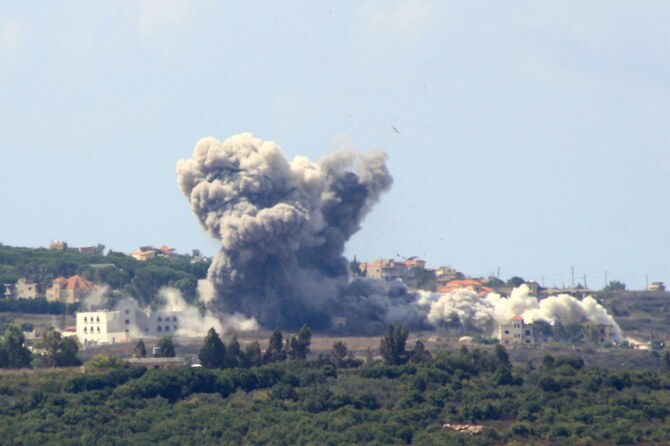

BEIRUT: Israeli airstrikes killed at least 490 people, including children, in Lebanon on Monday, the Health Ministry said, in what is by far the deadliest cross-border escalation since war erupted in Gaza on Oct. 7.
Monday’s confrontations between Hezbollah and the Israeli army entered a new phase of violence, disregarding all red lines.
The Litani River no longer served as a boundary to Israeli expansion northward.
According to the Lebanese Health Ministry’s health emergency center, the initial toll from more than 350 Israeli airstrikes on southern Lebanon and the Bekaa region was 356 dead and 1,246 wounded, including children, women, and paramedics.
The battle, which Hezbollah calls the “open-ended battle of reckoning,” has ignited Lebanon from the south to the east, with the Israeli army launching a series of wide-ranging air attacks early in the morning.
Dozens of warplanes simultaneously targeted residential homes, the squares of populated towns, valleys, and forests.
The Israeli military claimed that Hezbollah “uses civilian homes and private civilian facilities as hideouts to launch rockets,” similar to the war scenario in the Gaza Strip.
Israeli army spokesperson Daniel Hagari said that “Hezbollah is hiding guided missiles inside civilian homes.” Meanwhile, an advisor to Israeli Prime Minister Benjamin Netanyahu noted: “Hezbollah used Iranian drones against Israel.”
Israeli Foreign Minister Israel Katz said that Hezbollah’s Secretary-General Hassan Nasrallah had turned the people of Lebanon into “hostages, placing rockets and weapons inside their homes and towns to threaten Israel’s home front.”
He said the people of Lebanon should evacuate “any house that has become a site for the service of the Hezbollah organization to avoid harm.”
Caretaker Prime Minister Najib Mikati said that the ongoing Israeli “aggression against Lebanon constitutes a genocide in every sense of the word, as well as a destructive plan aimed at annihilating villages and towns and eradicating all green spaces.”
He reiterated his appeal to “decision-making countries to exert pressure on Israel to cease its aggression, implement UN Security Council resolution 2735, and resolve the Palestinian issue based on the adoption of the two-state solution and a just and comprehensive peace.”
He said: “We reaffirm our full commitment to resolution 1701 and, as a government, we are working to halt the renewed Israeli war while striving to avoid, as much as possible, falling into the unknown.”
Mikati spoke as the Israeli army launched on Monday morning a series of large-scale attacks from Lebanon’s south to east.
The army vowed to target sites deep in the Bekaa Valley in the afternoon.
Dozens of towns in the border region and in the area of Tyre were targeted by airstrikes.
The Israeli army hit a home housing seven people in the town of Barich in the Tyre district, killing five people, including children.
It also targeted the Nabatieh area, western Bekaa (specifically Machghara, Sohmor, and Yohmor), as well as the Jezzine area and Deir Al-Zahrani, all the way to Maghdoucheh and Ghaziyeh on the outskirts of Sidon.
The echoes of Israeli airstrikes on northern Bekaa resonated throughout the region.
People spoke of “highly destructive Israeli missiles.”
Loud explosions shook the Hermel highlands near the Syrian border.
A strike on these highlands killed one person and injured six others, two of whom are in intensive care.
Injured children were separated from their families upon being transferred to hospitals, prompting appeals for anyone with information about their relatives to come forward.
Women who were in their homes were buried under the rubble.
Calls were made through social media for nurses to report to hospitals that had exceeded their capacity to assist in providing care to those in need.
The Ministry of Health has requested that “all hospitals in the southern provinces, as well as in Nabatieh and Baalbek-Hermel, suspend all non-urgent procedures to allocate resources for the treatment of casualties resulting from the ongoing Israeli aggression against Lebanon.”
Israeli media reported that some airstrikes penetrated as deep as 125 km into Lebanese territory.
The Israeli Broadcasting Authority said that the air force “attacked the northern Lebanon Valley area, about 130 km from Israel’s northern border.”
The Israeli army accompanied its aggression with recorded voice messages to Lebanese cell phones in various areas, especially the south and Bekaa, extending to Beirut and Akkar in the north.
The messages urged people to evacuate homes near Hezbollah centers.
The telecom company Ogero reported that Lebanon received “about 80,000 suspected Israeli call attempts.”
The messages instructed people to “evacuate areas where Hezbollah weapons or infrastructure are located within at least 1,000 meters, or head to the local school and not return until further notice.”
The warning was echoed by a similar statement from the Israeli army’s spokesperson, addressing “villages in the Bekaa region.”
The airstrikes and phone threats had an immediate effect, as schools halted operations and urged parents to pick up their children.
Many families quickly fled from southern areas, which until recently were considered safe, heading deeper into Lebanon.
The entrance to Sidon, leading to Beirut, was jammed with thousands of cars carrying families and their belongings.
Displaced people have moved from the south to the predominantly Christian and Druze areas of Mount Lebanon, as well as to Beirut, which has a Sunni majority.
Additionally, some displaced persons have arrived in Akkar, located in the far north of Lebanon, where efforts have been made to provide them with housing.
The spokesperson for the Israeli army, Avichay Adraee, claimed that the military targeted “only the buildings that contain weapons belonging to Hezbollah.”
He addressed the residents of Lebanese villages, asking them to evacuate the homes where Hezbollah had concealed weapons immediately.
He said Hezbollah “is deceiving you and sacrificing you. While Hezbollah claims that you are part of its community and its supporters, it appears that its missiles and drones are more valuable and significant to it than you are.”
Reports on Monday indicated that an Israeli missile fell in a barren area in the Jbeil district in northern Lebanon, predominantly inhabited by Christians, with a Shiite presence.
The Lebanese army investigated the incident, and security sources suggested that the missile might have landed accidentally in the area.
UNIFIL, the UN’s peacekeeping force in Lebanon, asked all its civilian employees to leave with their families to safe areas north of the Litani River.
In response to the Israeli attack, Hezbollah said it “bombed the reserve headquarters of the Israeli army’s northern corps, the Galilee Division Reserve Base, and its stores of logistics at Ami’ad Base as well as Rafael’s military-industrial complexes in Zevulun area, north of Haifa, with dozens of missiles.”
Sirens sounded in Margaliot in the Upper Galilee, as reported by Israeli media.


