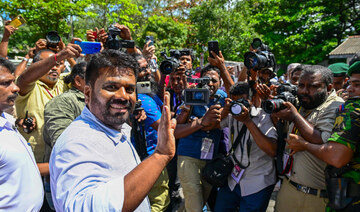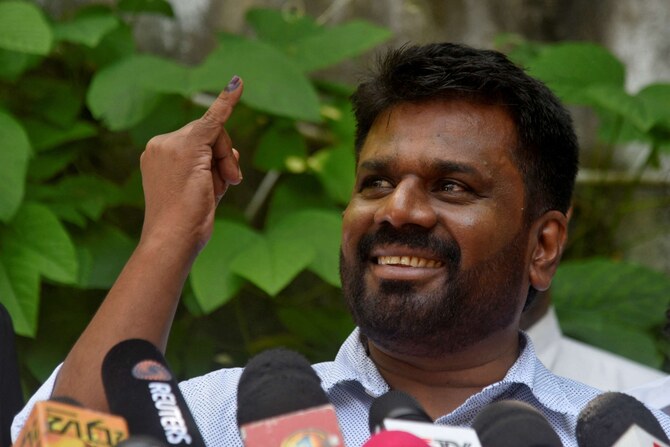

COLOMBO: Marxist lawmaker Anura Kumara Dissanayake won Sri Lanka’s presidential election on Sunday in the island nation’s first such vote since the 2022 economic collapse and mass protests that ousted its leader.
Dissanayake was declared the winner by the Election Commission of Sri Lanka, following the country’s first presidential runoff in its history.
Under a ranked choice election system, Sri Lankan voters had the option to list second and third-choice candidates when they cast their ballots on Saturday. As no candidate secured more than 50 percent of the vote in the initial count, those second-preference votes were added to the tally of the two frontrunners to determine a winner.
In the first round of counting, Dissanayake had garnered 42 percent of the vote and was up against Sajith Premadasa, the main opposition leader and son of a former president, who acquired around 32 percent of the vote.
By the end of the second count, Dissanayake had won over 5.7 million of the votes against Premadasa’s 4.5 million, official results showed.
“This victory belongs to all of us,” Dissanayake wrote on X after his victory was declared.
“The unity of Sinhalese, Tamils, Muslims, and all Sri Lankans is the bedrock of this new beginning. The new renaissance we seek will rise from this shared strength and vision. Let us join hands and shape this future together!”
Incumbent President Ranil Wickremesinghe, who took over after former President Gotabaya Rajapaksa was removed from power, was placed a distant third with about 17 percent of the vote, which knocked him out of the race during the runoff.
Sri Lanka saw almost an 80 percent turnout among 17 million eligible voters in the first election held since the island nation defaulted on its foreign debt in 2022.
That year, as the country’s foreign exchange reserves ran dry and people suffered through months of severe shortages of fuel and food, a popular protest movement eventually forced the powerful Rajapaksa clan out of power, throwing the Sri Lankan political landscape wide open.
This was the first time a presidential election in Sri Lanka had involved a broader political spectrum. Polls have traditionally been contested between coalitions of center-right and center-left parties.
“The voters want a change,” Dr. B.A. Husseinmiya, a Sri Lankan historian and former professor at the University Brunei Darussalam, told Arab News.
“All those people who are ardently against corruption and all the misdeeds carried out by the MPs and ministers of the previous governments … They all decided to vote against the incumbent president and the other parties who defrauded the people.”
Dissanayake, 55, leads the National People’s Power, a coalition of leftist political parties and groups backed by protesters who ousted Rajapaksa. He gained support from voters angry at the country’s political elite — represented by candidates like Wickremesinghe — who they blame for plunging the economy into a crisis.
“Apparently his sincerity in addressing people and taking up people’s causes at the bottom level — people’s upliftment — has appealed to many voters,” Husseinmiya said.
Dissanayake will be sworn in as Sri Lanka’s ninth president on Monday morning at the Independence Square in Colombo.
Sri Lanka remains on the road to recovery after its worst-ever financial crisis, with many people still struggling to make ends meet because of tax hikes and cuts to subsidies and welfare.
The country’s new president, popularly known as AKD, had presented himself as the candidate of change, promising to combat corruption within the government and scrutinize loan deals from countries such as China.
He also faces the task of ensuring Sri Lanka remains on track with the International Monetary Fund’s bailout program until 2027, which he plans to renegotiate to focus on more relief for the poor.
“People (will be) expecting the new president to walk his talk and implement quite a lot of promises he has made in this manifesto,” Husseinmiya said.