

PCB announces ‘Connection Camp’ to restore Pakistan cricket to former glory

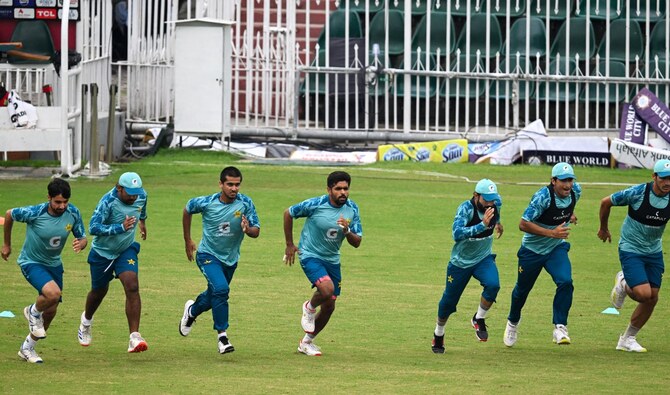
Pakistan's cricketers attend a training session at the Rawalpindi Cricket Stadium in Rawalpindi on August 28, 2024. (AFP/File)
Short Url
Updated 22 September 2024
Follow

PCB announces ‘Connection Camp’ to restore Pakistan cricket to former glory

  • PCB chairman to lead camp’s meeting on Monday with cricketers including Babar Azam, Shaheen Afridi and coaching staff
  • Development takes place after Pakistan suffered a string of humiliating losses, most recently a 2-0 Test series loss to Bangladesh

ISLAMABAD: The Pakistan Cricket Board (PCB) has announced that its Chairman Mohsin Naqvi will head a high-level “Connection Camp” on Monday that will feature the country’s elite cricketers and coaching staff aimed at restoring the country’s cricket to its former glory.

The camp, which will be held at a local hotel, will bring together Pakistan’s white-ball captain Babar Azam, Fakhar Zaman, Mohammad Rizwan, Saim Ayub, Salman Ali Agha, Saud Shakeel, Shadab Khan, Shaheen Shah Afridi, and Test captain Shan Masood. They will also be joined by national team head coaches Jason Gillespie and Gary Kirsten, assistant coach Azhar Mahmood and high performance specialist David Reid.

The development takes place with fans and critics alarmed at the state of affairs of the sport in the country. Since 2023, Pakistan has lost to Afghanistan, Ireland, United States and Bangladesh in all three formats of the game. 

The green shirts were whitewashed 2-0 by Bangladesh earlier this month. Pakistan have not won a single Test match at home since December 2021, leading many to wonder whether the sport is headed for a certain decline in the country. 

“The Connection Camp is a critical step toward unifying our approach to restore Pakistan cricket to its former glory,” Naqvi said in a statement. “Our aim is to identify key issues, foster open dialogue and collectively agree on a strategic path forward.”

The session will focus on fostering stronger collaboration between players and the PCB, the board said, adding it will reaffirm its commitment to supporting players in meeting strategic goals. 

“The ultimate aim is for players to take a leading role in inspiring the next generation of cricketers through outstanding performances,” it said. 

Masood said the discussions will help the cricketers set a strong course for the future. The Pakistani Test skipper said he was excited to be a part of this collaborative effort.

“The outcomes of the session will include performance benchmarks, player development programs and strategies to enhance grassroots cricket,” he said. 

Pakistan’s red-ball head coach Gillespie described the camp as a “valuable opportunity” for open dialogue and alignment between the coaching staff and players. 

“We’re all striving toward the same goal— raising the standard of Pakistan cricket and creating a culture of winning,” he said. 

Kirsten noted it was his responsibility to provide the best environment where players thrive. 

“We will focus on refining our approach in white-ball cricket to meet the standards of the highest levels of international competition,” he said. 

While critics and experts have pointed to a lack of quality pitches and infrastructure in the country for Pakistan’s lackluster performances, many blame frequent changes in the PCB’s management in the past year and a lack of unity in the team for the poor performances. 


At ECO meeting, Pakistan proposes ‘Regional Innovation Hub’ to curb natural disasters

Updated 21 January 2026
Follow

At ECO meeting, Pakistan proposes ‘Regional Innovation Hub’ to curb natural disasters

  • Pakistan hosts high-level 10th ECO Ministerial Meeting on Disaster Risk Reduction in Islamabad
  • Innovation hub to focus on early warning technologies, risk informed infrastructure planning

ISLAMABAD: Pakistan has proposed to set up a “Regional Innovation Hub on Disaster Risk Reduction” that focuses on early warning technologies and risk informed infrastructure planning, the Press Information Department (PID) said on Wednesday, as Islamabad hosts a high-level meeting of the Economic Cooperation Organization (ECO).

The ECO’s 10th Ministerial Meeting on Disaster Risk Reduction (DRR) is being held from Jan. 21-22 at the headquarters of the National Disaster Management Authority (NDMA) in Pakistan’s capital. 

The high-level regional forum brings together ministers, and senior officials from ECO member states, representatives of the ECO Secretariat and regional and international partner organizations. The event is aimed to strengthen collective efforts toward enhancing disaster resilience across the ECO region, the PID said. 

“Key agenda items include regional cooperation on early warning systems, disaster risk information management, landslide hazard zoning, inclusive disaster preparedness initiatives, and Pakistan’s proposal to establish a Regional Innovation Hub on Disaster Risk Reduction, focusing on early warning technologies, satellite data utilization, and risk-informed infrastructure planning,” the statement said. 

The meeting was attended by delegations from ECO member states including Pakistan, Türkiye, Azerbaijan, Iran, Kyrgyzstan, Tajikistan, Turkmenistan and Uzbekistan. Representatives of regional and international organizations and development partners were also in attendance.

Discussions focused on enhancing regional coordination, harmonizing disaster risk reduction frameworks, and strengthening collective preparedness against transboundary and climate-induced hazards impacting the ECO region, the PID said. 

ECO members states such as Pakistan, Türkiye, Afghanistan and others have faced natural calamities such as floods and earthquakes in recent years that have killed tens of thousands of people. 

Heavy rains triggered catastrophic floods in Pakistan in 2022 and 2025 that killed thousands of people and caused damages to critical infrastructure, inflicting losses worth billions of dollars. 

Islamabad has since then called on regional countries to join hands to cooperate to avert future climate disasters and promote early warning systems to avoid calamities in future.