

Pakistan police arrest six women in Karachi for using hypnosis to rob people 

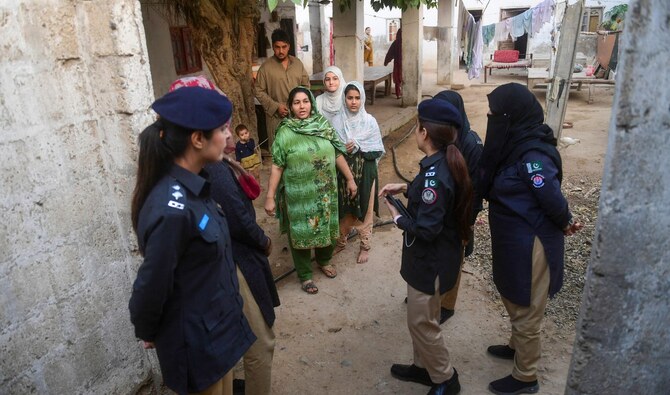
Police personnel interrogate Afghan refugees during a search operation to identify alleged illegal immigrants, on the outskirts of Karachi on November 17, 2023. (AFP/File)
Short Url
Updated 22 September 2024
Follow

Pakistan police arrest six women in Karachi for using hypnosis to rob people 

  • Police say inter-provincial gang has conducted robberies in Lahore, Sukkur, Hyderabad and Karachi cities 
  • Numerous cases have been reported in Karachi in the past where victims claimed they were hypnotized

KARACHI: Pakistani police arrested a gang of six suspected female robbers in the southern port city of Karachi on Sunday, accusing them of using hypnosis to rob their victims. 

Dr. Uzair Ahmed, the senior superintendent of police for investigation in the city’s Malir district, disclosed that the inter-provincial gang of women had previously committed robberies in Karachi, Hyderabad, Sukkur, Lahore and other cities of Punjab by hypnotizing their victims. 

While the scientific validity of hypnosis as a crime-inducing tool is often debated, numerous cases have been reported in Karachi in the past where victims have claimed to have been hypnotized before being robbed.

“We have arrested a gang leader and five other women for looting citizens while using hypnosis to manipulate them,” Dr. Ahmed told Arab News. 

He said the remaining members of the 25-member gang are still at large. 

“The modus operandi of the gang was that they would come to Karachi, stay in low-priced hotels in downtown Saddar, conduct robberies in various parts of the city and then return to their homes in Punjab,” Dr. Ahmed revealed.

He said the women would enter people’s homes by using various excuses, often asking for jobs or offering to sew clothes. 

“Once inside, the gang leader, an expert in hypnosis, would engage the women while others would loot them,” the police officer said.

He said the gang also had male members, whose job was to provide logistics and transportation to the women.

The arrested women have been identified as Sahiba alias Hina, Babli Maqbool, Kaneez Fareed, Sahiba Fatma, Lubna Shah, and Salman Hussain. Police said they had recovered Rs4 million [$14,418] from their possession.

“Two families of victims have also identified these women,” Dr. Ahmed said.

Various robberies over the years have been reported from Karachi in which the victims claimed they were hypnotized before robbers made away with their valuable items. 

Last year, a shopkeeper in Karachi said he was hypnotized and robbed on the city’s busy Burns Road. The suspect was later arrested and charged with the crime. 

In another incident reported from the port city in 2021, a man was robbed of Rs 3.5 million [$12,616] after being hypnotized in the city’s Gulshan-e-Iqbal area. 


Pakistani student launches ‘Urdu ChatGPT’ AI model

Updated 5 sec ago
Follow

Pakistani student launches ‘Urdu ChatGPT’ AI model

  • Developer says “Qalb” is largest large language model built exclusively for Urdu
  • Project highlights push to localize artificial intelligence for non-English users

ISLAMABAD: A Pakistani student studying in the United States has launched an artificial intelligence model designed exclusively for the Urdu language, a development its creator says could help bridge longstanding gaps in access to advanced digital tools for millions of speakers worldwide.

The project, called Qalb, is positioned as an Urdu-first large language model at a time when most generative AI systems are primarily trained on English and other widely used global languages. Supporters of language-specific models argue they can improve accuracy, cultural relevance and accessibility for users in education, business and public services.

Urdu is spoken by more than 230 million people globally, including in Pakistan, India and diaspora communities, but remains under-represented in advanced AI systems. Efforts to localize artificial intelligence have increasingly been seen as critical for widening participation in digital economies, particularly in developing countries.

“Qalb is now recognized as the world’s largest Large Language Model created exclusively for the Urdu language,” Taimoor Hassan, the project’s developer, was quoted this month in a report in state-run news agency APP. 

“Trained on a massive dataset of 1.97 billion tokens and benchmarked across seven-plus international evaluation frameworks, Qalb outperforms existing Urdu-focused AI models on key real-world performance indicators, setting a new standard for natural language processing in Pakistan,” Hassan said.

“This is a development model and in the next phase we would soon launch App for mobile and web so that people could use and benefit from Qalb ChatGPT.”

Hassan completed his undergraduate degree in computer science at FAAST University’s Peshawar campus and is currently studying for a master’s degree in computer science and software engineering at Auburn University in the United States. According to APP, he is a serial entrepreneur who has previously launched and exited multiple startups and has represented Pakistan at international technology forums.

“I had the opportunity to contribute in a small way to a much bigger mission for the country,” Hassan said.

“Together with my undergraduate roommates and teammates, Jawad Ahmed and Muhammad Awais, we are committed to continuously fine-tuning localized models for niche industries, which we believe can become a major breakthrough for Pakistan.”

Both collaborators are also graduates of FAAST University Peshawar Campus and are currently studying in Germany, APP reported.

The team behind Qalb said the model is intended to support local businesses, startups, educational platforms and voice-based digital services, arguing that meaningful innovation is no longer limited to large technology firms.

“Technology is no longer locked behind big budgets or big teams. With the right mindset, even a small group can build products that educate, automate, and serve millions,” Hassan told APP.