

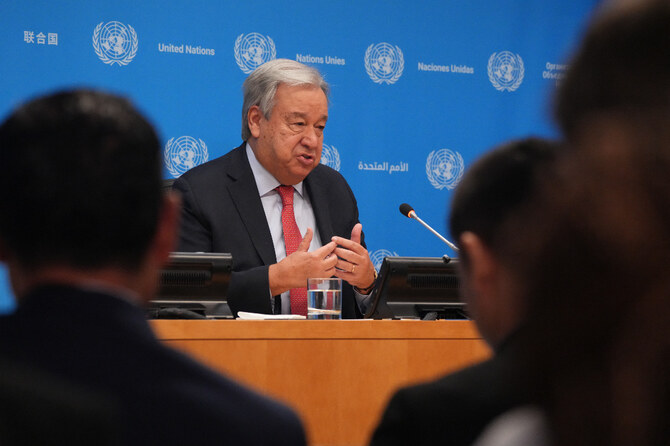

NEW YORK CITY: Top UN officials have called on member states to take renewed action on global issues ahead of the Summit of the Future, which aims to revive trust in multilaterism and counter growing criticism of the international organization.
The summit takes place on Sept. 22-23 during the 79th UN General Assembly, which began earlier this month.
It also aims to galvanize support for the UN’s Sustainable Development Goals, which were launched in 2015.
A “Pact for the Future,” negotiated and agreed upon by member states, will be declared at the end of the summit.
UN Secretary-General Antonio Guterres delivered a speech on Saturday ahead of the summit. “Four years ago, we began the process that brings us here today because we saw a world in trouble: torn apart by conflict and inequalities, threatened by climate chaos and unregulated technologies, the Sustainable Development Goals in peril — with many countries now mired in disastrous debt and a cost-of-living crisis,” he said.
“We saw our multilateral institutions ailing, unable to respond to contemporary challenges, let alone those of tomorrow.
“We saw faith in multilateral solutions eroding, and we saw trust in each other dissipating just when we needed it most. So we began a journey to reform.”
Through the summit, Guterres is seeking the support of world leaders in delivering the “Pact for the Future,” which covers emerging technologies such as artificial intelligence, and longstanding issues such as climate change.
But critics have argued that the pact has been watered down amid a gridlock in negotiations, and that the summit may join a list of long-forgotten UN campaigns.
The UN itself has faced growing criticism over its inefficacy in confronting global challenges.
Its longstanding bureaucracy and Security Council format have also come under fire, particularly amid the Russia-Ukraine and Gaza wars.
In his speech, Guterres pointed to sectors of society outside of government that could hold the key to change.
“The world belongs to us all. People want a say in the decisions that affect them,” he said. “And while governments have primary responsibility, we will not solve today’s global problems without contributions from all of society: from civil society and young people delivering change, promoting accountability, demanding better, standing up for truth and justice, and using new technologies to organize for a better world; from business and finance — critical to combating the climate crisis and shaping our digital future for the benefit of all; and from scientists, innovators and academics pushing the boundaries of our knowledge and developing solutions to the great challenges we face — from hunger and disease to online hate.”
Guterres conceded to criticism of the UN, calling for reform of the “outdated” Security Council format.
International financial institutions, which have a controversial track record in the Global South, were another target of Guterres, who called for “supercharging resources for sustainable development and climate action.”
UNGA President Philemon Yang supported Guterres in a letter on Friday. The former Cameroonian prime minister said his preliminary meetings with heads of state led to an “overwhelming message of support” for the summit’s goals.
“Over the past three years, we have all rallied around the promise of the Summit of the Future as an opportunity for the international community to forge a new global consensus that will actively seek to transform and scale-up existing commitments for the achievement of the Sustainable Development Goals,” he added. “The Pact of the Future meets this promise.”




