

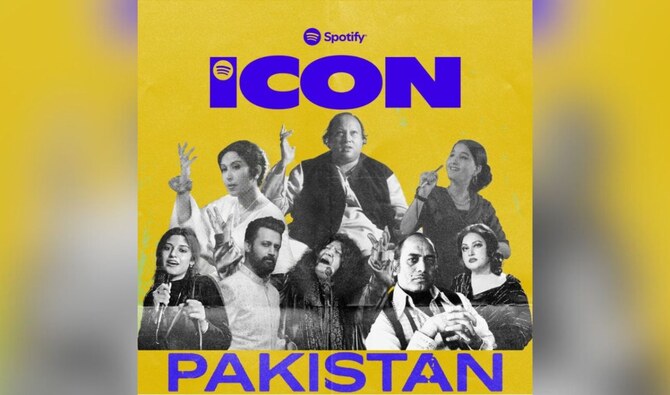

KARACHI: Spotify Pakistan this week launched its “ICON” program to connect the country’s younger audiences with its legacy artists such as Nusrat Fateh Ali Khan, Abida Parveen and Nazia Hassan, among others, hoping to bridge the gap between generations through timeless music.
Spotify ICON will bring the celebrated music of legendary musicians from the 1950s to the 2000s to digital-savvy Pakistani audiences. The program will focus on promoting a blend of curated playlists, on-platform promotion, and offline activations of Pakistan’s legendary musicians from the 1950s to the 2000s, the streaming service said.
The program was launched by Spotify on Saturday, Sept. 21, at a star-studded event at the TDF Ghar venue in Karachi. Some of the music from Khan, the first artist part of the program, was played at the event.
“The ICON program for Spotify by Spotify Pakistan is a tribute to legacy artists,” Khan FM, the platform’s senior artist and label partnerships manager for Pakistan, Bangladesh, and Sri Lanka, said. “We, at Spotify, have seen year-on-year growth for a lot of these artists from different decades.”
He explained that legendary Pakistani ghazal singer Mehdi Hassan has seen a “year-on-year growth [of] about 144 percent” in digital streams over the years.
“The really amazing thing is that the growth is being generated by the new generation, which is Gen Z,” he said. “We felt that it’s only suitable that we have a program dedicated to legacy artists.”
The ICON playlist will feature music from every decade, he said, highlighting artists from the 1950s up till the early 2000s such as Khan, Hassan, Ghulam Ali, Nayyara Noor, Abida Parveen, Nazia Hassan, Zoheb Hassan and popular Pakistani band Junoon.
The Spotify official explained that this was the first time that a program of such a nature was launched in any of the audio streaming platform’s markets worldwide.
“It hasn’t been done in any other [Spotify] market,” FM Khan said. “RADAR [and] EQUAL, those are global programs. This one, ICON, is purely born out of Pakistan.”
As per data provided by Spotify, legendary Pakistani singer Noor Jehan has seen a whopping 66 percent year-on-year increase in active listeners over the years. Out of these, 50 percent are in the 18-27 age group.
Meanwhile, Spotify data shows pop singers Sajjad Ali and Hadiqa Kiani have seen the highest year-on-year growth in listeners, amounting to 75 percent.
Pakistan’s iconic ghazal maestro Ustad Ghulam Ali Khan has seen an 82 percent increase in annual streams, with 49 percent of them coming from Gen-Z audiences, the platform said.
“I still remember vividly that the artists featured on the [Spotify ICON] playlist, in my life, I have listened to them on cassettes, CDs as well as by messaging on a radio show when there was a bit of balance in my phone,” YouTuber Irfan Junejo told Arab News.
“Now being able to play them at the click of a button is a bit magical for me,” he said. “I have been listening to Nusrat Fateh Ali Khan since my childhood. Now, the new generation is listening to him via Spotify. And everyone is able to relate to and connect with him irrespective of their age.”
Arshad Mahmud, a veteran Pakistani singer and music composer, stressed that the younger generation needs to know about the “monumental work” that the country’s musicians have produced.
“Preservation and its introduction to the new generation is a very significant initiative,” Mahmud explained. “It will have a very good effect on [them]. At least, they [would] know what they are inheriting.”


