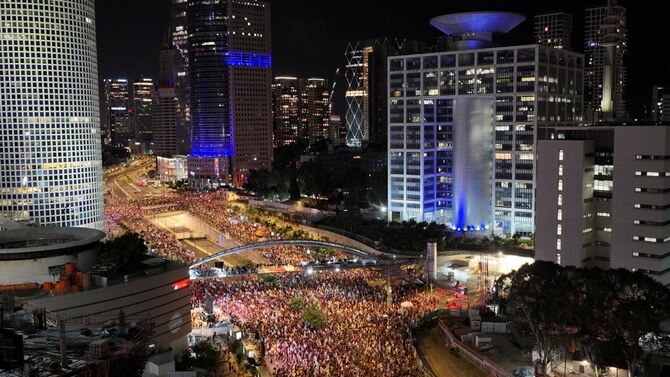
TEL AVIV: Thousands of Israelis again took to the streets of Israel’s commercial hub Tel Aviv on Saturday to press for a Gaza truce deal that could free dozens of hostages.
Weekly rallies in Tel Aviv throughout the war, which was triggered by Hamas’s October 7 attack, have become more critical of the Israeli government since the military announced earlier this month that six dead captives had been recovered from a tunnel in the southern Gaza Strip.
Prime Minister Benjamin Netanyahu, accused by critics of stalling in truce negotiations and prolonging the war to appease far-right coalition partners, has said Hamas militants “executed” the six hostages by shooting them in the back of the head.
Netanyahu has also blamed Hamas leaders for rejecting terms of a possible truce and hostage release deal, while himself facing calls from Israeli critics to make concessions to secure the return of 97 people still held in Gaza, including 33 the military says are dead.
Actor Lior Ashkenazi told the crowd in Tel Aviv on Saturday that “there will be no redemption” if the government allows the Israeli captives to be “abandoned to murderers and rapists for coalition considerations.”
“No one will agree to live under a broken leadership. Cry out, beloved land, for your leaders abandon you.”
As in past weeks, relatives of captives addressed the crowd.
Eli Elbag, father of hostage Liri Elbag, said addressing his daughter: “It’s been a year since I last kissed you, a year since I last laughed with you.”
“We will continue to fight to bring everyone home,” said the father.
Saturday’s protest unfolded in the shadow of increasing cross-border attacks between Israel and Lebanese group Hezbollah, a Hamas ally.
Shahar Mor, nephew of slain hostage Avraham Munder, said he feared the fight against Hezbollah would again distract leaders from the plight of the hostages.
“Their goal is to focus on the illusion of ‘absolute victory’ that is always just around the corner,” said Mor.
But like during successive phases of intense fighting in Gaza over nearly a year of war, the “corner... always shifts according to specific interests,” he said.
“Yesterday it was Rafah (in southern Gaza), tomorrow it will be Beirut.”
The October 7 attack that triggered the war resulted in the deaths of 1,205 people, mostly civilians, on the Israeli side, according to an AFP tally based on Israeli official figures that include hostages killed in captivity.
Palestinians militants seized 251 hostages that day, scores of whom were released during a one-week truce in November.
Israel’s retaliatory military offensive has killed at least 41,391 people in Gaza, most of them civilians, according to figures provided by the Hamas-run territory’s health ministry. The UN has acknowledged the figures as reliable.


![]()

Israelis rally to pressure government on hostage release
Short Url
https://arab.news/vch98
Israelis rally to pressure government on hostage release
- Prime Minister Benjamin Netanyahu is accused by critics of stalling in truce negotiations and prolonging the war
Latest updates


© 2026 SAUDI RESEARCH & PUBLISHING COMPANY, All Rights Reserved And subject to Terms of Use Agreement.