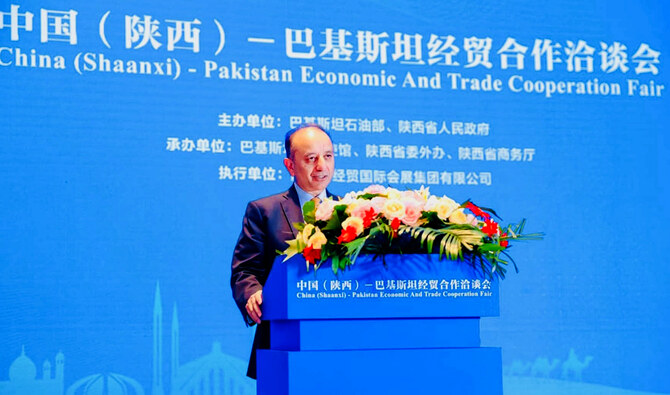
ISLAMABAD: Federal Minister for Petroleum Dr. Musadik Malik held roundtable meetings with Chinese companies at the Pakistan Pavilion, set up at the 8th Silk Route Expo in Xi’an, China, on Saturday, offering them opportunities to invest in his country by getting into joint ventures.
In recent years, Pakistan has significantly benefited from China’s involvement in the energy sector, primarily through projects carried out under the multibillion-dollar China-Pakistan Economic Corridor (CPEC).
Key areas of cooperation include the development of coal-fired power plants, hydropower projects and renewable energy sources. These projects have greatly enhanced Pakistan’s power generation capacity, with a report in China Daily last year mentioning the addition of over 8,000 megawatts to the national grid.
Malik conducted the roundtables at a time when leading Pakistani petroleum sector players, such as Oil and Gas Development Company, Pakistan Petroleum Limited and Mari Petroleum Company, are also participating in the expo.
“Opening the discussion forum, Federal Minister for Petroleum Dr. Musadik Malik laid down the vision of Prime Minister of Pakistan Shehbaz Sharif,” said an official statement from the Ministry of Energy. “He committed ... to provide full facilitation [to Chinese firms] in partnering with Pakistani companies in joint ventures whether individually or with consortium.”
The statement added the key areas in which the Chinese businesses have been invited to partner in are oil and gas exploration, refinery upgradation, coal conversion and regasification.
The minister noted that Pakistan has one of the largest reserves of coal, adding the government wanted to create value from its resources while protecting the environment.
“We will become technology partners, joint venture partners,” he was quoted as saying.
Pakistan has already invited Chinese investment in a number of sectors.
Only a day earlier, a Chinese business group announced to set up textile parks in the country to boost Pakistan’s exports by about $5 billion.


![]()

Pakistan’s petroleum minister seeks Chinese investment at Silk Route Expo in Xi’an
Short Url
https://arab.news/6snrv
Pakistan’s petroleum minister seeks Chinese investment at Silk Route Expo in Xi’an
- Dr. Musadik Malik promises to facilitate Chinese businesses interested in getting into joint ventures
- Potential areas of cooperation include oil and gas exploration, refinery upgradation and coal conversion
Latest updates


Recommended


© 2026 SAUDI RESEARCH & PUBLISHING COMPANY, All Rights Reserved And subject to Terms of Use Agreement.