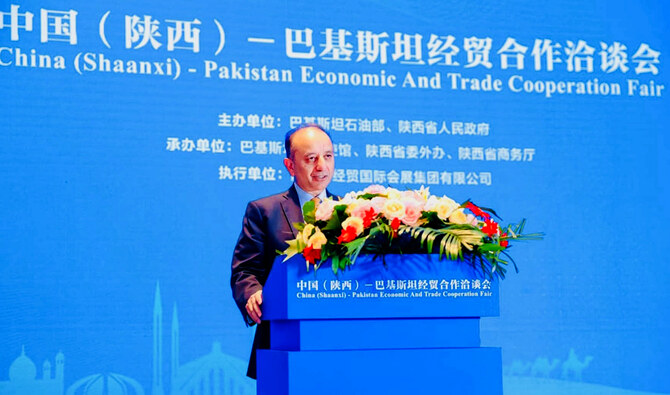
ISLAMABAD: Federal Minister for Petroleum Dr. Musadik Malik held roundtable meetings with Chinese companies at the Pakistan Pavilion, set up at the 8th Silk Route Expo in Xi’an, China, on Saturday, offering them opportunities to invest in his country by getting into joint ventures.
In recent years, Pakistan has significantly benefited from China’s involvement in the energy sector, primarily through projects carried out under the multibillion-dollar China-Pakistan Economic Corridor (CPEC).
Key areas of cooperation include the development of coal-fired power plants, hydropower projects and renewable energy sources. These projects have greatly enhanced Pakistan’s power generation capacity, with a report in China Daily last year mentioning the addition of over 8,000 megawatts to the national grid.
Malik conducted the roundtables at a time when leading Pakistani petroleum sector players, such as Oil and Gas Development Company, Pakistan Petroleum Limited and Mari Petroleum Company, are also participating in the expo.
“Opening the discussion forum, Federal Minister for Petroleum Dr. Musadik Malik laid down the vision of Prime Minister of Pakistan Shehbaz Sharif,” said an official statement from the Ministry of Energy. “He committed ... to provide full facilitation [to Chinese firms] in partnering with Pakistani companies in joint ventures whether individually or with consortium.”
The statement added the key areas in which the Chinese businesses have been invited to partner in are oil and gas exploration, refinery upgradation, coal conversion and regasification.
The minister noted that Pakistan has one of the largest reserves of coal, adding the government wanted to create value from its resources while protecting the environment.
“We will become technology partners, joint venture partners,” he was quoted as saying.
Pakistan has already invited Chinese investment in a number of sectors.
Only a day earlier, a Chinese business group announced to set up textile parks in the country to boost Pakistan’s exports by about $5 billion.

Pakistan’s petroleum minister seeks Chinese investment at Silk Route Expo in Xi’an
https://arab.news/6snrv
Pakistan’s petroleum minister seeks Chinese investment at Silk Route Expo in Xi’an
- Dr. Musadik Malik promises to facilitate Chinese businesses interested in getting into joint ventures
- Potential areas of cooperation include oil and gas exploration, refinery upgradation and coal conversion
Pakistan capital market transitions to T+1 settlement cycle ahead of multiple advanced markets
- A T+1 settlement cycle means that securities transactions are finalized and settled one business day after trade date
- Effective from Feb. 9, all eligible trades at the PSX are now settled on a T+1 basis, replacing the previous T+2 cycle
KARACHI: Pakistan’s capital market has officially transitioned to the Trade plus one (T+1) settlement cycle, a landmark reform that strengthens efficiency, reduces risk and aligns the country with international best practices, the Pakistan Stock Exchange (PSX) said on Tuesday.
A T+1 settlement cycle means that securities transactions are finalized and settled one business day after the trade date, which reduces counterparty risk and improves capital efficiency in the exchange of funds and securities.
Effective from Feb. 9, all eligible trades at the PSX are now settled on a T+1 basis, replacing the previous T+2 cycle. The transition was implemented under the guidance of the Securities and Exchange Commission of Pakistan (SECP) through close collaboration among all stakeholders, according to the PSX.
It aligns Pakistan’s capital market with leading markets such as the United States, Canada, Mexico, Argentina, Jamaica and China, which have already adopted shorter settlement cycles. Europe, the UK and Switzerland are set to follow by 2027. By moving early, Pakistan has demonstrated its commitment to modernization and investor protection.
“The transition to the T+1 settlement cycle brings important advantages for Pakistan’s capital market. It enables faster access to funds and securities, improving liquidity, while reducing settlement and counterparty risk through shorter exposure periods,” the PSX said.
“Quicker trade finalization enhances efficiency and the reform strengthens investor confidence, particularly among institutional and foreign investors. Together, these benefits support a stronger and more resilient market aligned with global best practices.”
Pakistan’s stock market has touched historic highs in recent months as broad institutional buying boosted investor confidence amid ongoing economic reforms under international lending programs. Pakistani state media reported in Jan. around 135,000 new investors had joined the PSX over the last 18 months.
SECP Chairman Dr. Kabir Ahmed Sidhu commended the PSX, the Central Depository Company and the National Clearing Company of Pakistan for the successful implementation of the T+1 settlement system.
“The reform brings Pakistan’s capital market at par with modern jurisdictions by accelerating trade settlement, reducing counterparty and market risks, and enhancing liquidity,” he was quoted as saying by the PSX.
“The adoption of T+1 will strengthen investor confidence and align Pakistan’s capital market with evolving international standards and global best practices.”


