

Russia detains two dozen over deadly Moscow shootout

1 / 3
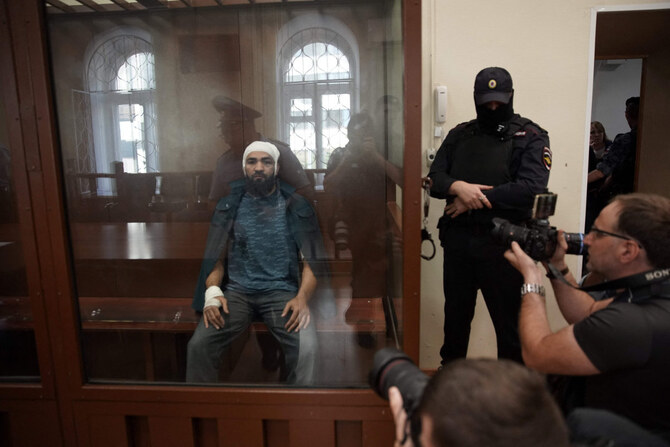
A suspect in the attempted raid on the Moscow office of Russian retailer Wildberries Umar Chichayev is seen during a court hearings in Moscow on September 20, 2024. (AFP)
2 / 3
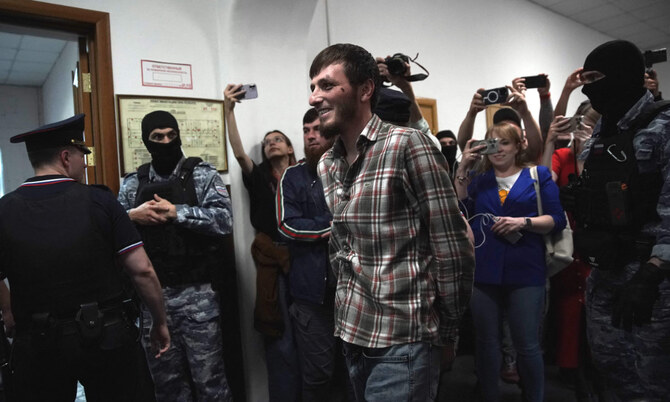
A suspect of an attempted raid on the Moscow office of Russian retailer Wildberries, Lambek Deniyev, is escorted in a court in Moscow on September 20, 2024. (AFP)
3 / 3
Eskerkhan Dadayev, suspect of an attempted raid on the Moscow office of Russian retailer Wildberries, is escorted in a courthouse in Moscow, on September 20, 2024. (AFP)
Short Url
Updated 21 September 2024
Follow

Russia detains two dozen over deadly Moscow shootout

  • The shootout involved the camps of Russia's richest woman Tatyana Bakalchuk and her estranged husband over control of retail giant Wildberries
  • The chaotic shooting just a few streets from the Kremlin evoked memories of the 1990s in Russia, where corporate disputes were sometimes settled through violence

MOSCOW: Russia authorities ordered the detention of two dozen people including a Chechen mixed martial arts fighter on Friday over a shootout in central Moscow that left two people dead.
A group of men turned up at the offices of Russian retail giant Wildberries on Wednesday, in what CEO Tatyana Bakalchuk described as an armed takeover attempt by her estranged husband and two disgruntled former executives.
Bakalchuk — Russia’s richest woman — and her husband had for months been locked in a bitter dispute over a company merger deal that President Vladimir Putin had personally approved but which Chechen ruler Ramzan Kadyrov denounced as an illegal seizure.
Among the men remanded into custody on Friday was Umar Chichaev, a mixed martial arts fighter and deputy commander of a national guard unit linked to Kadyrov, according to Russian news agencies.
“The court granted the petition of law enforcement agencies and remanded Chichaev in custody for one month and 30 days,” Moscow’s Basmanny court ruled, according to the state-owned TASS news agency.
The shootout came just over six weeks after Wildberries finalized its merger deal with Russ, a Russian advertising firm that is several times smaller than the corporate giant.
Bakalchuk’s husband Vladislav denounced the merger as a huge mistake, and enlisted the help of Kadyrov in July to stop the deal.

Two security guards were killed in the shootout, which injured seven others.
Tatyana released a tearful video message on Wednesday accusing her husband of organizing the attack.
Bakalchuk founded Wildberries in 2004 while on maternity leave, selling clothes out of her Moscow apartment with her then-IT technician husband Vladislav.
The business has since become an industry leader and made Bakalchuk a billionaire, although her fortune took a hit from the recent merger, according to Forbes.
In July, she announced she had separated from Vladislav and was getting a divorce.
In total, 30 people have been detained over two days in connection with Wednesday’s shooting, state media reported.
Vladislav’s lawyers said on Thursday he had been arrested on suspicion of murder and other crimes.
But late Friday, he released a cryptic video on Telegram saying that he was at home and would continue to fight for his “family business.”
“The truth is on my side. May justice prevail,” he said in a message accompanying the video.
The chaotic shooting just a few streets from the Kremlin evoked memories of the 1990s in Russia, where corporate disputes were sometimes settled through violent turf wars and criminal means.


Venezuela begins ‘large’ prisoner release amid US pressure

Updated 4 sec ago
Follow

Venezuela begins ‘large’ prisoner release amid US pressure

  • The releases are the first since Maduro’s former deputy Delcy Rodriguez took over, with the backing of President Donald Trump
  • The releases were announced by Rodriguez’s brother, parliament speaker Jorge Rodriguez

CARACAS: Venezuela on Thursday began releasing a “large number” of political prisoners, including several foreigners, in an apparent concession to the United States after its ouster of ruler Nicolas Maduro.
The releases are the first since Maduro’s former deputy Delcy Rodriguez took over, with the backing of President Donald Trump, who says he is content to let her govern as long as she gives Washington access to oil.
The White House credited Trump with securing the prisoners’ freedom.
“This is one example of how the president is using maximum leverage to do right by the American and Venezuelan people,” Deputy Press Secretary Anna Kelly said in a statement to AFP.
The releases were announced by Rodriguez’s brother, parliament speaker Jorge Rodriguez, a key figure in “chavismo,” the anti-US socialist movement founded by Maduro’s predecessor Hugo Chavez.
He said “a large number of Venezuelan and foreign nationals” were being immediately freed for the sake of “peaceful coexistence.”
He did not say which prisoners would be released, nor how many or from where.
Renowned Spanish-Venezuelan activist Rocio San Miguel, imprisoned since February 2024 over a purported plot to assassinate Maduro, was among five Spanish citizens freed, according to Spain’s foreign ministry.
Security was stepped up Thursday afternoon outside the notorious El Helicoide detention center in Caracas, used by the intelligence services to jail political and other prisoners.
Miguel was held in El Helicoide after her arrest.
Leading opposition figure Alfredo Diaz, who died in December in custody, was also held at the facility.
Families gathered outside on Thursday for news of their loved ones.
“I’m nervous. Please God may it be reality,” the mother of a detained activist from the party of opposition leader Maria Corina Machado told AFP.
On Tuesday, Trump had told Republican lawmakers that Rodriguez’s administration was closing a torture chamber “in the middle of Caracas” but gave no further details.
His remarks had sparked speculation that Venezuelan authorities had agreed to close El Helicoide.
Venezuelan rights NGO Foro Penal estimates over 800 political prisoners are languishing in the country’s jails.
It welcomed the government’s plans to liberate some of them but was still verifying releases.
As tensions with Washington climaxed in the past month Venezuela had already released dozens of dissenters in two phases.

- Trump rebuked by Senate -

Thursday’s move by Caracas came as Trump suggested the United States could run Venezuela and tap into its oil reserves for years.
Shortly after Maduro’s seizure in US airstrikes and a special forces raid that left 100 people dead, according to Caracas, Trump announced that the US would “run” the Caribbean country for a transitional period.
“Only time will tell” how long Washington will demand direct oversight of the country, he told The New York Times in an interview published Thursday.
When asked whether that meant three months, six months or a year, he replied: “I would say much longer.”
Meanwhile, the US Senate on Thursday took a major step toward passing a resolution to rein in military actions against Venezuela.
The Democratic-led legislation, expected to pass a vote next week, reflects widespread disquiet among lawmakers over Saturday’s secretive capture of Maduro, conducted without their express approval.
It is expected to face resistance in the Republican-dominated House, however.

- Millions of barrels of crude -

Oil has emerged as the key to US control over Venezuela, which has the world’s largest proven reserves.
Trump announced a plan earlier this week for the United States to sell between 30 million and 50 million barrels of Venezuelan crude, with Caracas then using the money to buy US-made products.
Delcy Rodriguez on Wednesday called the US attack to depose Maduro, who was taken to New York with his wife to face trial on drugs charges, a “stain” on relations with the United States.
But she also defended the planned oil sales to Washington.
On the streets of Caracas, opinions remain mixed about the plan.
“I feel we’ll have more opportunities if the oil is in the hands of the United States than in the hands of the government,” said Jose Antonio Blanco, 26.
The Wall Street Journal reported that Trump, who will meet oil executives on Friday, is also considering a plan for the US to exert control over Venezuela’s state oil company PDVSA.
Trump has warned Rodriguez she will pay “a very big price, probably bigger than Maduro” if she does not comply with his agenda.
“Her power comes from Washington, not from the internal structure. If Trump decides she’s no longer useful, she’ll go like Maduro,” Venezuela’s former information minister Andres Izarra told AFP in an email.