Frustrated Ghanaians brace for more power cuts

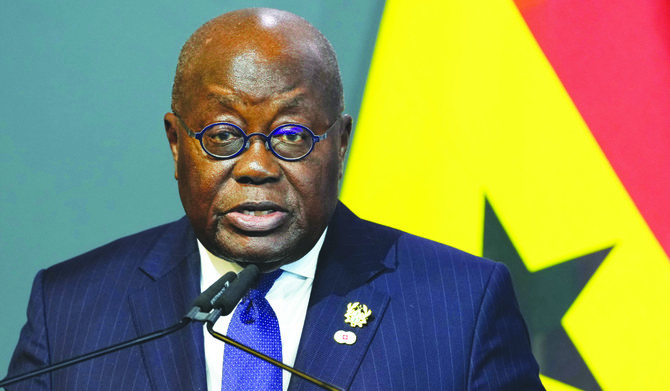
Ghana’s President Nana Addo Dankwa Akufo-Addo. (Supplied)
Short Url
Updated 17 June 2024
Follow

Frustrated Ghanaians brace for more power cuts

  • Nigeria provides Ghana with a percentage of the gas it needs to fire its power-generating plants

ACCRA: Exasperated Ghanaians already grappling with frequent, unplanned power outages are steeling themselves for more misery after electricity distributors announced increased disruption to the grid in the coming weeks.
The blackouts, known as “dumsor” in Ghana’s Akan language, are making it harder to run businesses that are already struggling due to the country’s economic crisis — the worst in a decade.
On Thursday, the Ghana Grid Company and the Electricity Company of Ghana, which distribute power throughout the West African country of 33 million people, said there would be three weeks of load management because of maintenance work by a gas supplier in Nigeria.

FASTFACT

The erratic power supply is tipped to become a key topic in the December presidential election campaign.

Nigeria provides Ghana with a percentage of the gas it needs to fire its power-generating plants.
The announcement came a day after WAPCo, the operator of the pipeline importing gas from Nigeria, also warned there would be a drop in the quantity of gas available because of maintenance work in Nigeria.
The news has exasperated Ghanaians, who are already dealing with frequent power cuts.
“The current unannounced power cuts are already making it very hard to keep my poultry frozen,” said Judith Esi Baidoo, a 50-year-old frozen poultry vendor in Accra.
She added: “Now, with this three-week load management plan, I fear my stock will spoil. I don’t know how my business can survive this.”
The erratic power supply is tipped to become a key topic in the December presidential election campaign.
Timothy Oddoye, who repairs mobile phones in the Accra suburb of Kokomlemle, said: “The government had failed us. They’ve had years to fix these problems, yet we still suffer from the same issues.
“How can we grow our businesses when we can’t even rely on basic electricity?”
Despite being one of the African countries where electrification is most advanced, Ghana continues to experience chronic power shortages.
Domestic electricity production — generated by power plants that are often old and poorly maintained — has struggled to expand in line with rising demand.
According to International Energy Agency figures, Ghana generates 34 percent of its electricity from hydropower and 63 percent from gas.
The country produces oil and gas but still needs to import gas from Nigeria via the 678-km West African Gas Pipeline through Benin and Togo.
“The reliance on gas, especially from external suppliers, leaves us vulnerable,” said Ben Boakye, the Africa Center for Energy Policy executive director.
“The government must prioritize investments in renewable energy and upgrade our existing hydro and thermal plants to ensure consistent power supply.”
Public frustration at the power cuts erupted on June 8, when hundreds of Ghanaians, led by prominent celebrities, took to the streets of Accra to protest against the erratic supply under the slogan #DumsorMustStop.
These power cuts are all the more disturbing for Ghanaians as the country emerges from an economic crisis that saw inflation soar to 54 percent in December 2022.
It fell back to 25 percent in April 2023 but the population still suffers.


More than 100 dead in torrential rain and floods across southern Africa

Updated 5 sec ago
Follow

More than 100 dead in torrential rain and floods across southern Africa

  • South Africa has reported at least 19 deaths in two of its northern provinces following heavy rains
  • Tourists and staff members were evacuated this week by helicopter from flooded camps

JOHANNESBURG: Torrential rains and flooding have killed more than 100 people in South Africa, Mozambique and Zimbabwe, and authorities warned Friday that more severe weather was expected across several countries in southern Africa.
South Africa has reported at least 19 deaths in two of its northern provinces following heavy rains that began last month and led to severe flooding.
Tourists and staff members were evacuated this week by helicopter from flooded camps to other areas in the renowned Kruger National Park, which is closed to visitors while parts of it are inaccessible because of washed out roads and bridges, South Africa’s national parks agency said.
In neighboring Mozambique, the Institute for Disaster Management and Risk Reduction said 103 people had died in an unusually severe rainy season since late last year. Those deaths were from various causes including electrocution from lightning strikes, drowning in floods, infrastructure collapse caused by the severe weather and cholera, the institute said.
The worst flooding in Mozambique has been in the central and southern regions, where more than 200,000 people have been affected, thousands of homes have been damaged, while tens of thousands face evacuation, the World Food Program said.
Zimbabwe’s disaster management agency said that 70 people have died and more than 1,000 homes have been destroyed in heavy rains since the beginning of the year, while infrastructure including schools, roads and bridges collapsed.
Flooding has also hit the island nation of Madagascar off the coast of Africa as well as Malawi and Zambia. Authorities in Madagascar said 11 people died in floods since late November.
The United States’ Famine Early Warning System said flooding was reported or expected in at least seven southern African nations, possibly due to the presence of the La Nina weather phenomenon that can bring heavy rains to parts of southeastern Africa.
South African President Cyril Ramaphosa visited flood-stricken areas in the northern Limpopo province on Thursday and said that region had received around 400 millimeters (more than 15 inches) of rain in less than a week. He said that in one district he visited “there are 36 houses that have just been wiped away from the face of the Earth. Everything is gone ... the roofs, the walls, the fences, everything.”
The flooding occurred in the Limpopo and Mpumalanaga provinces in the north, and the South African Weather Service issued a red-level 10 alert for parts of the country for Friday, warning of more heavy rain and flooding that poses a threat to lives and could cause widespread infrastructure damage.
The huge Kruger wildlife park, which covers some 22,000 square kilometers (7,722 square miles) across the Limpopo and Mpumalanga provinces, has been impacted by severe flooding and around 600 tourists and staff members have been evacuated from camps to high-lying areas in the park, Kruger National Park spokesperson Reynold Thakhuli said.
He couldn’t immediately say how many people there were in the park, which has been closed to visitors after several rivers burst their banks and flooded camps, restaurants and other areas. The parks agency said precautions were being taken and no deaths or injuries had been reported at Kruger.
The South African army sent helicopters to rescue other people trapped on the roofs of their houses or in trees in northern parts of the country, it said. An army helicopter also rescued border post officers and police officers stranded at a flooded checkpoint on the South Africa-Zimbabwe border.
Southern Africa has experienced a series of extreme weather events in recent years, including devastating cyclones and a scorching drought that caused a food crisis in parts of a region that often suffers food shortages.
The World Food Program said more than 70,000 hectares (about 173,000 acres) of crops in Mozambique, including staples such as rice and corn, have been waterlogged in the current flooding, worsening food insecurity for thousands of small-scale farmers who rely on their harvests for food.