

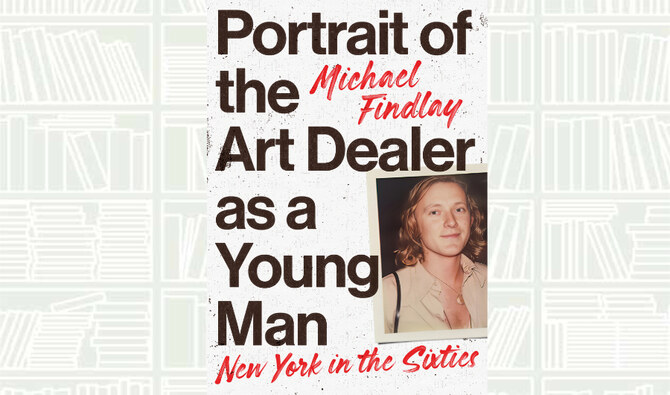
What We Are Reading Today: Portrait of the Art Dealer as a Young Man: New York in the Sixties

Photo/Supplied
Short Url
Updated 20 September 2024
Follow

What We Are Reading Today: Portrait of the Art Dealer as a Young Man: New York in the Sixties

  • On the subject of his birth, he writes: “I wriggled out of my mother’s womb in Dunoon, a fishing village on the River Clyde an hour from Glasgow, just as the Second World War was ending”

Author: Michael Findlay

If you ever wanted to be a fly on the wall during the New York art scene in the 1960s and 1970s, Michael Findlay’s memoir, “Portrait of the Art Dealer as a Young Man: New York in the Sixties,” provides a front-row seat on the happenings of the time.

Findlay, a high school drop-out who grew up in Scotland, found himself in the company of arguably one of the most famous — or infamous — American artists at the time, Andy Warhol. They became friends. Findlay also rubbed shoulders with some of the most influential artists and art collectors of that era and became one of the most seasoned art dealers, acquiring pieces from some of the most sought-after artists. How did this happen? Why did it happen?

In this book, he shows and doesn’t just tell.

On the subject of his birth, he writes: “I wriggled out of my mother’s womb in Dunoon, a fishing village on the River Clyde an hour from Glasgow, just as the Second World War was ending.”

Each of the pages is full of colorful antedates that are just as animated and articulate.

Fans of his work might know him from his previous books, “The Value of Art: Money, Power, Beauty,” as well as his other book, “Seeing Slowly: Looking at Modern Art.”

As one of the first art gallery directors in trendy SoHo in New York City, an industry he is still very active in, Findlay offers insights into the vibe and energy at the time, with intimate recollections about famous painters, sculptors, art deals and collectors, as well as anyone from the creative industry during those decades. Findlay certainly found himself in the middle of the action. His book is candid, descriptive and full of surprises.

He dedicates the book to “Victoria, my wife now and forever,” who is an art conservator and writer.

Today, Findlay is a director of Acquavella Galleries in New York and considers himself to be a “poet, essayist and author.”

Twentieth-century cultural history buffs — and those who are invested in the post-World War II art market or the crazy and chaotic art scene of 1960s and 1970s New York — will find this book a page-turner.


‘Maghras’ carries Al-Ahsa’s experimental farm from oasis to page

Updated 32 sec ago
Follow

‘Maghras’ carries Al-Ahsa’s experimental farm from oasis to page

AL-AHSA: Beneath a full moon and swaying palm trees, “Maghras: A Farm for Experimentation” was launched this month in Al-Ahsa, drawing a full crowd to Al-Sbakh Farm — the very landscape that inspired it.

Al-Ahsa, in Saudi Arabia’s Eastern Province, is home to 2.5 million date palms and is officially the largest palm oasis in the world, according to the Guinness Book of Records.

That agricultural abundance forms the foundation of Maghras, a project founded in 2024 by longtime friends Lulu Almana and Sara Al-Omran, who both grew up in the Eastern Province. Conceived as a space for experimentation, research and dialogue, Maghras centers on Al-Ahsa’s agricultural and cultural heritage.

The farm that hosts the project, Al-Sbakh, was established by the late Noura Al-Mousa, who worked alongside farmers and craftspeople for decades. Today, it is managed by her son’s Abdulmohsen Al-Rashed Humanitarian Foundation, alongside Dar Noura Al-Mousa for Culture and Arts, housed in her former home.

Earlier this year, Maghras traveled beyond the oasis. Curated by Almana and Al-Omran with US-based creative director Alejandro Stein, the project was presented at the Triennale di Milano from May 13 to Nov. 9, 2025 — marking the Kingdom’s inaugural participation. Commissioned by the Architecture and Design Commission under the Ministry of Culture, the pavilion took the form of a transplanted maghras, a traditional land unit defined by four palm trees.

The newly launched book, edited by Almana and Al-Omran alongside longtime collaborator Latifa Al-Khayat, extends that journey. Divided into five chapters — Water, Land, Infrastructure, Proximities and Lineages — it weaves imagery and text to document the farm’s evolving agro-ecosystems and seasonal harvest.

Featuring illustrations by Nada Al-Mulla and maps by Hayes Buchanan, and printed by Grafiche Mariano, Italy, and published by Kaph Books, the bilingual volume can be read in English or Arabic with identical wording.

Prince Nawaf bin Ayyaf, CEO of the Architecture and Design Commission, delivered opening remarks at the launch and is featured throughout the publication and the project’s journey.

The book is not a catalogue of the Milan activation. Instead, it captures the spirit of the experimental farm, including commissioned works by Leen Ajlan, Sawtasura (Tara Al-Dughaither), and Mohammad Al-Faraj. Developed through research and workshops circling the central maghras, the publication brings together insights, origin stories and first-person essays.

With attendees crossing from neighboring Bahrain and generations of Hasawi elders and emerging voices gathered under the palms, the launch underscored Maghras’s central premise: rooted in Al-Ahsa, yet reaching far beyond it.