


BEIRUT: Israel killed a top Hezbollah commander in an airstrike on Beirut’s southern suburbs on Friday, sharply escalating the year-long conflict between Israel and the Iran-backed group.
The target was Hezbollah’s operations commander Ibrahim Aqil, who served on the group’s top military body.
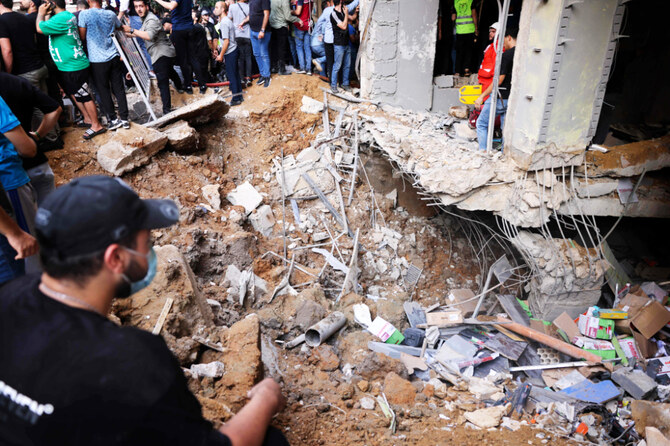
Aqil was killed alongside members of Hezbollah’s elite Radwan Unit as they were holding a meeting in a 10-story building in the area of Al-Jamous, sources said.
The strike killed 16 people and wounded 66 others.
A number of people went missing following the strike, and families were searching for their children and relatives.
Sources told Arab News that Aqil and his colleagues were holding the meeting in an underground room, and therefore rescue workers were not able to retrieve their bodies four hours after the explosion.
An eyewitness told Arab News: “The strike leveled the building, which was residential, and it is difficult to determine the number of victims inside.”
Israeli media reported that the target, Aqil, was a “prominent Hezbollah member who directs the fighting in southern Lebanon.”
The US State Department had previously offered a reward of up to $7 million for information leading to Aqil’s arrest, stating that he is a “member of Hezbollah’s Jihad Council and accused of the 1983 bombings of the Marine barracks and the US Embassy.”
Black smoke was seen rising from the site as people fled in all directions.
Hezbollah ambulances arrived at the scene, and paramedics were seen pulling out the injured, including children and the elderly. Hezbollah members quickly cordoned off the area.
The Israeli army described its attack as a “precise operation,” targeting a senior Hezbollah official.
The targeted building is near the Al-Qaem Mosque, which is affiliated with Hezbollah, and the area is considered within the party’s security zone.
This operation is the third of its kind targeting Beirut’s southern suburb, following the assassination of Hezbollah military official Fuad Shukr a month ago, and prior to that, Hamas leader Saleh Al-Arouri in January.
The operation comes amid a military escalation between Hezbollah and the Israeli army following mass explosions that targeted communication devices used by Hezbollah members on Tuesday and Wednesday, resulting in dozens of deaths and thousands of injuries.
On Friday, Hezbollah launched dozens of rockets toward Israeli military sites, one of which hit Al-Ulayqa base for the first time, located north of Katzrin in the occupied Syrian Golan Heights, approximately 20 km from the Lebanese border.
The escalation coincided with Hezbollah chief Hassan Nasrallah’s Thursday speech, in which he vowed retaliation against Israel for its crime.
He described the explosions that hit the party as “major Israeli aggression that will face a severe reckoning and just retribution.”
Nasrallah added: “The real news is in what you will see, not what you will hear, and we are keeping it within a tight circle.”
Hezbollah launched Katyusha rockets at the 210th Golan Division headquarters in Nafah, and targeted the “command headquarters of the Golan Division’s military gathering at Yarden barracks,” the “headquarters of rocketry and artillery battalion in Yoav barracks,” and the “newly established headquarters of the 91st Division at Ayelet HaShahar.”
Israeli media reported that “Hezbollah launched around 150 rockets, with the last salvo consisting of 20 rockets aimed at the Meron airbase in Upper Galilee.”
In the last 24 hours, Hezbollah continued to shell the Metula site, targeting, according to its statement, “Israeli soldiers’ position with a guided missile.”
The Israeli side confirmed that rockets hit the site. Hezbollah also struck “the main air defense base of the Northern Command at the Birya barracks with volleys of Katyusha rockets.”
The Israeli army confirmed that “two soldiers were killed and nine others injured in Hezbollah’s attacks on the border with Lebanon.” The army’s statement added: “The remaining injuries were caused by drone explosions that targeted Western Galilee.”
Since Thursday night and well into Friday, the Israeli army bombarded the southern Lebanese border areas with dozens of artillery shells, airstrikes, and ground sweeps from its military positions.
Israel’s Channel 14 reported: “The Israeli army will increase its attacks on Lebanon, with the number reaching dozens daily, starting this evening. Lebanon, not Gaza, is now Israel’s primary battlefield.”
The Israeli shelling on the town of Beit Lif resulted in the death of Hezbollah member Youssef Mohammed Al-Sayyed. Another member, Ali Hassan Al-Zein, was also mourned by Hezbollah.
Heavy shelling targeted Aita Al-Shaab, the outskirts of Alma Al-Shaab, Mays Al-Jabal, Odaisseh, Kfarkila, Al-Taybeh and Kfarshouba. Wadi Zebqine and the western sector were also subject to Israeli artillery shelling.
Israeli warplanes launched airstrikes on Odaisseh, Al-Taybeh, Aitaroun, Yaroun, Hanin and Aita Al-Shaab in Bint Jbeil.
Shortly after Nasrallah’s speech, the Israeli army carried out around 70 raids in 20 minutes over forested mountain areas in Mahmoudieh, Aaichiyeh, Al-Rehan and the surroundings of the Barghaz River in the south.
These raids caused “mountains to evaporate,” according to witnesses.
The Israeli army claimed that “it is attacking Hezbollah targets to damage and destroy its terrorist capabilities and military infrastructure.”
Israeli army spokesperson Avichay Adraee claimed that “air force fighter jets targeted hundreds of launch barrels set to immediately fire toward Israeli territory.”
Adraee stated that the Israeli army struck “over 100 rocket launchers and additional military infrastructures containing 1,000 launch barrels ready for immediate shooting.”
Adraee accused Hezbollah of “turning southern Lebanon into a war zone.”
He said: “For decades, Hezbollah has weaponized civilian homes, dug tunnels beneath them, and used civilians as human shields. The Israeli army is operating to bring security to northern Israel in order to enable the return of residents to their homes, and to achieve all the war goals.”
Israeli public broadcaster Kan announced that “Israel’s army chief, Lt. Gen. Herzi Halevi, has approved battle plans for the northern front.”
In a separate statement, Israeli Minister of Defense Yoav Gallant announced that “he has been deliberating the various possibilities of the evolution of the campaign against Hezbollah on the northern border.”
Gallant said: “This is a new phase in the war; it has significant opportunities, but also heavy risks.”
He noted that “Hezbollah is feeling chased, and the sequence of our military operations will continue.”
Sabrina Singh, the Pentagon’s deputy press secretary, told Sky News Arabia that “Washington believes that the war between Israel and Lebanon is not imminent.
“The best way to lessen tensions on the Lebanese and Gazan fronts is through diplomatic means.”


