UN peacekeepers in Lebanon urge immediate de-escalation

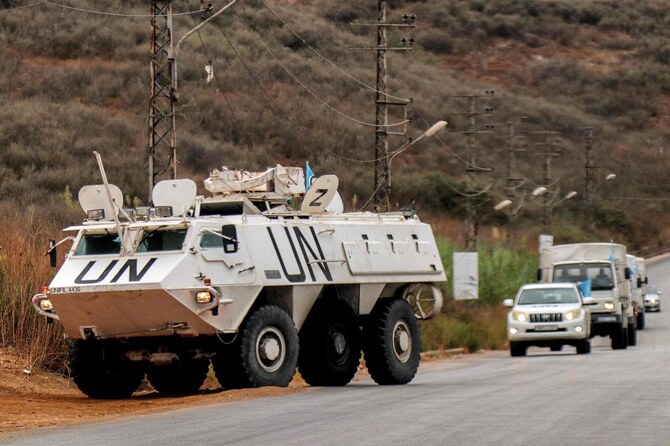
An armored personnel carrier of the United Nations Interim Force in Lebanon (UNIFIL) patrols along Al-Khardali road in south Lebanon on September 17, 2024. (AFP)
Short Url
Updated 20 September 2024
Follow

UN peacekeepers in Lebanon urge immediate de-escalation

  • Israel and the Iran-backed Hezbollah have been trading fire for almost a year

BEIRUT: The UN peacekeeping force in south Lebanon urged de-escalation on Friday after a big increase in hostilities at the Lebanese-Israeli border, where Israel and the Iran-backed Hezbollah have been trading fire for almost a year.
The UNIFIL force had witnessed “a heavy intensification of the hostilities across the Blue Line” and throughout its area of operations, spokesperson Andrea Tenenti told Reuters.
“We are concerned at the increased escalation across the Blue Line and urge all actors to immediately de-escalate,” he said.
The Blue Line refers to the frontier between Lebanon and Israel.
Late on Thursday, Israeli warplanes carried out their most intense strikes on southern Lebanon of the conflict.
It followed attacks this week which blew up thousands of pagers and walkie-talkies used by Hezbollah, killing at least 37 people and wounding thousands more.


Syria transition ‘fragile’, one year on: UN investigators

Updated 2 sec ago
Follow

Syria transition ‘fragile’, one year on: UN investigators

GENEVA: Syria’s transition is fragile, one year on from the overthrow of ruler Bashar Assad, and the country’s cycles of vengeance and reprisal need to end, United Nations investigators said Sunday.
Syrians have been marking the first anniversary since Islamist-led forces pressed a lightning offensive to topple Assad on December 8, 2024 after nearly 14 years of war.
The UN Independent International Commission of Inquiry on Syria investigates and records all international human rights law violations since March 2011 in the country.
The panel congratulated Syria on the steps it has taken so far to address the crimes and abuses inflicted during previous decades.
But it said violent events since Assad’s downfall had caused renewed displacement and polarization, “raising worries about the future direction of the country.”
The commission said the “horrific catalogue” of abuse inflicted by Assad’s regime “amounted to industrial criminal violence” against Syria’s people.
“The cycles of vengeance and reprisal must be brought to an end, so that Syria can continue to move toward a future as a state that guarantees full respect for the human rights of all its people, with equality, the rule of law, peace and security for all in name and in deed,” the commission said.
“Syria’s transition is fragile. While many across the country will celebrate this anniversary, others are fearing for their present security, and many will sleep in tents again this winter. The unknown fate of many thousands who were forcibly disappeared remains an open wound.”
The commission said moving beyond the legacy of war and destruction would take “great strength, patience and support.”
“The Syrian people deserve to live in peace, with full respect for rights long denied, and we have no doubt they are up to the task,” it said.
The three-person commission is tasked with establishing facts with a view to ensuring that the perpetrators of violations are ultimately held accountable.
The UN Human Rights Council extended its mandate for a further year in April.