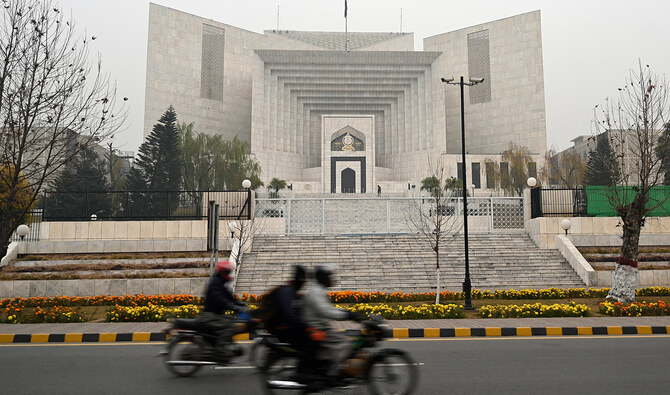
ISLAMABAD: President Asif Ali Zardari on Friday signed into law the Supreme Court (Practice and Procedure) Amendment Ordinance 2024, legislation widely believed to have curtailed the powers of the country’s senior judiciary and which was passed by parliament last year but blocked by the top court.
The Supreme Court (Practice and Procedure) Act 2023 was passed in the last days of the first term in government of Prime Minister Shehbaz Sharif. However, before the law could be enacted on April 21, 2023, an eight-member bench constituted by then Chief Justice Umar Ata Bandial issued a stay order on it on April 13, 2023.
“Every cause, appeal, or matter before the Supreme Court shall be heard and disposed of by a Bench comprising the Chief Justice of Pakistan, the next most senior judge of the Supreme Court and a Judge of the Supreme Court nominated by the Chief Justice of Pakistan from time to time,” the ordinance, which was signed into law, said.
One provision, which is widely seen as limiting the power of Supreme Court judges to initiate cases of public importance or fundamental laws on their own through suo moto proceedings, said a bench hearing a matter under Article 184(3) of the constitution would decide and identify through a “reasoned and speaking order” the question of public importance in the case and what fundamental right it was seeking to enforce.
Article 184 of the constitution confers original jurisdiction, the authority to hear a case at its initiation, often referred to as Public Interest Litigation, in the form of judicial review to Pakistan’s Supreme Court. Clause (3) of Article 184 is cited as the source of suo motu powers. In essence, it gives the apex court the extraordinary power to assume jurisdiction over any “question of public importance with reference to the enforcement of any fundamental right”.
Under the new law, each case would be heard in turn, that is the cases filed first will be heard first, and a reason furnished for taking up cases out of turn. All hearings will be recorded and transcripts publicly available.
Hearings on petitions against the Supreme Court (Practice and Procedure) Act 2023 began in September 2023 and were broadcast live by Pakistan’s state television.
Chief Justice Qazi Faez Isa had taken up the petitions challenging the law as his first order of business shortly after taking oath the same month and had constituted a full-court bench of the apex court comprising all 15 judges.


![]()

Much-debated Pakistan Supreme Court Practice and Procedure Ordinance becomes law
Short Url
https://arab.news/b5eqf
Much-debated Pakistan Supreme Court Practice and Procedure Ordinance becomes law
- Supreme Court cases to be heard by bench comprising chief justice, next most senior judge and SC judge nominated by CJ
- The law is widely seen as curtailing the powers of the senior judiciary to initiate cases on their own through suo moto proceedings
Latest updates


© 2026 SAUDI RESEARCH & PUBLISHING COMPANY, All Rights Reserved And subject to Terms of Use Agreement.