

Speaker tells Pakistan election body to ‘honor’ parliament’s laws amid tensions with judiciary

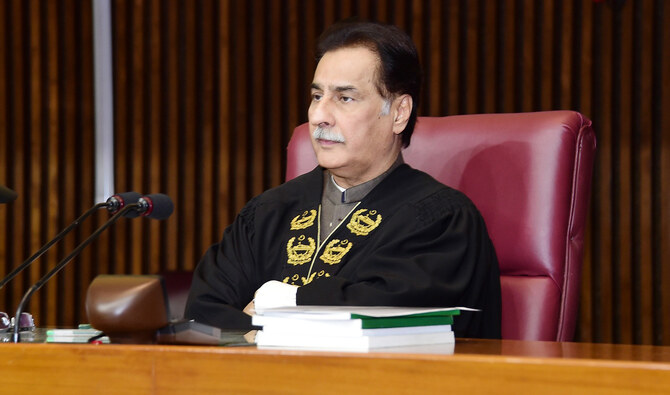
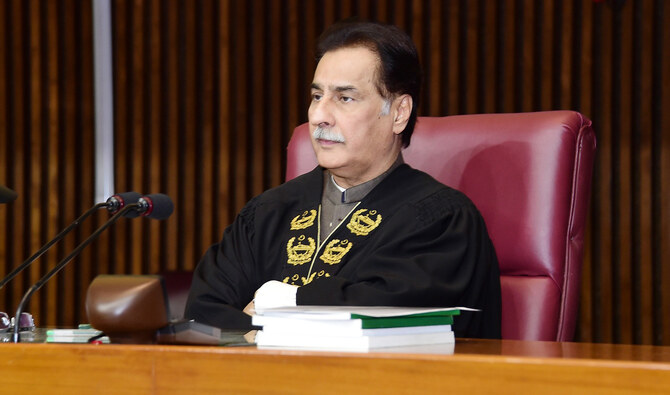
Pakistan’s National Assembly Speaker Sardar Ayaz Sadiq chairs a session of the lower house in Islamabad, Pakistan on September 16, 2024. (@NAofPakistan/X)
Short Url
Updated 19 September 2024
Follow

Speaker tells Pakistan election body to ‘honor’ parliament’s laws amid tensions with judiciary

  • Pakistan’s top court in July ruled that ex-PM Khan’s party is entitled to reserved seats in parliament for women and minorities
  • Sharif’s government last month amended country’s election law that restricts allottment of reserved seats to ex-PM Khan’s party 

ISLAMABAD: Pakistan’s National Assembly Speaker Sardar Ayaz Sadiq on Thursday told the country’s electoral body that amendments made to Pakistan’s election laws last month would supersede a prior ruling of the top court related to reserved seats in parliament, raising fears of a standoff with the Supreme Court. 

Sadiq’s letter to the Election Commission of Pakistan (ECP) came after the Supreme Court censured the election regulatory authority last week for what it said were “dilatory tactics” to avoid implementing a judgment on reserved seats for women and minorities in the national and provincial legislatures that favored the opposition Pakistan Tehreek-e-Insaf (PTI) party. 

In a verdict on July 12, a 13-member bench of the court declared the PTI of Pakistan’s jailed former prime minister Imran Khan eligible for reserved seats after the ECP forced the party’s candidates to contest the February 8 polls as independents. After the election, the PTI-backed candidates were forced to join Sunni Ittehad Council (SIC) party to claim a share of the reserved seats as independents are not eligible for the extra seats.

The Supreme Court overturned the ECP’s decision, saying it had misconstrued an earlier verdict related to the party’s election symbol by depriving the PTI of the reserved seats. The verdict was a blow to the ruling coalition government led by Prime Minister Shehbaz, which could lose its two-thirds majority if the verdict is implemented. 

In August, Pakistan’s parliament passed the Elections (Second Amendment) Bill, 2024, which restricted granting the reserved seats in parliament to the PTI. The bill says that if a candidate does not submit a declaration of his affiliation with a political party to the returning officer before seeking the allotment of an election symbol, he or she shall be “deemed to be considered as an independent candidate and not a candidate of any political party.” 

“As the judgment of the SC was rendered based on the law prior to the enactment of the amendment, the said judgment is now incapable of implementation,” Sadiq wrote in a letter to the ECP. 

“Instead, it is the Amended Election Act that shall prevail and supersede the prior ruling.”

He pointed out that the consistent jurisprudence of the Supreme Court also held the view that the parliamentary law was superior to the court’s order. 

“It is also brought to your kind notice that the Amended Election Act is in the field, therefore, it is the statutory obligation of the ECP to honor the laws made by Parliament and uphold the principles of democracy and parliamentary supremacy,” the letter said. 

He warned that actions perceived to be undermining parliament’s sovereignty can “erode public trust and confidence in our institutions.”

CONSTITUTIONAL AMENDMENTS

The development takes place at a time when Sharif’s coalition government is planning to get a constitutional amendment passed from parliament to allegedly give an extended term to the country’s top judge. 

The amendment requires a two-thirds majority in both houses of parliament, though the coalition can lose a portion of its existing number of seats after the Supreme Court’s July 12 ruling on reserved seats gets implemented. 

The package of reforms, widely believed to include as many as 22 amendments to the constitution, is expected to increase the retirement age of superior judges by three years and change the process by which the Supreme Court chief justice is appointed.

The amendments have raised widespread concerns among opposition parties and legal experts who say the moves are aimed at increasing the government’s power in making key judicial appointments and dealing with the defection of lawmakers during house votes. 


Pakistan rules out military operation in northwestern Tirah Valley 

Updated 1 min 16 sec ago
Follow

Pakistan rules out military operation in northwestern Tirah Valley 

  • Residents in the northwestern Tirah Valley fled their homes this month fearing a military operation against militants
  • Khawaja Asif says army conducting intelligence-based operations in area, migration “routine” practice due to harsh cold 

ISLAMABAD: Defense Minister Khawaja Asif on Tuesday clarified that the military was not conducting a military operation in the northwestern Tirah Valley, saying that the ongoing residents’ migration from the area was a routine practice due to the harsh cold in the area during the winter season. 

The defense minister’s clarification came as residents of Tirah Valley in Pakistan’s northwestern Khyber Pakhtunkhwa (KP) province bordering Afghanistan fled their homes this month, fearing a planned military operation by the army against militants, particularly the Tehreek-e-Taliban Pakistan (TTP) group. 

Pakistan’s information ministry on Sunday issued a clarification that the armed forces were not involved in the “depopulation” of the valley. It pointed to a notification from the provincial Khyber Pakhtunkhwa Relief, Rehabilitation and Resettlement Department in December which demanded the release of funds, reportedly Rs4 billion [$14.24 million], for the voluntary movement of people from Tirah Valley. 

Speaking to reporters at a news conference alongside Information Minister Attaullah Tarar and Special Assistant to the PM for Information and KP Affairs Ikhtiar Wali Khan, Asif said the last military operation in the area was conducted several years ago. He said the military had decided that intelligence-based operations (IBOs) were more effective than military operations as they resulted in lower civilian casualties. 

“So over a long period of time, the army gave up [military] operation in favor of IBOs,” Asif said. “For many years this practice has been continuing. Hence, there is no question of an operation there.”

The defense minister described the migration of residents from Tirah Valley as a “routine” practice that has been taking place since decades due to the freezing cold in the winter season. 

He criticized the provincial government, led by the Pakistan Tehreek-e-Insaf (PTI) party for not serving the people of the area, accusing it of not building any schools, hospitals, or police stations in Tirah Valley.

Asif said around 400-500 TTP members lived in the valley with their families, alleging that hemp was being harvested there on over 12,000 acres of land. He said that while hemp is also used for medicinal and construction purposes, its dividends were going to militants and politicians. 

“All of this hemp is harvested there and the dividends from it either go to the people associated with politics or the TTP,” the minister said.

“We have initiated the process to stop this so that the people benefit from this harvest and so that schools and hospitals are constructed there.”

The minister said that a district-level jirga or tribal council met representatives of the KP government on Dec. 11, 24 and 31 to decide matters related to the residents’ migration in the area. 

Holding up the KP Relief, Rehabilitation and Resettlement Department notification, Asif said:

“In the presence of this notification, in the presence of this tribal council and in the presence of all of these things, where do you see the army?“

The minister accused the provincial government of deflecting its “failures” in the province to the armed forces or to a military operation that did not exist. 

The migration has exposed tensions between the provincial government and the military establishment over the use of force in the region.

KP Law Minister Aftab Alam Afridi said earlier this month that the provincial government will not allow a military operation to take place in the area, arguing that past military campaigns had failed to deliver lasting stability.