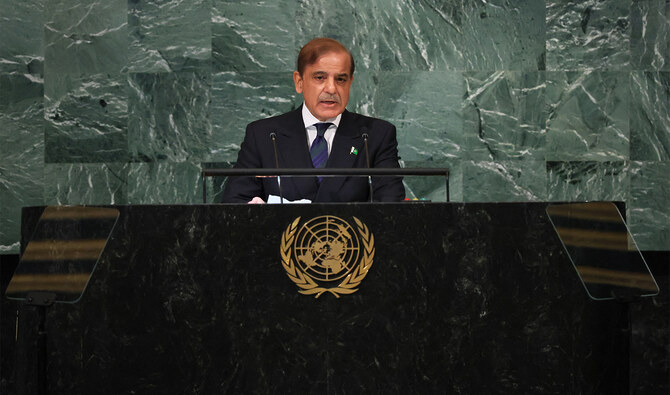
ISLAMABAD: Prime Minister Shehbaz Sharif will participate in the high-level segment of the 79th Session of the United Nations General Assembly (UNGA) in New York from September 23 to 27, Pakistan’s foreign office said on Thursday.
Each September, world leaders and delegates gather at the UN Headquarters in New York to discuss the most pressing global issues within the framework of the UN Charter. The UNGA opened the 79th session on September 10, with the high-level general debate scheduled to begin on September 24 and conclude on September 30.
“Prime Minister Muhammad Shehbaz Sharif will participate in the high-level segment for the 79th Session of the UN General Assembly in New York from 23rd to 27th of September,” the foreign office spokesperson, Mumtaz Zahra Baloch, said during her weekly news briefing in Islamabad.
She noted that Sharif would be accompanied by Deputy Prime Minister Ishaq Dar and other senior government officials.
In his address to the world body, the prime minister will emphasize the importance of addressing longstanding issues on the Security Council’s agenda, including the question of Palestine and the Jammu and Kashmir dispute, she added.
“The prime minister will attend several high-level meetings on the sidelines of the UNGA session including the high-level meeting on existential threat posed by sea level rise and the UN Security Council’s open debate on leadership for peace,” she said, adding that his program would also include bilateral meetings with world leaders and members of the Pakistani diaspora.
INDUS WATER TREATY
Asked about the notice sent by India to Pakistan under Article 33 of the Indus Water Treaty, calling for the reassessment of the agreement on a bilateral basis, Baloch said Pakistan expected India to remain committed to the accord.
India sent a notice to Pakistan on August 30, requesting a review of the water-distribution mechanism outlined in the treaty, signed by the two countries on September 19, 1960, citing “fundamental and unforeseen” changes in circumstances.
The treaty, brokered by the World Bank, grants India control over the Beas, Ravi, and Sutlej rivers, while Pakistan controls the Indus, Chenab, and Jhelum rivers. Both nations can seek arbitration from the World Bank in case of any water disputes.
In 2016, Pakistan requested arbitration over India’s Kishanganga and Ratle hydropower projects. While India claims its water usage complies with the treaty, Pakistan opposes some of these projects, arguing they violate the agreement, which is crucial for its agriculture as 80 percent of the country relies on the Indus River.
“The Indus Waters Treaty is an important treaty that has served both Pakistan and India well over the last several decades,” Baloch said, adding that Pakistan believed it was a “gold standard” of bilateral treaties on water sharing.
“Pakistan is fully committed to its implementation, and we expect India to also remain committed to the treaty,” she added.
The spokesperson said Pakistan believes it is a collective responsibility to maintain ecological balance, protect the environment, and avoid measures that may have adverse implications for the region’s climate.
“The two countries have a mechanism of water commissioners, and we believe all issues pertaining to this treaty can be discussed in this mechanism,” she added.
PAKISTAN’S NATIONAL ANTHEM
Responding to a query about the incident of purported disrespect toward Pakistan’s national anthem during a ceremony in Peshawar by an Afghan diplomat, Baloch said Pakistan had rejected the explanation the acting consul general provided for his actions and lodged a strong protest with Afghan authorities.
Videos circulated on social media showed Afghan Consul General Mohibullah Shakir seated while the Pakistani anthem was played during a religious conference, as others stood in respect. According to a representative of the Afghan diplomatic mission, Shakir had no intention of disrespecting Pakistan, explaining that he did not stand because of the background music.
He further maintained that Afghan authorities had banned their own national anthem for the same reason.
The Afghan Taliban believe music is forbidden in Islam, though several schools of thought within the same religion do not agree with their stance.
“We have raised this issue with the Afghan authorities and conveyed our strong displeasure on this and we also reject the explanation that the acting council general has given for his actions,” Baloch said, adding that Pakistan believed this action had hurt the sentiments of its people.
Asked about a media report suggesting that Shakir had been staying in Pakistan without valid documentation, she said, according to available data, the acting Afghan consul general was in possession of a valid visa and enjoyed diplomatic status.
She also mentioned Pakistan’s Special Representative for Afghanistan Asif Durrani’s recent termination from his position, saying such appointments were made by the government based on the country’s requirements at specific times.
“Ambassador Asif Durrani was appointed as Special Representative of Pakistan for Afghanistan in May 2021 and after serving three years in this position, the government has decided to terminate his contract,” she said, adding it had been done in keeping with the present requirements.
“No decision has been made so far on his replacement,” she added.


![]()

Pakistan PM to attend UNGA from Sept. 23-27, focus on highlighting Gaza and Kashmir
Short Url
https://arab.news/pbuu9
Pakistan PM to attend UNGA from Sept. 23-27, focus on highlighting Gaza and Kashmir
- PM to attend several high-level sideline meetings including on existential threat of sea level rise, leadership for peace
- UNGA opened the 79th session on Sept. 10, with high-level general debate scheduled to begin on Sept. 24
Latest updates


© 2026 SAUDI RESEARCH & PUBLISHING COMPANY, All Rights Reserved And subject to Terms of Use Agreement.