ISLAMABAD: Pakistan’s top diplomat at the United Nations has warned the world of the “terrorist” threat from Afghanistan, according to an official statement released on Thursday, noting that the situation in that country continues to remain unstable three years after the Taliban administration assumed power.
Pakistan has faced a sharp rise in militant violence in recent years and attributed this surge to armed factions allegedly based in Afghanistan. Officials in Islamabad have particularly raised concern over the presence of the outlawed Tehreek-e-Taliban Pakistan (TTP), a group responsible for carrying out deadly suicide attacks targeting civilians, security forces and Chinese nationals involved in large-scale energy and infrastructure projects.
Last year, Pakistan accused the Afghan government of “facilitating” the TTP, which led to a deportation drive against Afghan immigrants, resulting in the expulsion of over 700,000 of them from the country.
The Afghan authorities deny any involvement in Pakistan’s security problems and have objected to Pakistan’s decision to expel its citizens.
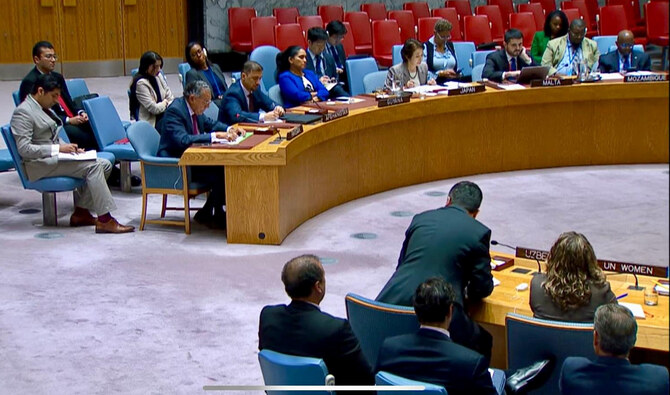
“Given its long association with Al Qaeda, it will not be long before the TTP becomes the spearhead for Al Qaeda’s planned regional and global terrorist goals,” Ambassador Munir Akram told a UN Security Council meeting on the current situation in Afghanistan.
“Thus, while some of our friends may believe that they are only threatened by ISIL-K [Islamic State of Iraq and the Levant-Khorasan] i.e. Daesh, they should also be concerned by the threat they could confront from a strengthened TTP in the not too distant future,” he added.
The Pakistani envoy noted the 34th report of the UN monitoring team has highlighted the “disturbing dimension of terrorism emanating from Afghanistan.”
Indicating the TTP’s potential of causing regional destabilization, he said it was fast emerging as an umbrella organization that was now coordinating with Baloch secessionist groups targeting Pakistan’s southwestern province.
“It is clear that Afghanistan is nowhere near normalization three years after the Taliban assumed power,” he added. “There will be no normalization until the fundamental issues that trouble Afghanistan are addressed: terrorism, human rights, political inclusion, illegal Afghan migration and the problem of Afghan refugees.”
Ambassador Akram reaffirmed Pakistan’s commitment to supporting a peaceful and stable Afghanistan, as he pointed out the necessity of greater political inclusion which he described as vital for enhancing the prospects of stability and normalization within that country.
He also expressed concern the human rights situation in the country, particularly in relation to women and girls.
“Instead of easing earlier restrictions, the Afghan Interim Government has doubled down on misogyny with new edicts to literally stifle the voices of women and girls,” he said. “We are especially appalled that these abhorrent measures are being justified by reference to Islam.”
“These backward and obscurantist measures violate the principles of our enlightened religion which was the first to uphold equal rights for men and women,” he added.
The Pakistani envoy said his country was committed to expanding trade and commercial relations with Afghanistan and remained a key partner in implementing regional infrastructure and connectivity projects to enhance economic stability and growth in the region.


![]()

Pakistan warns UN of ‘terrorist’ threat from unstable Afghanistan under Taliban rule
Short Url
https://arab.news/cn6ge
Pakistan warns UN of ‘terrorist’ threat from unstable Afghanistan under Taliban rule
- Munir Akram says Afghanistan is nowhere near normalization three years after the Taliban assumed power
- He maintains Pakistan wants to expand trade ties with Afghanistan and continue efforts for regional connectivity
Latest updates


© 2026 SAUDI RESEARCH & PUBLISHING COMPANY, All Rights Reserved And subject to Terms of Use Agreement.