

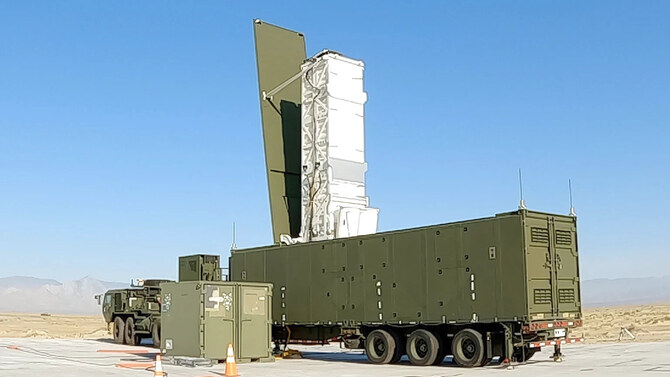

MANILA: The United States has no immediate plans to withdraw a mid-range missile system deployed in the Philippines, despite Chinese demands, and is testing the feasibility of its use in a regional conflict, sources with knowledge of the matter told Reuters.
The Typhon system, which can be equipped with cruise missiles capable of striking Chinese targets, was brought in for joint exercises earlier this year, both countries said at the time, but has remained there.
The Southeast Asian archipelago, Taiwan’s neighbor to the South, is an important part of US strategy in Asia and would be an indispensable staging point for the military to aid Taipei in the event of a Chinese attack.
China and Russia condemned the move – the first deployment of the system to the Indo-Pacific – and accused Washington of fueling an arms race.

Breakdown of a Typhon MRC battery's structure and components. (US Army illustration via Wikimedia Commons)
The deployment, some details of which have not been previously reported, comes as China and US defense treaty ally the Philippines clash over parts of the hotly contested South China Sea. Recent months have brought a series of sea and air confrontations in the strategic waterway.
Philippine officials said Filipino and US forces continued to train with the missile system, which is in northern Luzon, which faces the South China Sea and is close to the Taiwan Strait, and they were not aware of immediate plans to return it, even though the joint exercises end this month.
A Philippine army spokesman, Col. Louie Dema-ala, told Reuters on Wednesday that training was ongoing and it was up to the United States Army Pacific (USARPAC) to decide how long the missile system would stay.
A public affairs officer for USARPAC said that the Philippine army had said the Typhon could stay beyond September and soldiers trained with it as recently as last week, engaging “in discussions over employing the system, with a focus on integrating host nation support.”
A senior Philippine government official, who spoke on condition of anonymity, and another person familiar with the matter said the USand the Philippines were testing the feasibility of using the system there in the event of a conflict, trialing how well it worked in that environment.
The government official said the Typhon — a modular system, which is intended to be mobile and moved as needed — was in the Philippines for a “test on the feasibility of deploying it in country, so that when the need arises, it could easily be deployed here.”
The office of Philippine President Ferdinand Marcos Jr did not respond to a request for comment.
‘Sleepless nights’
The US army flew the Typhon, which can launch missiles including SM-6 missiles and Tomahawks with a range exceeding 1,600 km (994 miles), to the Philippines in April in what it called a “historic first” and a “significant step in our partnership with the Philippines.”
A note by the US Congressional Research Service, a policy institute of the USCongress, published at the time said it was “not known if this temporary deployment could eventually become permanent.”
In July, army spokesman Dema-ala confirmed the Typhon missile launcher remained in the Philippines’ northern islands and said there was no specific date as to when it would be “shipped out,” correcting an earlier statement that it was due to leave in September.
A satellite image taken on Wednesday by Planet Labs, a commercial satellite firm, and reviewed by Reuters showed the Typhon at the Laoag International Airport, in Ilocos Norte province.

A satellite image of the Typhon missile system at Laoag International Airport in the northern Philippine city of Laoag, released on September 18, 2024, by Planet Labs Inc. (REUTERS)
Jeffrey Lewis, director of the East Asia Nonproliferation Program at the James Martin Center for Nonproliferation Studies, who analyzed the images, said the system remained.
The senior government official who spoke to Reuters said there were no immediate plans to withdraw it.
“If ever it will be pulled out, it is because the objective has been achieved and it may be brought (back) in after all the repairs or the construction would have been done,” the official said, adding that there was strategic value for the Philippines in keeping the system to deter China.
“We want to give them sleepless nights.”
Anti-ship weapons
The US has been amassing a variety of anti-ship weapons in Asia, as Washington attempts to catch up quickly in an Indo-Pacific missile race in which China has a big lead, Reuters has reported.
Although the US military has declined to say how many will be deployed in the Indo-Pacific region, more than 800 SM-6 missiles are due to be bought in the next five years, according to government documents outlining military purchases. Several thousand Tomahawks are already in US inventories, the documents showed.
China has denounced the deployment of the Typhon several times, including in May when Wu Qian, spokesperson for China’s defense ministry, said Manila and Washington had brought “huge risks of war into the region”.
Russian President Vladimir Putin in June cited the deployment when announcing his country would resume production of intermediate- and shorter-range nuclear-capable missiles.
Philippine Foreign Affairs Secretary Enrique Manalo in July assured his Chinese counterpart the presence of the missile system in his country
posed no threat to China and would not destabilize the region.
China has fully militarized at least three of several islands it built in the South China Sea, which it mostly claims in full despite a 2016 arbitral ruling that backed the Philippines, arming them with anti-ship and anti-aircraft missiles, the UShas said.
China says its military facilities in the Spratly islands are purely defensive, and that it can do what it likes on its own territory.


