

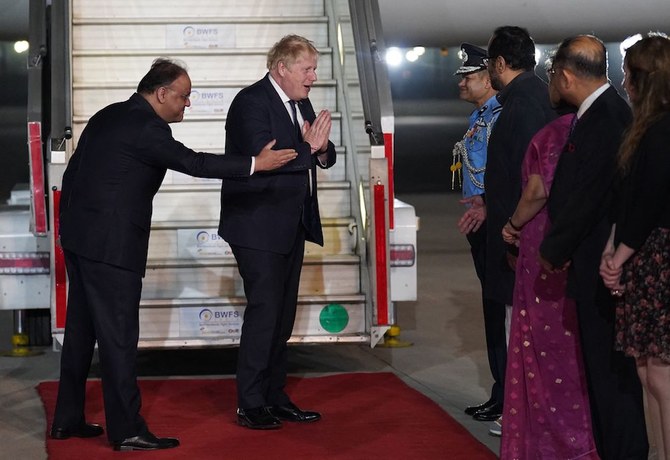

NEW DELHI: UK Prime Minister Boris Johnson’s visit is unlikely to change New Delhi’s relations with Moscow, analysts said on Thursday, as the PM arrived in India to strengthen security and economic cooperation.
In the wake of Russia’s invasion of Ukraine, New Delhi has faced mounting Western pressure to speak out against the war. India has abstained from UN resolutions censuring Russia, its longtime ally and main provider of weapons, and has not imposed sanctions on Moscow.
When Russian Foreign Minister Sergey Lavrov arrived in New Delhi earlier this month, his trip was preceded by visits of Western envoys, including US Deputy National Security Adviser Daleep Singh and UK Foreign Secretary Liz Truss, who had tried to press India for tougher action.
But that is not expected this time, even though Johnson is one of the few world leaders who visited the Ukrainian capital, Kyiv, since the beginning of the Russian assault, in what has widely been seen as a display of solidarity.
“I think India’s position has been widely articulated and it’s not going to change. Despite those differences, he is coming to India,” Prof. Harsh V. Pant, head of strategic studies at the New Delhi-based Observer Research Foundation, told Arab News.
“If this issue was the centerpiece, or this visit was primarily about Ukraine, he would be reluctant (to come) because at the end of the day he would not get anything out of it.”
Johnson is on his first trip to India since taking office in 2019. He started the visit by meeting business leaders in Gujarat, the home state of Indian Prime Minister Narendra Modi and the ancestral home to half of the Indian diaspora in the UK.
From there, Johnson will go to New Delhi on Friday to meet Modi. The UK prime minister’s spokesperson said earlier this week that the two leaders will talk about a new defense partnership and a free trade agreement, which they began discussing at the start of the year.
“I think the significance is that the two sides are really charting a strategic road map for their relationship,” Pant said. “Trade is becoming a very important part of discussion for various reasons. Of course, one is that Britain is searching for post-Brexit economic policy when it needs to reach out to new centers of economic power, and India is certainly a large part of the dynamic.”
He added that New Delhi, too, wants to establish itself as a “responsible economic player.”
In early April, India signed a free trade agreement with Australia. A similar deal will come into effect with the UAE on May 1.
“The UK is another country where India would like to take this conversation really seriously forward,” Pant said.
Anil Trigunayat, India’s former ambassador to Jordan, Libya and Malta, told Arab News that New Delhi has “acquired a tremendous importance” for the UK after London completed its exit from the EU in 2020.
“This is one of the first trade agreements that they have been discussing with India and trying to push for it across the streams,” he said.
“In the case of the Ukraine and Russia crisis, I believe India’s position is well known and probably will be reiterated.”


