

Experts explore pathways for faster electric vehicle integration

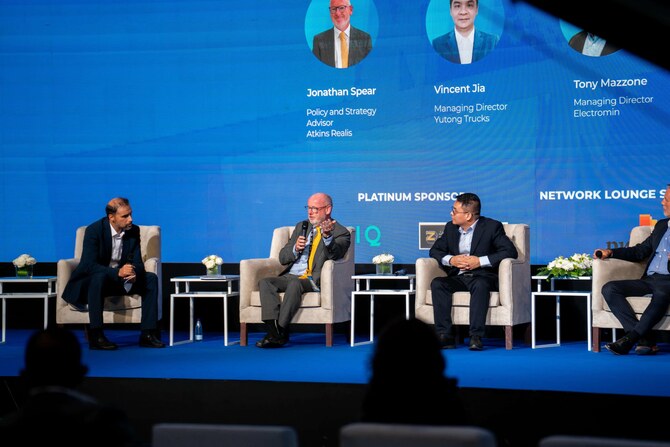
Industry leaders speak at a panel on the second day of the EV Auto Show in Riyadh. AN photo
Short Url
Updated 18 September 2024
Follow

Experts explore pathways for faster electric vehicle integration

RIYADH: Experts discussed the progress of electrification in the private vehicle market, noting that while advancements are being made, mass adoption has not yet been achieved.

Jonathan Spear, policy and strategy adviser at Atkins Realis, shared these insights during a keynote panel titled “How Electric Vehicles Can See Faster Commercial Adoption” at the EV Auto Show on Wednesday.

Key challenges facing the sector include high purchase prices driven by battery costs and the necessity for robust charging infrastructure. Spear pointed out that leading nations in electric vehicle adoption include China, Europe, and the US, while emerging economies are lagging due to the logistical difficulties of electrifying their vehicle fleets.

He emphasized that national regulations and city-level policies play a critical role in promoting the adoption of zero-emission fleets, particularly through public procurement strategies for cleaner vehicles and infrastructure.

Tony Mazzone, managing director at Electromin, highlighted the importance of government support in accelerating the development of EV charging infrastructure. He noted that the cost of electric vehicles remains significantly higher than that of diesel vehicles, largely due to the high expenses associated with technology and batteries.

Mazzone also mentioned that the electrification of larger trucks is progressing more slowly due to technological challenges. For instance, he explained that electrifying a 40-ton truck involves substantial battery weight, making the establishment of charging infrastructure along key routes equally demanding.

Looking ahead, Mazzone expressed optimism that advancements in technology, such as solid-state batteries, could address these challenges by 2030.

Vincent Jia, managing director at Yutong Trucks, discussed the company’s focus on three primary markets in the Middle East: Saudi Arabia, the UAE, and Qatar. He observed that Saudi Arabia’s electric truck market is slower to adopt compared to its neighbors, attributing this to the kingdom’s lower fuel prices.

Spear reiterated the importance of implementing the right policies, legislation, and national regulations to foster EV adoption in Saudi Arabia. He also stressed the need for openness to innovation and technological trials that suit the region’s climatic conditions.

In conclusion, Spear suggested that effective practices should consider the entire lifecycle of electric vehicles, including their construction and supply chain, to ensure a comprehensive approach to reducing carbon emissions.


Egypt–Saudi power link set to boost regional energy integration, minister says 

Updated 22 February 2026
Follow

Egypt–Saudi power link set to boost regional energy integration, minister says 

RIYADH: Electricity interconnection projects between Egypt and Saudi Arabia will strengthen regional energy cooperation and economic integration, Egypt’s minister of electricity and renewable energy said during a visit to a key cross-border power facility. 

Mahmoud Esmat made the remarks while inspecting the Egypt–Saudi electricity interconnection station linking the two countries’ power grids, where he reviewed construction progress and equipment testing ahead of trial operations expected in the coming weeks, according to a statement from the Egyptian State Information Service. 

The project is described as the first of its kind in the Middle East in terms of scale, manufacturing technology, operation, and application in grid interconnection lines. 

The initiative supports the state’s broader vision to implement sustainable solutions aimed at ensuring the stability of the national unified grid and enhancing the reliability and quality of electricity supply. 

It also aligns with Egypt’s allocation of 136.3 billion Egyptian pounds ($2.8 billion) to the electricity and renewable energy sector in its 2025–26 development plan, nearly double the 72.6 billion pounds set aside the previous year. 

The plan focuses on diversifying energy sources, expanding renewable capacity, and strengthening the national grid to meet rising demand. 

The statement said: “The minister toured the station’s departments and control and operation center, following up on the completion of testing for all equipment and components in preparation for launching operations and synchronizing the project with the unified power grids of Egypt and Saudi Arabia in the coming weeks.” 

It added: “Esmat reviewed the implementation rate of the project and testing works, as well as the project’s timeline. He highlighted finalization of operational tests at the Badr transformer station and the Sakakin Taba 2 station, as well as the 500 kilovolts overhead transmission line extending approximately 320 km.”  

The minister said the project forms part of broader efforts to build an integrated power network connecting the two countries, facilitating efficient and flexible electricity exchange and laying the groundwork for a unified Arab electricity market. 

He added that the initiative reflects a clear vision and comprehensive strategy to strengthen the efficiency of the energy system while delivering both immediate and long-term solutions to safeguard grid stability and enhance service quality.