

Saudi EV industry to advance significantly, top executives predict

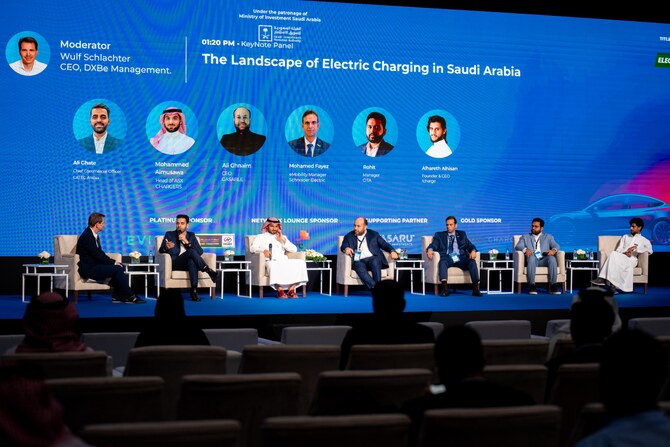
Held in Riyadh on Sept. 18, the panel titled ‘The Landscape of Electric Charging in Saudi Arabia’ highlighted encouraging insights about the local community’s embrace of the Kingdom’s transition to EVs. AN photo
Short Url
Updated 18 September 2024
Follow

Saudi EV industry to advance significantly, top executives predict

RIYADH: Saudi Arabia’s electric vehicle industry is poised for substantial advancements in the coming years, according to officials during a panel discussion at the EV Auto Show.

Held in Riyadh on Sept. 18, the panel titled “The Landscape of Electric Charging in Saudi Arabia” featured Ali Ghnaim, CEO of Gasable, who shared encouraging insights about the local community’s embrace of the Kingdom’s transition to EVs.

“We find that the willingness to have an electric vehicle in Saudi Arabia at around 60 percent. Following our audience, and this is a very great percentage,” he noted.

During the same discussion, Mohammed Al-Musawa, head of ASX E-Mobility, emphasized the importance of collaboration among companies and dealerships. He stated: “The goal of this market is the dealership and then we complement the dealership with the charging infrastructure. So, everyone here plays a very vital role in just providing the facility or facilitating the infrastructure to the dealerships itself, to the end users, giving them the assurance that we will be there. We will give you the choices.”

Al-Musawa highlighted the Saudi government’s proactive stance on the future of EVs, saying, “From what I’ve seen, the push for the government, the money that is already on the table. We know that there will be a future for the EVs. So, dealerships here are trying to raise awareness, trying to set up the facilities. (The government is) trying to set up the infrastructure for the charging stations.”

Rohit Ramesh, manager at CITA EV and a panelist, spotlighted two of the Kingdom’s giga-projects, NEOM and The Red Sea, which are crucial to the EV sector. “So, the newer infrastructures, the new constructions that we are expecting from NEOM and Red Sea, all these sites already have these EV charger infrastructures in the development phase itself,” he said.

Saudi Arabia has already supported EV companies through its giga-project initiatives. In 2023, The Red Sea developed the largest off-grid EV charging network in the Kingdom, installing over 150 terminals to power 80 guest transport vehicles.

NEOM’s commitment to zero-carbon goals includes implementing shared autonomous and electric shuttles, which will enhance urban passenger mobility and feature a high-speed underground transit system.

The panel concluded with optimistic forecasts for the EV sector's future in Saudi Arabia. Ramesh remarked: “By 2030, the vision of Saudi Arabia would be seeing several charging stations across (the country), and it will be more seamless to travel within the region, and more electric vehicles will be coming into the market as well.”


Saudi energy minister holds series of high-level meetings to cement collaborations

Updated 16 January 2026
Follow

Saudi energy minister holds series of high-level meetings to cement collaborations

RIYADH: Saudi Arabia’s Minister of Energy held a series of strategic meetings in Riyadh with senior ministers from various counties, in a diplomatic push to bolster international energy collaboration.

Officials from Greece, Brazil, and Morocco were among those to meet with Prince Abdulaziz bin Salman, as well as representatives from Libya and Pakistan.

The discussions centered on expanding cooperation across a wide spectrum of energy sectors, from traditional hydrocarbons to cutting-edge clean technologies, according to the Saudi Press Agency.

The engagements underscored Saudi Arabia’s proactive role in shaping the global energy transition through bilateral partnerships. A consistent theme across the talks was the dual focus on securing energy supplies and advancing climate-related solutions, including renewable power, clean hydrogen, and carbon management.

Deepening European and South American ties

Prince Abdulaziz bin Salman met with Greece’s Minister of Environment and Energy, Stavros Papastavrou. Building upon a previously signed Memorandum of Understanding, the two officials explored avenues for joint cooperation in oil and gas, electricity, and renewables, as well as other related sectors.

In a separate meeting with Brazil’s Minister of Mines and Energy, Alexandre Silveira, the parties discussed prospects for collaboration across various energy domains. They reviewed means to enhance coordination, particularly in electricity, renewables, oil and gas, and the exchange of technical expertise.

Signing a program with Morocco

A key outcome emerged from the meeting with Morocco’s Minister of Energy Transition and Sustainable Development, Leila Benali. Following their discussions on mutual interests, investment opportunities in renewables, and energy efficiency, the two sides signed an executive cooperation program.

This program, falling under an MoU signed in May 2022, aims to concretize the energy partnership. Its goals are boosting mutual investments in renewable projects and enabling national companies to collaborate on renewable energy projects.

It also encompasses using renewables in development projects, establishing joint research and development centers, and facilitating training and knowledge transfer.

Strengthening regional and Islamic cooperation

Prince Abdulaziz also conferred with Libya’s Minister of Oil and Gas, Khalifa Rajab Abdulsadek. Their meeting focused on energy cooperation, including energy technologies and solutions, as well as enhancing investment opportunities in renewables and energy efficiency.

Discussions with Pakistan’s Minister of Petroleum, Ali Pervaiz Malik, covered shared interests in oil and its supplies, renewable energy, energy efficiency, joint investment opportunities, and the exchange of expertise in project, policy, and regulatory development.

This flurry of diplomatic activity highlights Saudi Arabia’s comprehensive energy strategy, which seeks to maintain its leadership in traditional energy markets while pursuing a stake in the future clean energy economy.